Tourism enterprises step up efforts to meet Vietnam’s growth goals

Vietnam’s tourism sector is intensifying efforts to contribute to the government’s GDP growth target of 8.3–8.5%, with travel enterprises implementing strong action plans to fulfill the objectives set under Resolution No. 226/NQ-CP.

Tourism businesses and localities are taking strong action to meet the challenging 2025 targets. (Photo: VietnamPlus)

Hanoi (VNA) – Vietnam’s tourism sector is intensifying efforts to contribute to the government’s GDP growth target of 8.3–8.5%, with travel enterprises implementing strong action plans to fulfill the objectives set under Resolution No. 226/NQ-CP.

According to industry representatives, the government’s growth goal presents both a major opportunity and a significant challenge, particularly for the tourism industry, a key pillar of the national economy.

Cao Tri Dung, Chairman of Da Nang's Tourism Association and the Vietnam Society of Travel Agents, noted that tourism businesses are actively taking measures to turn the government’s resolution into concrete outcomes.
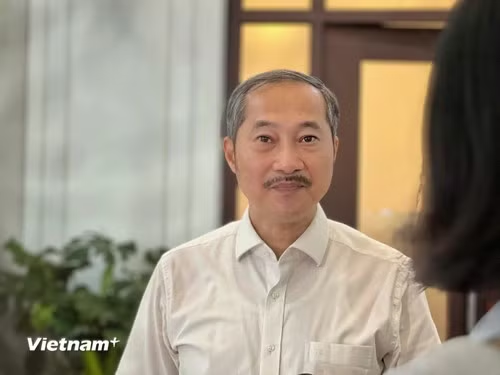
cao-tri-dung.jpg
Cao Tri Dung, Chairman of Da Nang's Tourism Association and the Vietnam Society of Travel Agents. (Photo: VietnamPlus)

The Vietnam Tourism Association (VTA) has rapidly encouraged its member enterprises and provincial branches to implement an action programme designed to transform the resolution into practical initiatives. The plan aims to help the sector achieve the government’s target of 25 million international visitors and 150 million domestic travellers by 2025 - figures that place heavy pressure on the tourism community.

Under this plan, enterprises are launching a series of market-survey trips from key regions such as North-East Asia, Southeast Asia, Europe, Australia, and the US to Vietnamese destinations with fully developed tourism products. These source markets are seen as highly responsive to policy changes and capable of generating fast visitor growth.

At the same time, a number of large-scale promotional events are scheduled for the remaining months of 2025, including MICE EXPO 2025 in Hanoi from September 25–27, and the Da Nang Tourism Festival Day on October 15–16, which will gather more than 100 foreign companies and 200 domestic travel agencies, along with major online-travel-platform operators. These events aim to introduce new tourism-stimulus products aligned with the government’s incentive policies.

Another highlight will be the Vietnam Travel Day to be co-organised with Quang Ninh province in late October and early November. The event is expected to serve as a platform for exchange between domestic and foreign agencies, development of specialised tourism products, and joint promotional activities.


vitm-3.jpg
Tourism promotion activities at VITM 2025. (Photo: VietnamPlus)
vitm-2025-6.jpg
Tourism promotion activities at VITM 2025. (Photo: VietnamPlus)
vitm-2025-7.jpg
Tourism promotion activities at VITM 2025. (Photo: VietnamPlus)
vitm-2025-9.jpg
Tourism promotion activities at VITM 2025. (Photo: VietnamPlus)

In addition, the association plans to lead business delegations to major markets such as Malaysia and the Republic of Korea (RoK), while inviting international media, influencers, and travel experts to attend key tourism events in Vietnam.

Through these specific actions, the VTA aims to ensure that the tourism industry contributes effectively to the national growth effort in the final months of 2025.

As one of Vietnam’s leading tourist destinations, Da Nang is setting ambitious goals in line with the national agenda. The city has welcomed nearly 5 million international and 8 million domestic visitors in the first eight months of 2025, equivalent to around 30 % of the country’s total foreign arrivals.

Building on this performance, Da Nang targets 18 million visitors for 2025, including 8 million foreigners. To achieve this, the city is rolling out a “Da Nang Tourism Stimulus Programme 2025” from August 30 to September 30 and December 1–31.
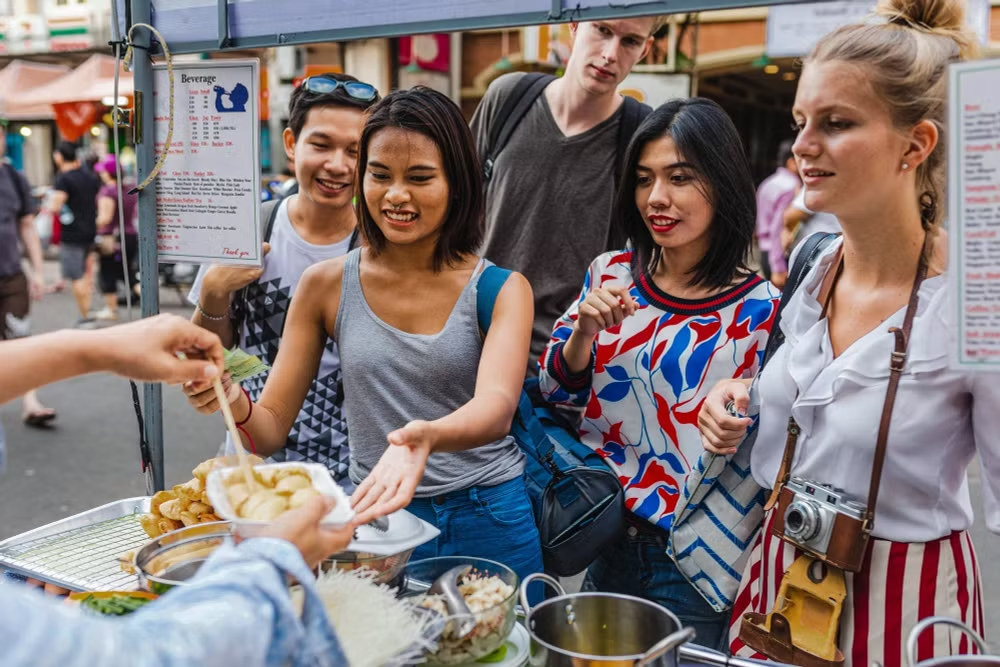
ux-credits-bookingcom-and-gettyimages-962627050.jpg
International visitors enjoy the authentic charm of Vietnamese street food. (Photo: VietnamPlus)

The programme introduces creative products such as “Food Passports,” “Heritage Passports,” and “Event Passports” designed to enrich tourist experiences and extend visitor stays.

Promotional efforts will span both B2B and B2C channels, leveraging online-travel-agency platforms and social-media campaigns to attract visitors from key markets such as the Philippines, Indonesia, India, and Taiwan (China).

Despite these strong initiatives, industry experts acknowledge that the 2025 growth target remains highly challenging. For long-haul markets like Europe, Australia, and the United States, tour planning typically begins six to twelve months in advance, making it difficult to generate immediate results.

phuong-roi-nuoc-dao-thuc-dong-anh-hn-10.jpg
Preserving traditional water puppet troupes helps create unique tourism products that attract foreign visitors. (Photo: VietnamPlus)

Therefore, the sector is prioritising nearby markets with high policy sensitivity, such as the RoK, China, Japan, Taiwan (China), the Philippines, Indonesia, Malaysia, Thailand, Singapore, and India. These are expected to deliver 20–30 % growth in arrivals compared with the same period last year, while distant markets may see around 15 % growth toward year-end.
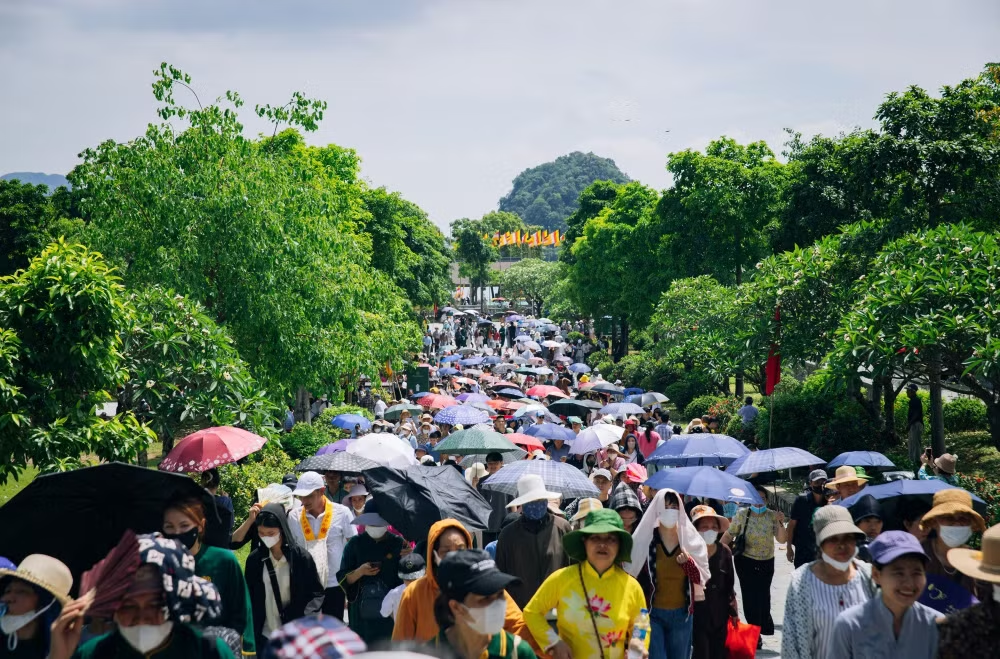
dong-nguoi-do-ve-chiem-bai-xa-loi-phat-2.jpg
Crowds of visitors flock to pay homage to Buddhist relics at Tam Chuc Pagoda. (Photo: VietnamPlus)

To meet the Government’s target of 25 million international visitors, Vietnam would need to attract roughly 2.5–2.6 million visitors per month, a pace the industry has rarely achieved before.

Observers attribute recent positive momentum in inbound tourism to the government’s timely and practical policy adjustments. These include expanded visa exemptions, extended stays, and special visa privileges for experts and high-level guests. Such measures have already shown visible results in markets where visa policies were recently relaxed.
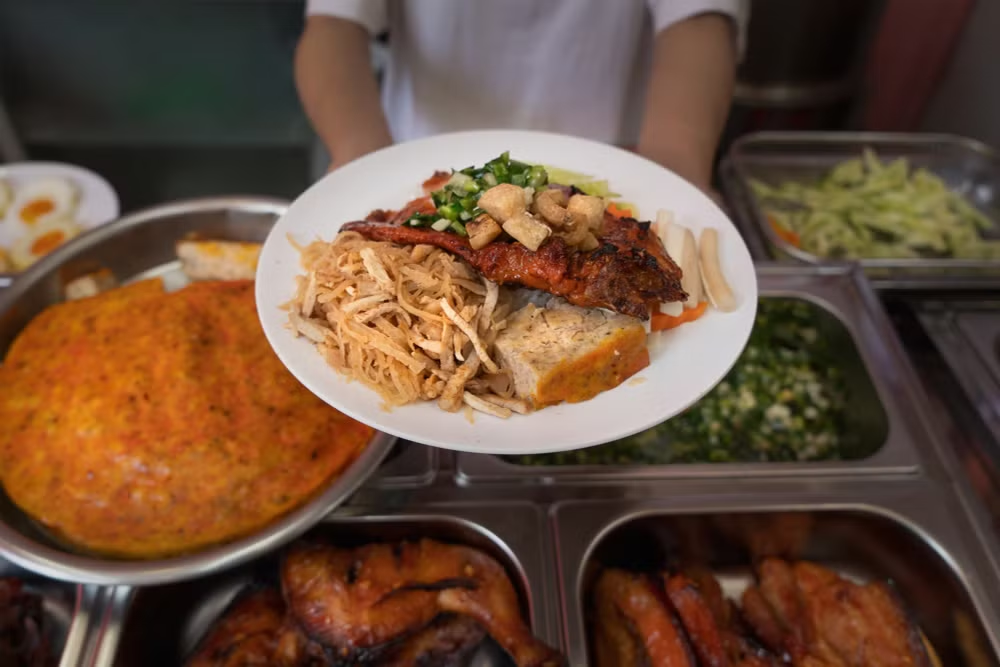

com-tam.jpg
Cuisine remains one of Vietnam’s key competitive strengths in tourism. (Photo: VietnamPlus)
banh-mi-sai-gon.jpg
Cuisine remains one of Vietnam’s key competitive strengths in tourism. (Photo: VietnamPlus)

According to Dung, the combined effects of government facilitation, proactive promotion by national and local agencies, and the adaptability of private enterprises have created strong synergy for the sector. Vietnamese businesses have developed customised tourism products aligned with each target market’s preferences, while leveraging the country’s cultural and natural assets.

He emphasised that the current policies serve as both a launchpad and a support base for tourism growth in 2025 and beyond. The continued expansion of visa facilitation, alongside the implementation of Resolution 226, is expected to sustain positive momentum through the end of the year and lay the foundation for stronger growth from 2026, particularly in long-haul markets.

Industry experts and enterprises alike remain confident that, with well-coordinated action and effective policy execution, Vietnam’s tourism sector will overcome near-term challenges and maintain its trajectory toward becoming a competitive destination in the region./.

See more

Karst limestone mountains in the Phong Nha - Ke Bang National Park, with large cave entrances opening amid the primeval forest, reflect a geological formation process spanning millions of years. (Photo: VNA)

Phong Nha - Ke Bang named among Vietnam’s 11 most beautiful destinations

According to the magazine, boat trips into Phong Nha Cave and strolls through Paradise Cave (both family-friendly) offer a tantalising glimpse of their astonishing scale, but the real adventure lies deeper within the park, where cavers wade through underground rivers and weave among stalagmites.

The Trang An Festival 2026 opens at Trang An Ecotourism Site in Ninh Binh province on May 3 (Photo: VNA)

Tourism seeks new growth momentum under Resolution 26

Tourism effectiveness should be measured not only by visitor numbers and revenue, but also by spending, length of stay, repeat visits, job quality, visitor satisfaction and environmental carrying capacity, said experts.

Vietnam welcomes nearly 2 million international visitors in August, up 19.7% from July and 18.4% year-on-year. (Illustrative photo: VNA)

Vietnam tourism maintains strong growth, expands international markets

The National Statistics Office under the Ministry of Finance reported that Vietnam welcomed nearly 2 million international visitors in August, up 19.7% from July and 18.4% year-on-year. The figure represented 63.6% of the tourism sector’s full-year target of 25 million arrivals.

News website news.ru reports that the number of Russian visitors to Vietnam could reach a historic record of 1.5 million in 2026. (Photo: VNA)

Russian arrivals to Vietnam forecast to reach record high

Russian arrivals to Vietnam surpassed 1 million in the first eight months of 2026, representing a remarkable 165.7% increase year-on-year. This was the highest growth rate among Vietnam’s major international tourist markets.

Secretary of the Party Central Committee and Deputy Prime Minister Pham Thi Thanh Tra speaks at the conference. (Photo: VNA)

Vietnam moves to make tourism a true new growth driver

Resolution No. 26-NQ/TW, issued on August 22, sets out a new vision, with a focus on fundamentally renewing the mindset, methods and approaches to tourism development and governance, shifting from quantity to quality and increasing the sector’s contribution to the national economy.

Tourists visit Golden Bridge in Da Nang city in the rainy season. (Photo: hanoimoi.vn)

Turning rainy season into tourism opportunity

Seasonality has long been a challenge for Vietnam’s tourism industry. In many localities, tourism peaks in summer but visitor numbers fall during the rainy months. Destinations are now seeking to restructure their tourism ecosystems and develop products that can operate year-round.

A pot of Mi Quang (Quang noodles). (Photo: VNA)

Da Nang promotes distinctive cuisine as key tourism attraction

As travellers increasingly seek authentic local experiences, the central coastal city of Da Nang is stepping up efforts to integrate cuisine into tourism itineraries, linking culinary promotion with destination branding and cultural preservation.

Flower vendors form a distinctive feature of Hanoi’s autumn. (Photo: VNA)

Hanoi builds four-season tourism appeal

Hanoi’s tourism events are increasingly designed to inspire exploration beyond individual festivals. At the Hanoi Tourism Gift Festival, for instance, visitors can make handicrafts with artisans, explore destinations through virtual reality and discover new tours and tourism stimulus programmes.

A view of the Lo Lo Chai community tourism village in Tuyen Quang province (Photo: VNA)

Vietnam taps community tourism potential for sustainable development

The tourism market is shifting from sightseeing towards living and connecting with destinations. Visitors increasingly seek authentic and locally rooted experiences, interaction with local people, culture and nature, as well as small-group and personalised trips with limited environmental impact and clear benefits for communities.

Delegates press the button to launch the “Phong Nha – Hue Ancient Capital: World Heritage Journey” tourist train. (Photo: VNA)

Tourist train linking Phong Nha and Hue heritage sites launched

The 190-km route runs between Hue, Dong Ha, My Trach, Dong Hoi and Tho Loc stations, giving travellers access to destinations including the Complex of Hue Monuments, Quang Tri Ancient Citadel, Vinh Moc Tunnels, Hien Luong–Ben Hai historical site and Phong Nha-Ke Bang National Park.