Vietnam aims to build internationally competitive tourism growth poles

A notable feature of Resolution No. 26-NQ/TW is its focus on developing three major tourism growth poles – Hanoi, Ho Chi Minh City and Da Nang – while gradually turning Phu Quoc into a new growth pole. It also calls for the development of 10 key tourism centres and 20 national tourism areas.

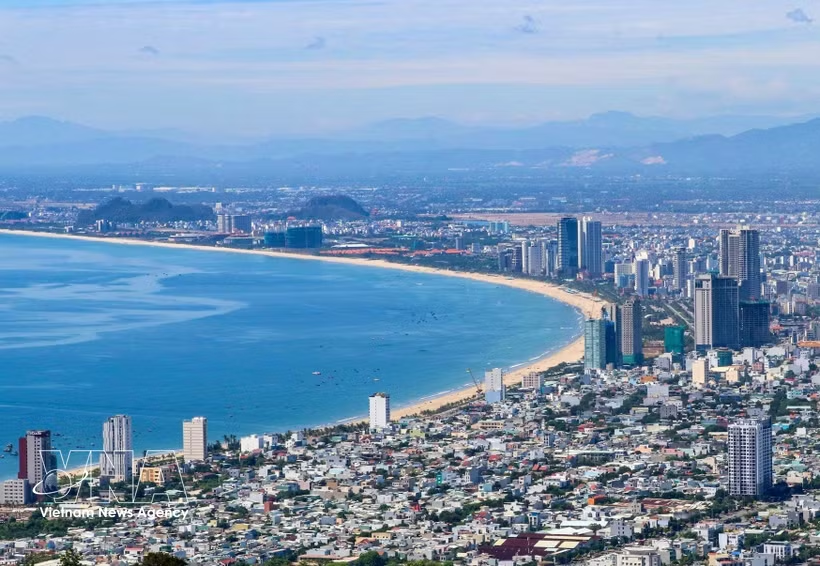
A corner of Da Nang city (Photo: VNA)

Hanoi (VNA) – Resolution No. 26-NQ/TW, dated August 22, 2026, on developing tourism into a spearhead economic sector in the new era, sets ambitious targets for Vietnam’s tourism industry while outlining a new approach to organising tourism growth.

By 2030, tourism is expected to contribute 10-12% directly to GDP, with Vietnam welcoming 45-50 million international visitors and serving 160 million domestic tourists. Greater emphasis will be placed on high-spending and long-stay visitors, with total tourism revenue targeted at 80-90 billion USD. By 2045, Vietnam aims to rank among the world’s 30 most competitive tourism destinations.

A notable feature of the resolution is its focus on developing three major tourism growth poles – Hanoi, Ho Chi Minh City and Da Nang – while gradually turning Phu Quoc into a new growth pole. It also calls for the development of 10 key tourism centres and 20 national tourism areas.

The approach seeks to move beyond fragmented infrastructure investment and isolated local development towards an interconnected tourism ecosystem with internationally competitive centres and growth poles.

International gateways are to be linked with tourism centres through multimodal transport networks, including aviation, expressways, railways and seaports. Strategic investors will be encouraged to develop cultural, sports and entertainment complexes, shopping facilities, high-end resorts, healthcare services and destinations capable of operating around the clock.
tnw-anh-1.jpg
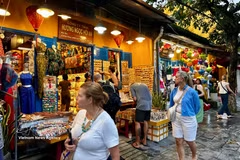
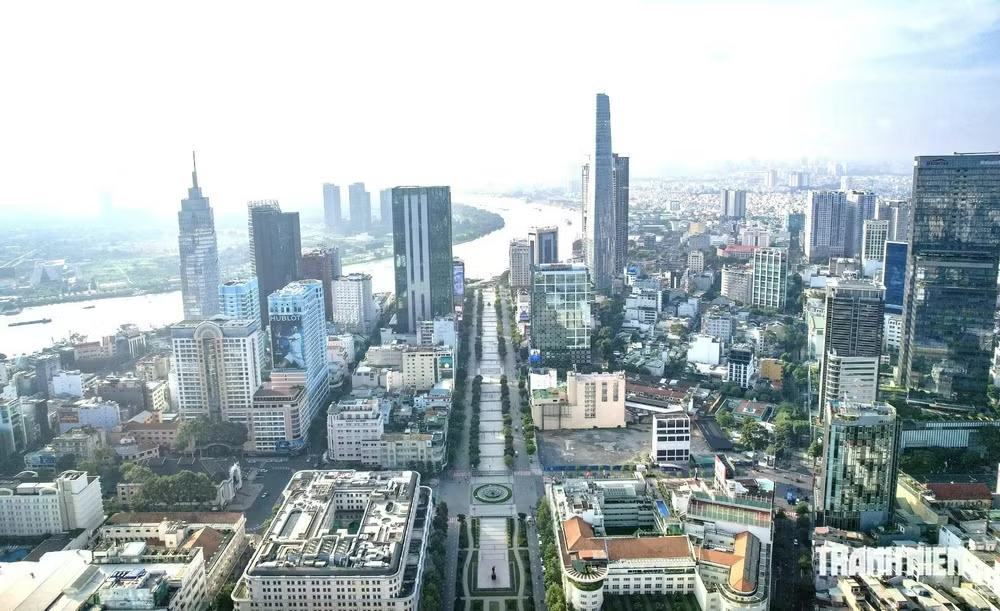
Infrastructure, connectivity and a service ecosystem provide a foundation for tourism hubs to enhance their competitiveness. (Photo: thanhnien.vn)

Hanoi, Ho Chi Minh City and Da Nang are positioned to serve as leading tourism hubs for their respective regions. Hanoi can leverage its cultural heritage, cuisine and international air connectivity to link with destinations such as Ninh Binh, Quang Ninh and the northern mountainous provinces. Ho Chi Minh City, with its large tourism and service market, international connectivity, MICE activities, entertainment and night-time economy, can serve as a gateway to the southeastern region, the Mekong Delta and coastal and island destinations.

Da Nang has established itself as a tourism centre in central Vietnam, combining beach resorts, events and MICE tourism with its proximity to major heritage destinations such as Hue and Hoi An.

Meanwhile, Resolution No. 26 calls for Phu Quoc to gradually become a new growth pole, focusing on high-end island tourism and international events.

According to Dr. Chung Le Khang, a lecturer at Ho Chi Minh City University of Education, the key change lies in shifting from each locality competing for visitors to developing strong centres capable of driving regional growth. A growth pole should be assessed not only by visitor numbers but also by connectivity, spending, length of stay, repeat visits and its ability to spread tourism opportunities to neighbouring areas.

Assoc. Prof. Dr. Nguyen Duc Thang, Vice Rector and Dean of the Faculty of Tourism at East Asia University of Technology, said growth poles should function both as magnets attracting visitors and as gateways distributing tourist flows across their regions. Strong infrastructure, connectivity, services and destination branding are therefore essential.

The development of these growth poles is ultimately aimed not at a race for visitor numbers, but at enhancing the quality, added value and international competitiveness of Vietnam’s tourism industry./.

VNA

See more

Russian arrivals are emerging as a standout feature of Vietnam’s international tourism growth in the closing months of 2026. (Photo: Sun Group)

Why Phu Quoc is winning over high end Russian travellers

For a long-haul holiday, the journey itself can be the greatest hurdle, especially for families travelling with young children or older relatives. Vietnam’s 45-day visa exemption for Russian citizens gives Phu Quoc an immediate advantage, accommodating an extended winter escape with ease.

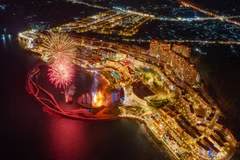
Sunset Town lights up with spectacular performances by the sea in Phu Quoc. (Photo: Sun Group)

The Times: Phu Quoc is the “bonkers” Asian island that won’t stay off-grid for long

In an article titled “The bonkers Asian island that won’t stay off-grid for long”, Adams portrays a Phu Quoc full of contrasts that somehow sit comfortably alongside one another: some of Asia’s finest beaches beside dazzling spectacles; secluded, peaceful resorts just a short distance from an “unhinged” world of fireworks, jet skis and European-inspired architecture.

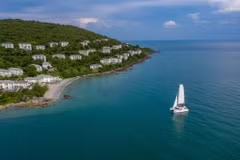
Resorts set along some of the world’s most beautiful beaches make a vacation in Phu Quoc even more rewarding. Photo: Premier Village Phu Quoc.

Thailand's newspaper spotlights Phu Quoc as luxurious vacation island for 2026

In an article highlighting islands suited to luxury vacations, Thairath placed particular emphasis on Phu Quoc’s appeal to Thai travellers. The newspaper described Vietnam’s largest island as an ideal choice for those seeking the privacy and comfort of a five-star retreat without spending hours in transit.

Karst limestone mountains in the Phong Nha - Ke Bang National Park, with large cave entrances opening amid the primeval forest, reflect a geological formation process spanning millions of years. (Photo: VNA)

Phong Nha - Ke Bang named among Vietnam’s 11 most beautiful destinations

According to the magazine, boat trips into Phong Nha Cave and strolls through Paradise Cave (both family-friendly) offer a tantalising glimpse of their astonishing scale, but the real adventure lies deeper within the park, where cavers wade through underground rivers and weave among stalagmites.

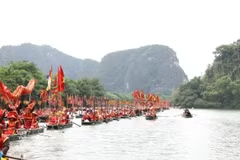
The Trang An Festival 2026 opens at Trang An Ecotourism Site in Ninh Binh province on May 3 (Photo: VNA)

Tourism seeks new growth momentum under Resolution 26

Tourism effectiveness should be measured not only by visitor numbers and revenue, but also by spending, length of stay, repeat visits, job quality, visitor satisfaction and environmental carrying capacity, said experts.

Vietnam welcomes nearly 2 million international visitors in August, up 19.7% from July and 18.4% year-on-year. (Illustrative photo: VNA)

Vietnam tourism maintains strong growth, expands international markets

The National Statistics Office under the Ministry of Finance reported that Vietnam welcomed nearly 2 million international visitors in August, up 19.7% from July and 18.4% year-on-year. The figure represented 63.6% of the tourism sector’s full-year target of 25 million arrivals.

News website news.ru reports that the number of Russian visitors to Vietnam could reach a historic record of 1.5 million in 2026. (Photo: VNA)

Russian arrivals to Vietnam forecast to reach record high

Russian arrivals to Vietnam surpassed 1 million in the first eight months of 2026, representing a remarkable 165.7% increase year-on-year. This was the highest growth rate among Vietnam’s major international tourist markets.

Secretary of the Party Central Committee and Deputy Prime Minister Pham Thi Thanh Tra speaks at the conference. (Photo: VNA)

Vietnam moves to make tourism a true new growth driver

Resolution No. 26-NQ/TW, issued on August 22, sets out a new vision, with a focus on fundamentally renewing the mindset, methods and approaches to tourism development and governance, shifting from quantity to quality and increasing the sector’s contribution to the national economy.

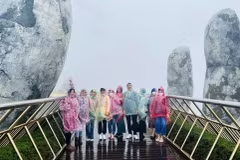
Tourists visit Golden Bridge in Da Nang city in the rainy season. (Photo: hanoimoi.vn)

Turning rainy season into tourism opportunity

Seasonality has long been a challenge for Vietnam’s tourism industry. In many localities, tourism peaks in summer but visitor numbers fall during the rainy months. Destinations are now seeking to restructure their tourism ecosystems and develop products that can operate year-round.