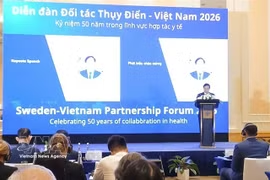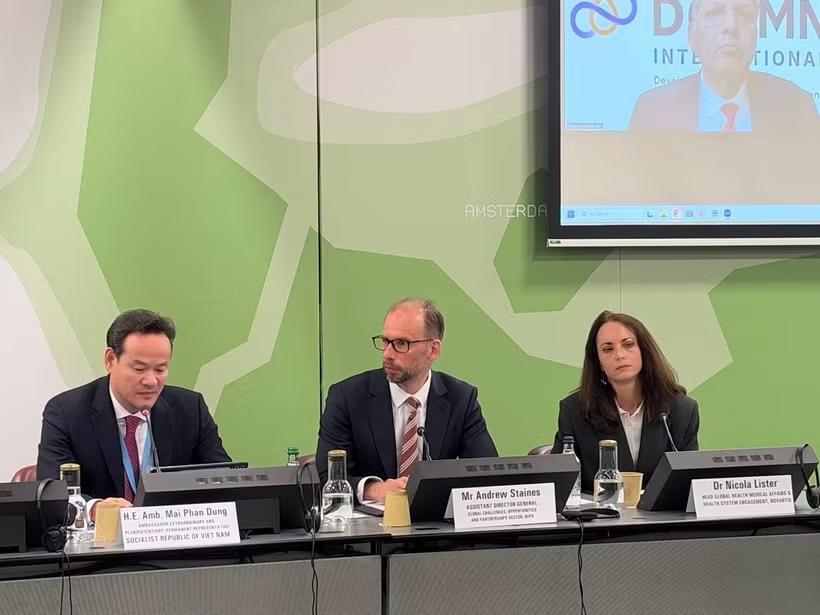
Geneva (VNA) – Ambassador Mai Phan Dung, Permanent Representative of Vietnam to the United Nations and other international organisations in Geneva, has affirmed that Vietnam stands ready to continue working with the World Health Organisation (WHO), the World Intellectual Property Organisation (WIPO), the World Trade Organisation (WTO), international and regional partners, as well as the private sector to promote innovation, expand production and improve access to essential medical technologies.
Addressing a technical symposium jointly held by the three organisations in Geneva on November 25, the ambassador stressed that the COVID-19 pandemic highlighted the need to diversify production capacity, reduce dependence on a limited number of supply centres and build a sustainable pharmaceutical manufacturing ecosystem.
Developing the pharmaceutical industry is not merely an economic objective but also a strategic priority for protecting public health, strengthening self-reliance and enhancing the capacity to respond to public health emergencies, he said.
Sharing Vietnam's experience, Dung said the domestic pharmaceutical market is currently worth approximately 7 billion USD. Locally manufactured medicines account for around 60% of the volume of medicines used but only about 46% of market value.
Under the National Strategy for the Development of the Pharmaceutical Industry to 2030, with a vision to 2045, Vietnam aims to ensure that domestically produced medicines meet around 80% of demand and account for 70% of market value by 2030. The country also aims to develop domestic pharmaceutical material production capacity to meet 20% of the demand for raw materials used in local drug manufacturing.
To achieve these targets, it is prioritising the development of research and production capacity for medicines, vaccines and medical technologies; encouraging investment, innovation and cooperation between domestic enterprises and international corporations and research institutes; and ensuring that advances in the pharmaceutical industry help improve the quality, safety and affordability of medicines.
The ambassador affirmed that strengthening domestic production capacity and deepening international integration and cooperation are mutually reinforcing priorities.
On intellectual property, he emphasised that it is not merely a tool for protecting rights but also a driver of innovation, investment, technology transfer and the commercialisation of research outcomes.
He highlighted the Politburo's Resolution No. 57-NQ/TW, issued in December 2024, and Conclusion No. 51-KL/TW, issued in June 2026, along with the Intellectual Property Strategy to 2030, updated in August 2026, on the exploitation and commercialisation of intellectual property assets.
Vietnam seeks to strike a balance between the legitimate interests of innovators and the need to protect public health, in line with Articles 7 and 8 of the Agreement on Trade-Related Aspects of Intellectual Property Rights (TRIPS) and the Doha Declaration on the TRIPS Agreement and Public Health, he said.
Regarding emerging technologies, Dung noted that AI and digital transformation are creating opportunities to accelerate drug research and development, optimise production processes and improve quality control. However, developing countries continue to face challenges related to digital infrastructure, data, human resources and finance.
International cooperation should therefore help narrow, rather than widen, technological gaps among countries, he stressed.
In terms of international cooperation, Vietnam proposed promoting practical forms of technology cooperation, including voluntary licensing, joint research and joint ventures; prioritising workforce training and strengthening the capacity to absorb and master technologies; and developing pharmaceutical production networks and regional value chains, particularly within ASEAN.
The ambassador also called on WHO, WIPO and WTO to enhance coordination in providing technical assistance tailored to the specific needs of each country. WHO can support regulatory management, quality assurance and health policies; WIPO can assist with intellectual property systems, patent information exploitation and technology transfer links; while WTO can provide support in trade policies, intellectual property rules and trade facilitation.
During the discussion, answering a question on frugal innovation and shortening the time needed to bring research results to market, Dung proposed strengthening links among research institutes, manufacturing enterprises and technology owners; making greater use of intellectual property in licensing and technology transfer; and improving access to finance, technical assistance and management support.
He also shared Vietnam's successful cooperation with WIPO in establishing dedicated intellectual property units within Vietnamese enterprises, suggesting that the model could be expanded to the manufacturing sector.
In response to a question about the relationship between voluntary licensing and the flexibilities under the TRIPS Agreement, the ambassador affirmed that these are complementary tools that could be applied according to each country's public health needs and specific circumstances.
He noted that removing patent barriers does not necessarily mean gaining access to manufacturing know-how, particularly advanced vaccines and biological products. Vietnam therefore attaches importance to developing research capacity, training human resources, strengthening technology absorption and cooperating with international manufacturers.
At the end of the session, Andrew Staines, representing WIPO, praised Vietnam's insights into its pharmaceutical development strategy and its approach to building an efficient and balanced intellectual property system. He expressed interest in continuing discussions with Vietnam on expanding the model of intellectual property cooperation within enterprises and sharing the experience with other countries.
The WIPO will continue coordinating with WHO, WTO and partners to strengthen the role of intellectual property across the entire innovation ecosystem, he affirmed./.
See more
Health Ministry urges vigilance against new COVID-19 variant
The Ministry of Health's Department of Preventive Medicines advised the public not to be complacent or alarmed.
Vietnam hands over hospital expansion project to Laos
The Vang Vieng District Hospital expansion project, a gift from the Party, State and people of Vietnam to Laos, reflects the enduring affection and care that Vietnam has for Laos.
Vietnam helps shape a global framework for climate-resilient and low-carbon health systems: WHO
The World Health Organization (WHO) has published an article highlighting one of the most important lessons from a pioneering initiative that has placed Vietnam among the first countries – alongside Canada – testing indicators aligned with the WHO operational framework for building climate-resilient and low-carbon health systems.
Vietnam encourages vaccine technology transfer
Deputy Prime Minister Pham Thi Thanh Tra called on pharmaceutical group MSD (Merck Sharp & Dohme) to consider investing in a pharmaceutical and vaccine manufacturing plant in Vietnam.
What international parents look for when choosing a hospital for their child in Hanoi
Beyond clinical expertise, service quality also matters. Parents value strict patient triage to minimise cross-infection and attentive guidance from healthcare staff.
Ophthalmology experts discuss blindness prevention measures at Da Nang conference
Permanent Deputy Minister of Health Vu Manh Ha said ophthalmic techniques, technologies and treatment methods were developing rapidly, while patients were increasingly concerned about vision recovery and quality of life after treatment.
Ho Chi Minh City accelerates efforts to provide health check-ups for all residents
Statistics from the municipal Department of Health showed that, as of November 9, more than 9.53 million people had undergone health examinations and screening or had their health records updated, representing 74.6% of the city's population.
Male plastic surgery: Why masculine aesthetics require a different approach
Plastic surgery has long been associated with procedures for women, but men also seek treatment for abdominal fat, enlarged breasts and age-related changes around the eyes and face. The American Society of Plastic Surgeons (ASPS) includes liposuction, gynecomastia surgery and eyelid surgery among procedures performed on male patients.
Flu can trigger cardiovascular events, worsen chronic conditions in the elderly
Experts recommend annual flu vaccination, while also considering enhanced protection options suited to this high-risk group.
Traditional medicine gives wellness tourism distinctive identity
The country's abundant medicinal resources provide a cornerstone for leveraging the strengths of traditional medicine and expanding opportunities to develop high-value medicinal products.
Ho Chi Minh City develops multi-tier elderly care network amid population ageing
Dr. Huynh Minh Chin, Deputy Director of the department, said rising elderly care needs are putting pressure on traditional family-based care, as older people increasingly face multiple chronic illnesses, mobility problems, malnutrition, dementia and depression, requiring continuous support and closer coordination among hospitals, grassroots healthcare facilities, families and social support institutions.
Vietnam seeks to develop medical tourism, tap high-value potential
Demand for healthcare, better quality of life and physical and mental well-being has grown in recent years, making wellness tourism an increasingly valuable market segment that can extend visitors' stays, boost spending and stimulate related sectors.
Ho Chi Minh City steps up hand, foot and mouth disease prevention as cases exceed 44,000
The city recorded more than 44,000 cases from the beginning of the year, up over 65% year-on-year, along with five deaths and more than 1,600 outbreaks, according to the municipal Department of Health.
Free medical examinations provided to remote communities in Cambodia
Vietnamese Ambassador Nguyen Minh Vu said the programme has been jointly organised by the embassy and the hospital annually in various Cambodian localities to provide healthcare support to disadvantaged households and contribute to the Cambodian Government’s efforts to improve public health. The initiative also reflects close cooperation in healthcare and the strong bonds between the people of Vietnam and Cambodia.
All residents set to have electronic health records integrated into VNeID by June 30, 2027
The Ministry of Health, in coordination with the Ministry of Public Security, is tasked with completing the integration of electronic health records into the VNeID system for 100% of the population before June 30, 2027, according to a notice issued by the Party Central Committee’s Office.
Amended law on human tissue, organ donation puts children’s rights, interests first
Standing Deputy Minister of Health Vu Manh Ha said that the 2006 Law on Donation, Removal and Transplantation of Human Tissues and Organs and Donation and Removal of Cadavers has established an important legal framework, contributing to the development of tissue and organ transplantation in Vietnam.
Ho Chi Minh City eyes internationally standardised service ecosystem to boost medical tourism
An official of Ho Chi Minh City said the city's specialised hospitals, skilled workforce and modern medical capabilities provide a strong foundation for developing services in specialised treatment, dentistry, assisted reproduction, cosmetic procedures and health check-ups.
Hue Central Hospital sets record with 18-hour preservation of kidney for cross-country transplant
The fifth transplant set a milestone with a cold ischemia time of approximately 18 hours during transport across more than 1,800km.
Vietnam advances towards high-quality, specialised healthcare
Recent developments in Hanoi and other localities highlight efforts to develop specialised treatment, standardise professional practices and apply artificial intelligence (AI) and advanced medical techniques, towards a more modern healthcare system.
Bach Mai Hospital becomes Vietnam’s first to win top WSO stroke certification
Hanoi-based Bach Mai Hospital has become the first healthcare facility in Vietnam to earn the “Advanced Stroke Centre” certification from the World Stroke Organisation (WSO).