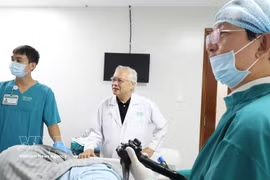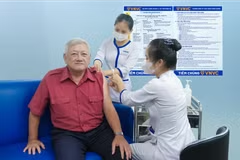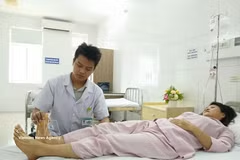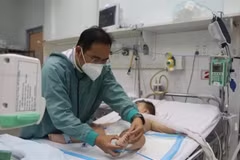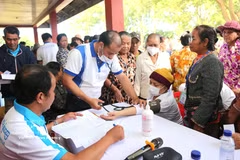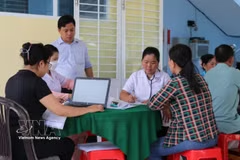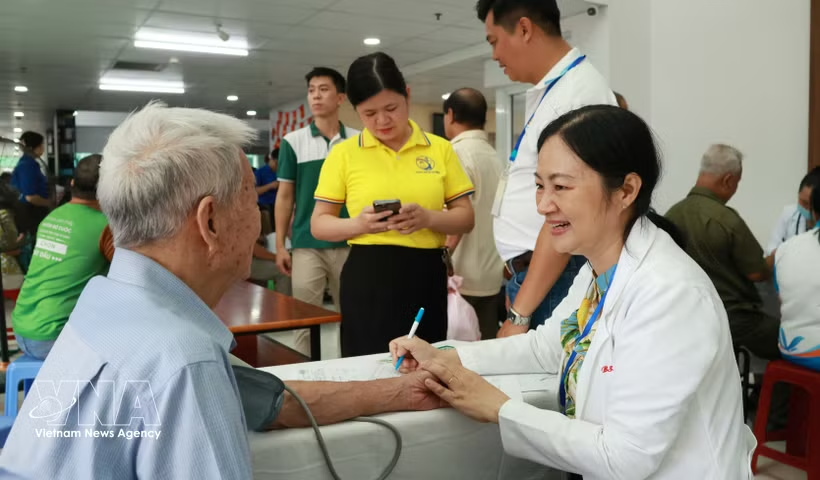
Ho Chi Minh City (VNA) – More than 9.5 million residents of Ho Chi Minh City have received periodic health check-ups, equivalent to 74.6% of the city's population. In the remaining period of 2026, the city is stepping up efforts to achieve its target of providing health check-ups for 100% of its residents.
According to Director of the municipal Department of Health Tang Chi Thuong, a key outcome of the universal health check-up programme is not simply the number of people examined, but also the ability to turn health examination data into valuable information for healthcare management, prevention and public health services.
Analysed health data will be transferred to local health stations and community-based continuous healthcare teams, enabling them to proactively reach out to, advise and monitor people at high risk or those diagnosed with diseases. This marks an important shift from large-scale health examinations to proactive, continuous and targeted health management, contributing to the transition from a treatment-focused approach to preventive healthcare, in line with the Politburo's Resolution No. 72-NQ/TW.
Statistics from the municipal Department of Health showed that, as of November 9, more than 9.53 million people had undergone health examinations and screening or had their health records updated, representing 74.6% of the city's population. During the acceleration phase, the city is focusing on speeding up examinations for students, workers and residents whose health check-up records have not yet been registered locally.
Seven localities have recorded health check-up coverage of below 50% of their populations: the wards of Binh Tri Dong, An Nhon, An Lac, Cau Ong Lanh and Phu Thanh, and the communes of Thuong Tan and Binh Hung. The municipal People's Committee has instructed these localities to move beyond general public mobilisation and instead review each target group, clearly assign responsibilities, organise appropriate examinations and fully update the results on the electronic health management system.
Among formally employed workers, 2,391,312 have received health check-ups, equivalent to 53.2% of the estimated workforce of around 4.5 million. Coverage in export processing zones and industrial parks has reached 86.2%, while that in the hi-tech park stands at only 22.31%.
The municipal People's Committee has therefore tasked the municipal Labour Federation, the Ho Chi Minh City Export Processing and Industrial Zones Authority (HEPZA), and the Management Board of the Saigon Hi-Tech Park with directing trade unions at all levels and businesses to organise periodic health check-ups for workers in accordance with the Law on Occupational Safety and Hygiene. They are expected to ensure that all workers under their management receive regular examinations before November 30, 2026.
Among school pupils and students, health check-up coverage has reached 93.9% at primary schools and 87.1% among children under six, while the rate for upper-secondary pupils remains at 62.6%. The figure for university and college students is only 44.8%, or 201,423 out of an estimated 450,000.
The municipal People's Committee has assigned the Department of Education and Training to coordinate with relevant agencies and localities to review the number of students who have yet to undergo examinations and ensure that health check-ups for all pupils and students are completed before November 30, 2026.
The municipal authorities have also instructed the Department of Health to regularly monitor and assess progress in each ward, commune and special zone, and mobilise medical personnel and healthcare facilities from localities that have achieved coverage of over 90% or basically completed their tasks to support areas with lower rates. Healthcare facilities have been asked to increase staffing, extend examination hours and expand examination venues, while working with local authorities to make it as convenient as possible for residents to participate.
The department is also required to strengthen inspections and supervision of examination quality, and ensure that healthcare facilities fully and accurately upload results to the community health management platform. It will continue reviewing, cross-checking and integrating data from periodic health check-ups, medical examinations and treatment, and chronic disease monitoring to avoid duplication, prevent waste of resources and reduce inconvenience for residents.
Based on data collected through the universal health check-up programme, the Department of Health will continue refining analytical reports on disease patterns, the prevalence of non-communicable diseases, risk factors and health risk stratification by age group, gender and residential area.
Particular attention will be paid to identifying groups at high risk of cardiovascular diseases, hypertension, diabetes and other common chronic conditions, providing a basis for developing appropriate intervention programmes./.
See more
Male plastic surgery: Why masculine aesthetics require a different approach
Plastic surgery has long been associated with procedures for women, but men also seek treatment for abdominal fat, enlarged breasts and age-related changes around the eyes and face. The American Society of Plastic Surgeons (ASPS) includes liposuction, gynecomastia surgery and eyelid surgery among procedures performed on male patients.
Vietnam, Denmark expand cooperation in high-tech healthcare
Ambassador Nguyen Le Thanh called on Vietnamese and Danish partners to identify priority areas and promote research and training programmes, knowledge transfer and technology application in line with Politburo's Resolution No. 57-NQ/TW on breakthroughs in science – technology development, innovation and national digital transformation.
Flu can trigger cardiovascular events, worsen chronic conditions in the elderly
Experts recommend annual flu vaccination, while also considering enhanced protection options suited to this high-risk group.
Traditional medicine gives wellness tourism distinctive identity
The country's abundant medicinal resources provide a cornerstone for leveraging the strengths of traditional medicine and expanding opportunities to develop high-value medicinal products.
Ho Chi Minh City develops multi-tier elderly care network amid population ageing
Dr. Huynh Minh Chin, Deputy Director of the department, said rising elderly care needs are putting pressure on traditional family-based care, as older people increasingly face multiple chronic illnesses, mobility problems, malnutrition, dementia and depression, requiring continuous support and closer coordination among hospitals, grassroots healthcare facilities, families and social support institutions.
Vietnam seeks to develop medical tourism, tap high-value potential
Demand for healthcare, better quality of life and physical and mental well-being has grown in recent years, making wellness tourism an increasingly valuable market segment that can extend visitors' stays, boost spending and stimulate related sectors.
Ho Chi Minh City steps up hand, foot and mouth disease prevention as cases exceed 44,000
The city recorded more than 44,000 cases from the beginning of the year, up over 65% year-on-year, along with five deaths and more than 1,600 outbreaks, according to the municipal Department of Health.
Free medical examinations provided to remote communities in Cambodia
Vietnamese Ambassador Nguyen Minh Vu said the programme has been jointly organised by the embassy and the hospital annually in various Cambodian localities to provide healthcare support to disadvantaged households and contribute to the Cambodian Government’s efforts to improve public health. The initiative also reflects close cooperation in healthcare and the strong bonds between the people of Vietnam and Cambodia.
All residents set to have electronic health records integrated into VNeID by June 30, 2027
The Ministry of Health, in coordination with the Ministry of Public Security, is tasked with completing the integration of electronic health records into the VNeID system for 100% of the population before June 30, 2027, according to a notice issued by the Party Central Committee’s Office.
Amended law on human tissue, organ donation puts children’s rights, interests first
Standing Deputy Minister of Health Vu Manh Ha said that the 2006 Law on Donation, Removal and Transplantation of Human Tissues and Organs and Donation and Removal of Cadavers has established an important legal framework, contributing to the development of tissue and organ transplantation in Vietnam.
Hue Central Hospital sets record with 18-hour preservation of kidney for cross-country transplant
The fifth transplant set a milestone with a cold ischemia time of approximately 18 hours during transport across more than 1,800km.
Vietnam advances towards high-quality, specialised healthcare
Recent developments in Hanoi and other localities highlight efforts to develop specialised treatment, standardise professional practices and apply artificial intelligence (AI) and advanced medical techniques, towards a more modern healthcare system.
Bach Mai Hospital becomes Vietnam’s first to win top WSO stroke certification
Hanoi-based Bach Mai Hospital has become the first healthcare facility in Vietnam to earn the “Advanced Stroke Centre” certification from the World Stroke Organisation (WSO).
Vietnam's organ transplant sector masters multi-organ, domino techniques
The country now has 34 transplant centres capable of performing heart, liver, lung, kidney and cornea transplants. Beyond single-organ procedures, Vietnam has also mastered multi-organ and domino transplant techniques.
Ho Chi Minh City acute respiratory infections surge over 64%
According to the Ho Chi Minh City Centre for Disease Control (HCDC), influenza viruses are are among the fastest-rising pathogens, with 151 positive samples in a single week. Influenza A is the dominant strain, with A/H1N1pdm09 in 116 samples, or nearly 77%.
Vietnam targets modern, internationally integrated traditional medicine by 2030
The strategy aims to create a traditional medicine economy with high valued added, support health tourism, help enhance the national soft power, and build Vietnam’s national brand in traditional medicine.
Phu Tho builds hospital culture to improve patient satisfaction
In recent years, alongside efforts to improve the quality of medical examinations and treatment, Phu Tho province’s health sector has focused on creating civilised, friendly hospital environments and strengthening healthcare workers’ sense of responsibility and service-oriented attitudes, with the aim of earning patients’ trust and satisfaction.
Science, technology seen as lever for medicinal plant industry
Vietnam is one of the world’s biodiversity-rich countries, with more than 5,100 medicinal plant and fungal species, along with hundreds of animal and mineral species used in traditional medicine.
Vietnam reaches out to WHO after death of Russian lab worker
Deputy PM suggests studying long-term development of hospital ship model
Vietnam is one of VAMED’s important partners in Southeast Asia. The group plans to invest 1.2 billion EUR in Vietnam over the next five years, creating jobs for thousands of workers and promoting knowledge and technology transfer. It also wishes to expand cooperation through preferential credit projects, public-private partnerships (PPPs) and partnerships with private enterprises; and supply medical products from Austria and Germany for Vietnamese partners.