Vietnam's organ transplant sector masters multi-organ, domino techniques

The country now has 34 transplant centres capable of performing heart, liver, lung, kidney and cornea transplants. Beyond single-organ procedures, Vietnam has also mastered multi-organ and domino transplant techniques.

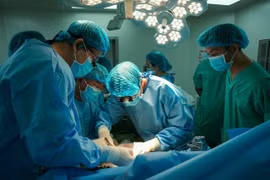
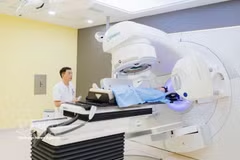
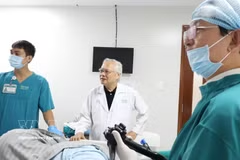
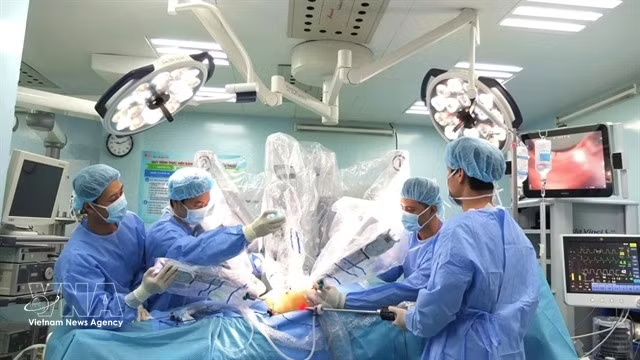
Robotic surgery for organ transplantation at Binh Dan Hospital (Photo: VNA)

Hanoi (VNS/VNA) – Vietnam’s transplant sector has made notable advances, progressing from single-organ procedures to more complex techniques such as multi-organ and domino transplantation.

According to the Department of Medical Examination and Treatment Management under the Ministry of Health, the country now has 34 transplant centres capable of performing heart, liver, lung, kidney and cornea transplants. Beyond single-organ procedures, Vietnam has also mastered multi-organ and domino transplant techniques.

Dr Ha Anh Duc, director of the department, said the country’s capacity to perform these techniques has reached a level comparable to that of the world’s leading transplant centres.

Multi-organ transplantation involves transplanting two or more organs into the same patient when clinically indicated. Compared with single-organ transplantation, it places greater demands on patient selection, donor organ assessment, surgical organisation and complication management.

Domino transplantation is a specialised form in which an organ removed from a transplant recipient can be transplanted into another patient, provided strict professional criteria are met.

Performing these procedures depends not only on surgical skill but also on co-ordination among multiple teams, an effective organ co-ordination system and the capacity to handle complex situations.

This also reflects the development of the transplant speciality, from adopting advanced treatment techniques to performing procedures with increasingly demanding professional requirements.

Within the broader development of the speciality, liver transplantation is one of the fields with the highest technical and treatment-organisation requirements.

A research work entitled “Application, Development and Successful Transfer of Liver Transplantation Techniques Contributing to Raising the Standing of Vietnam’s Organ Transplant Speciality” focuses on applying, developing and transferring liver transplantation techniques, a field of considerable importance to the treatment of serious liver diseases and to the development of the transplant sector.

Its nomination for the Ho Chi Minh Prize means the work will undergo review and evaluation against high standards of scientific and technological value and practical effectiveness.

Under Article 10 of Government Decree No 18/2024/NĐ-CP, a technology application work considered for the Ho Chi Minh Prize must be exceptionally outstanding, of very high technological value and of great service to the revolutionary cause. It must also have a broad and lasting influence on people’s lives and make an important contribution to the country’s socio-economic development and to science and technology.

These criteria show that the Ho Chi Minh Prize does not merely recognise technical achievement but also places high value on creativity, practical applicability and contributions of enduring influence.

For the liver transplantation work, the results of research, technical development and technology transfer must be assessed on the basis of a scientific dossier, evidence of real-world effectiveness and specific contributions to the speciality.

Across the sector as a whole, the progression from single-organ to multi-organ and domino transplantation is expanding the capacity to treat complex cases. However, these are achievements shared by many Vietnamese medical institutions and cannot be attributed solely to the liver transplantation work mentioned above.

The development of the speciality also highlights the need to further improve the system for organ donation, retrieval, coordination and transplantation to ensure treatment quality and protect patients’ interests.

From advances in organ transplantation to research works being considered for State-level science prizes, science and technology are playing an increasingly important role in enhancing the capabilities of Vietnamese medicine./.

VNA
See more

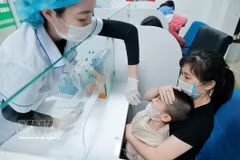
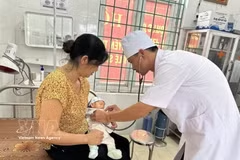
Collecting a sample from a pediatric patient for influenza testing (Photo: VNA)

Ho Chi Minh City acute respiratory infections surge over 64%

According to the Ho Chi Minh City Centre for Disease Control (HCDC), influenza viruses are are among the fastest-rising pathogens, with 151 positive samples in a single week. Influenza A is the dominant strain, with A/H1N1pdm09 in 116 samples, or nearly 77%.

A doctor at Trung Nguyen Medical Station in Te Lo commune, Phu Tho province, examines a child patient. (Photo: VNA)

Phu Tho builds hospital culture to improve patient satisfaction

In recent years, alongside efforts to improve the quality of medical examinations and treatment, Phu Tho province’s health sector has focused on creating civilised, friendly hospital environments and strengthening healthcare workers’ sense of responsibility and service-oriented attitudes, with the aim of earning patients’ trust and satisfaction.

An overview of the meeting between Deputy Prime Minister Pham Thi Thanh Tra and César Louis-Philip Marseille, Managing Director of VAMED Engineering GmbH of Austria and member of the Board of Directors of VAMED+WWH Group of Germany,in Hanoi on October 7. (Photo: VNA)

Deputy PM suggests studying long-term development of hospital ship model

Vietnam is one of VAMED’s important partners in Southeast Asia. The group plans to invest 1.2 billion EUR in Vietnam over the next five years, creating jobs for thousands of workers and promoting knowledge and technology transfer. It also wishes to expand cooperation through preferential credit projects, public-private partnerships (PPPs) and partnerships with private enterprises; and supply medical products from Austria and Germany for Vietnamese partners.

The Son Tra regional medical centre (Photo: benhviensontra.com.vn)

Da Nang: Satellite hospitals prove effective at grassroots level

The model is an important component of the roadmap to turn Da Nang into a specialised medical centre for the central and Central Highlands regions, with a number of key specialties, in line with the spirit of Politburo Resolution No. 72-NQ/TW dated September 9, 2025, on breakthrough solutions to strengthen the protection, care and improvement of people's health.

Illustrative image (Photo: daibieunhandan.vn)

Ho Chi Minh City digitises 99.4% of hospital records

As of July 2026, 163 of the city's 164 hospitals, or 99.4%, adopted electronic medical records, the report said. About 64% of public hospitals and 65% of private hospitals now run the technology across their entire operations

Yersin International Clinic in Ho Chi Minh City. (Photo: VNA)

Ho Chi Minh City eyes more foreign medical tourists

Director of the municipal Department of Health Tang Chi Thuong said a key prerequisite for attracting foreign patients is a strategy to develop centres of medical excellence. He proposed selecting hospitals and specialties with strong expertise for investment towards international standards, particularly in competitive fields such as cardiology, oncology, robotic surgery, assisted reproduction, paediatrics, dentistry, cosmetic medicine, specialised health check-ups, traditional medicine and rehabilitation.

A nurse from Children's Hospital No. 1, Ho Chi Minh City, collects a blood sample for HIV testing from an infant. (Illustrative photo: VNA)

Health cooperation adds fresh momentum to Vietnam-US relations

Through this MOU, the US Department of State, working with Congress, plans to provide 98.75 million USD in life-saving global health assistance over the next five years, including 21.385 million USD in dedicated Global Health Security funding, to support Vietnam’s transition to full country ownership of its HIV/AIDS and tuberculosis programmes while strengthening its capacity to detect and respond to emerging and re-emerging infectious disease threats.

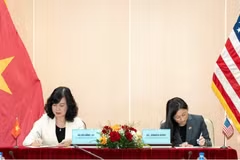
Minister of Health Dao Hong Lan and US Ambassador to Vietnam Jennifer McNamara Wick sign the memorandum of understanding on health cooperation. (Photo: US Embassy in Vietnam)

Vietnam, US launch five-year health cooperation

The cooperation will also support Vietnam in strengthening its healthcare capacity and gradually enhancing self-reliance in HIV/AIDS and tuberculosis prevention and control programmes, as well as in responding to emerging and re-emerging infectious diseases.

Director of the Ho Chi Minh City Department of Health Tang Chi Thuong (third, right) presents flowers to congratulate six young doctors who have volunteered to work at grassroots-level health stations (Photo: VNA)

Ho Chi Minh City strengthens grassroots healthcare workforce

Ho Chi Minh City's Department of Health on September 10 reviewed a pilot programme combining hospital-based practice with work at grassroots health stations and organised the fourth healthcare job fair, attracting nearly 1,000 candidates and 94 recruiters offering 806 positions.