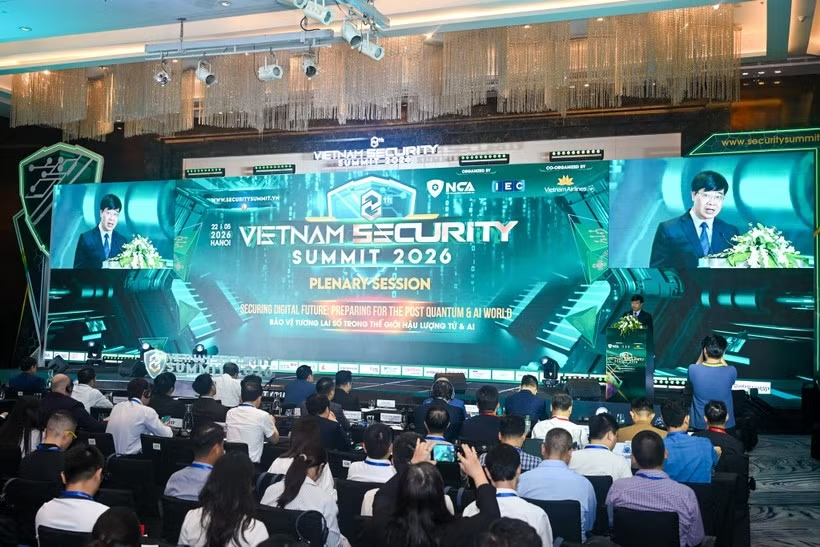
Hanoi (VNA) – Vietnam must move beyond responding to immediate cyber threats and begin building long-term capabilities to safeguard national cybersecurity in the age of artificial intelligence (AI) and quantum computing, experts said at the Vietnam Security Summit 2026 in Hanoi on May 22.
The annual event brought together policymakers, technology companies, cybersecurity experts and research organisations to discuss strategies for protecting data, securing critical digital infrastructure and strengthening cyber resilience as emerging technologies reshape the digital economy.
Participants also shared the latest cybersecurity trends and solutions to foster trust and support Vietnam's digital transformation.

Opening the summit, Colonel Dr. Nguyen Hong Quan, Deputy Director of the Ministry of Public Security's Department of Cybersecurity and High-Tech Crime Prevention (A05), said rapid advances in AI and quantum computing are creating both opportunities and new security risks.
AI is helping organisations detect cyber threats faster, automate security operations and improve data analysis. However, the same technology is increasingly being exploited by cybercriminals to launch sophisticated phishing campaigns, ransomware attacks and identity fraud.
At the same time, quantum computing is expected to challenge existing encryption standards, requiring governments and businesses to prepare for the transition to post-quantum cryptography.
"The challenge today is not only responding to current cyber threats, but also building cybersecurity capabilities for the next stage of technological development," Quan said.
He warned that attacks targeting critical information systems, financial institutions, energy infrastructure, telecommunications networks, and personal and corporate data are likely to become more frequent and sophisticated in the coming years.
Quan called on government agencies and businesses to strengthen cybersecurity awareness, invest more in advanced technologies, skilled personnel and risk management, and enhance coordination with competent authorities to detect and address threats at an early stage.
He also stressed the need to develop a coordinated and sustainable national cybersecurity ecosystem through closer cooperation among government agencies, technology companies, research institutions and the cybersecurity community.
The summit's plenary session featured presentations by government agencies and international technology firms on key cybersecurity issues expected to shape the coming years.
Topics included cybersecurity priorities for 2026 and beyond, strategies for countering increasingly sophisticated cyber threats, the growing confrontation between cyber attackers and defenders in cloud-based AI environments, AI governance for enterprise data architectures, and securing AI agents in corporate environments.

A high-level panel discussion, moderated by Do Ngoc Duy Trac, founder and Chief Executive Officer of VinCSS, brought together representatives from the Government Cipher Committee, the Vietnam Cyber Emergency Response Teams (VNCERT), the National Cybersecurity Association and leading industry experts to discuss policy directions and practical solutions for strengthening Vietnam's cyber resilience.
Running alongside the conference was a technology exhibition featuring more than 40 domestic and international cybersecurity solution providers, including Sophos, Viettel Cyber Security, FPT, Huawei, Thales, Bitdefender, Qualys, Synology, CMC Telecom and several other global technology firms.
The exhibition showcased a wide range of advanced cybersecurity technologies, including AI-powered security platforms, security operations centres (SOC) and security information and event management (SIEM) systems. It also included identity and privileged access management (IAM/PAM), cloud security, operational technology (OT) and industrial control system (ICS) protection, endpoint detection and response (EDR/XDR). Zero Trust architecture, post-quantum cryptography, deepfake detection, distributed denial-of-service (DDoS) mitigation, data loss prevention, and database security solutions rounded out the roster of cybersecurity tech.
Participants said these technologies will play an increasingly important role as organisations strengthen defences against evolving cyber threats while supporting Vietnam's digital transformation and the sustainable development of its digital economy./.