Vietnamese among Asia’s top foodie travellers

The findings, derived from a survey of Asian travellers as part of Agoda’s 2026 Travel Outlook Report, reveal that 35% of Vietnamese travellers cite food as a key reason for travel, placing Vietnam among Asia’s top foodie markets.

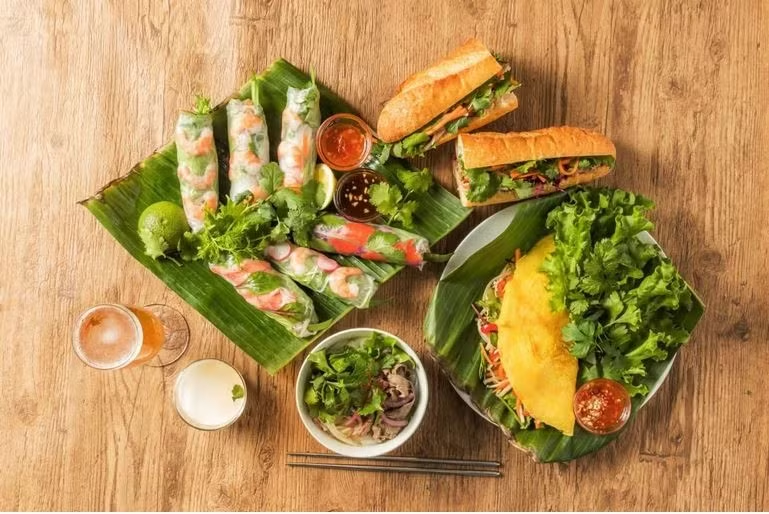
Some of famous Vietnamese dishes (Photo: Agoda)

Hanoi (VNA) – Vietnamese travellers are among Asia’s most passionate culinary explorers, ranking second in the region for choosing destinations based on food experiences, according to new findings from digital travel platform Agoda.

The findings, derived from a survey of Asian travellers as part of Agoda’s 2026 Travel Outlook Report, reveal that 35% of Vietnamese travellers cite food as a key reason for travel, placing Vietnam among Asia’s top foodie markets.

Food is increasingly taking centre stage as a primary reason for travel, with more Asian travellers eager to explore destinations that offer unforgettable culinary experiences. This shift reflects a broader trend where gastronomy is becoming a significant motivator in choosing where to go, what to do, and where to stay, as travellers seek to immerse themselves in the local food culture of their chosen destinations.

Agoda’s survey results highlight this evolution, revealing that culinary experiences have climbed into the top three motivators for Asian travellers, jumping from sixth place last year.
vnanet-du-khach-viet-nam-va-quoc-te-ngay-cang-uu-tien-trai-nghiem-mon-an-dia-phuong-khi-lua-chon-diem-den.jpg
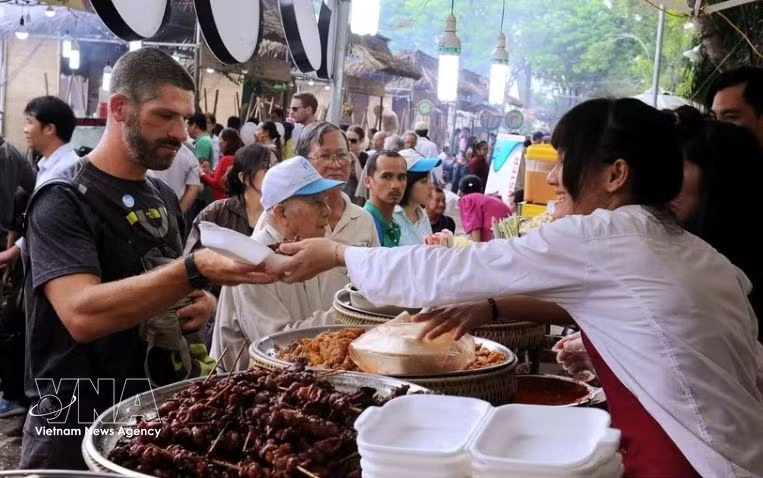
Vietnamese and international tourists increasingly prioritise local cuisine when choosing destinations. (Photo: VNA)

On the journey where Vietnamese travellers explore destinations abroad, many do so with a strong desire to understand global cuisines firsthand – whether sampling authentic sushi in Japan, street food in Thailand, or Michelin-starred restaurants in Europe. Food, for Vietnamese travellers, is not merely sustenance but a meaningful gateway to culture, history, and connection – both at home and abroad.

The top five nations that Vietnamese travellers explored to sate their culinary appetites last year include Japan, Thailand, the Republic of Korea (RoK) , Malaysia and China.

Vietnam emerges as a global culinary destination

This cross-cultural exchange also works in reverse, as Vietnam’s rich culinary landscape has become a powerful magnet for international visitors. Travellers from around the world increasingly visit Vietnam to experience its dynamic street food culture, heritage recipes, and rapidly evolving contemporary dining scene.

Vietnam’s deep-rooted culinary heritage sees cuisine woven into daily life and cultural identity. From iconic national dishes such as “pho” and “banh mi” to regional specialties like Hue’s royal cuisine or the Mekong Delta’s fresh seafood, Vietnamese cuisine is celebrated for its balance of flavours, fresh ingredients, and regional diversity.

Regionally, only Taiwanese travellers ranked higher, with 47% citing food as a primary travel driver, followed by the Republic of Korea at the third place with 34%. Other markets in the top eight include Malaysia (33%), Japan (32%), Indonesia (31%), Thailand (20%), and India (8%).

Vu Ngoc Lam, Agoda Country Director, shared that Vietnam’s ranking reflects just how deeply food is embedded in our culture and in the way Vietnamese travellers experience the world. For many Vietnamese, travel is not complete without discovering authentic local flavours, whether through exploring regional specialties at home or seeking iconic dishes abroad./.
VNA

See more

At Noi Bai International Airport in Hanoi (Photo: VNA)

Air travel demand holds steady during Hung Kings, April 30-May 1 holidays

Despite volatility in aviation fuel prices triggered by tensions in the Middle East, flexible Government policies, particularly measures by the Ministry of Construction to cut fuel-related taxes, fees and infrastructure costs, helped maintain stable operations across the sector. As a result, no broad ticket shortages emerged.

A representative of Anex Tour Vietnam presents a conical hat to the first passengers arriving in Da Nang from Vladivostok. (Photo: VNA)

Da Nang welcomes first flight from Vladivostok

According to the plan, the programme will run from April 16 to October 23, connecting eight cities across Russia, the CIS, and Belarus with Da Nang. The total number of visitors is expected to reach approximately 25,500, with a maximum frequency of 36 flights per month, equivalent to around 4,800 passengers monthly.

Visitors explore and experience the cultural space of Lo Lo Chai village in Lung Cu commune, Tuyen Quang province. (Photo: qdnd.vn)

Administrative expansion unlocks new momentum for tourism development

Nguyen Thi Hoai, Deputy Director of the Department of Culture, Sports and Tourism of Tuyen Quang, said the expansion of administrative boundaries has opened up new development space for the province, with key tourism products including cultural-historical tourism, ethnic cultural experiences, community-based tourism linked to scenic sites, spiritual tourism, and other distinctive experiential offerings.

At Thung Nham ecological tourism site in Ninh Binh province. (Photo: VNA)

Vietnam’s tourism defies fuel price shock with record Q1 “hat-trick”

According to data released by the National Statistics Office, foreign arrivals in March reached nearly 2.1 million, up 1.3% year-on-year. In total, Vietnam welcomed an estimated 6.76 million foreign tourists in the first quarter, a more than 12% jump from the same period in 2025 and the highest Q1 figure ever recorded.

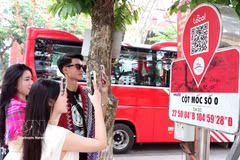
Visitors scan QR codes at Km0 Ha Giang to access tourism information. (Photo: VNA)

Technology powers tourism growth in mountainous province

Last year, Tuyen Quang welcomed over 3.9 million visitors, and is aiming to attract around 4.1 million arrivals, including around 600,000 foreigners, this year. Tourism continues to be identified as a key economic sector, with development oriented toward sustainability, green growth, and enhanced competitiveness through digitalisation.

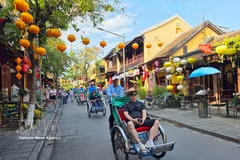
Tourists enjoy a rickshaw tour of Hoi An Ancient Town, Da Nang city. (Photo: VNA)

ITE HCMC 2026 to promote Vietnam’s tourism on global map

With its large scale, the ITE HCMC 2026 aims to promote tourism cooperation between Vietnam and priority markets such as Northeast Asia, Western Europe, North America, Southeast Asia, and Oceania while also boosting visitor arrivals from the Indian market

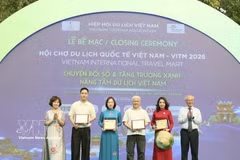
The organisers of VITM 2026 honour sponsors. ( Photo: VNA)

VITM 2026 boosts tourism demand ahead of peak season

According to the organisers, around 4,500 representatives from Vietnamese and international tourism enterprises attended the event, generating more than 25,000 business meetings and partnership exchanges. Approximately 15,000 discounted tours and travel products were offered to visitors.

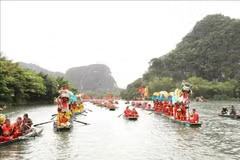
Traditional dragon procession held on the river in Ninh Binh. (Photo: VNA)

Cultural heritage drives sustainable tourism growth in Ninh Binh

In the first two months of 2026, Ninh Binh welcomed over 5.4 million visitors, up 9.9% year-on-year, generating nearly 5.84 trillion VND (221 million USD) in tourism revenue, up 15.9%. During the 2026 Lunar New Year holiday alone, the province received 2.38 million visitors, an 81.4% increase from the previous year, ranking second nationwide.

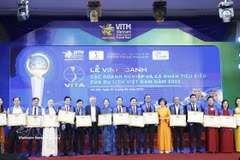
Outstanding individuals and firms honoured at VITM 2026 (Photo: VNA)

Outstanding individuals, firms honoured at Vietnam International Travel Mart 2026

In 2025, Vietnam’s tourism sector recorded its highest-ever number of visitors, welcoming more than 21.5 million international arrivals, up more than 20% from 2024, and serving over 135.5 million domestic travellers. Tourism revenue also surpassed 1 quadrillion VND (nearly 38 billion USD). The sector has become a bright spot of the economy, with Vietnam ranking among the world’s fastest-growing tourism destinations.

The Ba Trieu Temple in Thanh Hoa province (Photo: VNA)

Thanh Hoa taps digital transformation to boost heritage tourism

With 28 nationally-recognised intangible cultural heritage elements, Thanh Hoa province has prioritised integrating conservation with tourism development. Digital transformation, in particular, is seen as a crucial bridge connecting tradition with innovation, helping heritage sites become more accessible and engaging.