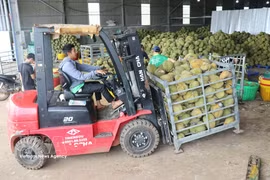
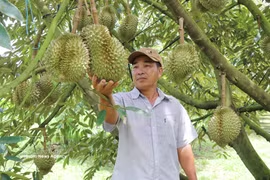
Hanoi (VNA) – Durian has emerged as one of Vietnam’s highest-value agricultural export products. However, behind its impressive growth are challenges involving production organisation, value-chain linkages, product quality, traceability, preservation and processing, according to the Ministry of Agriculture and Environment.
The sector therefore needs to shift from addressing problems as they arise to proactive, long-term planning, with quality and market requirements as the foundations for sustainable growth.
Exports surge, markets expand
Speaking at the Government’s regular press conference on September 3, Deputy Minister of Agriculture and Environment Dang Ngoc Diep said Vietnam has around 200,000 hectares of durian in 2026, with estimated output of 2.08 million tonnes. Major growing areas are located in the Central Highlands, southeastern, south-central coastal and Mekong Delta regions.
Durian export revenue rose sharply from 177.7 million USD in 2021 to approximately 3.85 billion USD in 2025, accounting for around 45% of the country’s total fruit and vegetable export value.
In the first seven months of 2026, exports reached 1.47 billion USD, up 44.1% year-on-year, with China accounting for more than 95% of the total or 1.38 billion USD, up 49.6% year-on-year.
Vietnam has also expanded exports to more than 20 countries and territories. Notably, India officially authorised imports of fresh Vietnamese durian in July, creating new opportunities for market diversification.
As of August 30, the country had 1,599 operational growing-area codes and 281 packing-facility codes for durian exports. On August 14, China’s General Administration of Customs approved an additional 401 growing-area codes and 166 packing-facility codes.
Export testing capacity has also improved, with 52 laboratories in Vietnam approved by China. Since July 1, the Ministry of Agriculture and Environment has implemented electronic traceability for agricultural products, including exported durian.
Despite these achievements, the sector faces several bottlenecks. In some localities, cultivation areas have expanded without adequate planning or consideration of land, water and infrastructure conditions. Links among farmers, cooperatives, processors and exporters remain weak, while data standardisation and traceability have yet to meet requirements in some areas.
Preservation and processing capacity is also limited, with activities still focusing mainly on fresh-fruit exports, cold storage and freezing. Meanwhile, international competition is intensifying and importing markets are imposing increasingly stringent technical requirements.
Quality and value chains as priorities
According to the Ministry of Agriculture and Environment, the key lesson is to move from reactive problem-solving towards proactive planning, placing quality, food safety and traceability at the centre of development. Production must be organised according to market demand, with stronger links among stakeholders, greater market diversification and higher added value, contributing to developing a stable, transparent and sustainable durian sector.
In the coming period, the ministry will promote trade, expand exports to potential markets such as India, Australia and New Zealand, and encourage exports of frozen durian and processed products.
It will also review and reorganise growing areas in line with local conditions, develop concentrated raw-material zones and strengthen cooperation among farmers, cooperatives and businesses. Enterprises will be encouraged to invest in production areas and contribute to building the Vietnamese durian brand.
Other priorities include improving quality standards and traceability, expanding cold-storage and processing facilities, upgrading logistics, irrigation and transport infrastructure, and applying technology to reduce costs and improve product quality.
The ministry will also expand the network of qualified testing laboratories and strengthen testing capacity for Cadmium, Auramine O and other indicators required by importing markets./.