Lang Son, November 18 (VNA) – The northern mountainous province of Lang Son’s strong export-import growth in the first 10 months of 2026 has become a major budget driver, driven by administrative reform and digital transformation by agencies, with customs at the core, plus businesses’ proactive role.
Reform, digital transformation to boost budget revenue
The provincial Department of Finance reported total state budget revenue in the locality at nearly 25 trillion VND (960 million USD) after 10 months, or 185.3% of the local target. Domestic revenue surpassed 5 trillion VND while export-import turnover exceeded 19.8 trillion VND. The province already beat its full-year 2026 revenue target in the first half.
Total export-import turnover through the local border gates exceeded 106 billion USD, up more than 38% annually. More than 7,250 enterprises carried out customs procedures at border gates, up about 35% year on year.
Nguyen Duy Anh, Deputy Director of the provincial Department of Finance, lauded coordination in regulating vehicles, handling procedures and clearing corporate bottlenecks, together with administrative reform, IT and digital transformation, for stronger clearance capacity and smoother trade flows.
Nguyen Thi Minh Hang, deputy head of the Customs Sub-Department of Region VI, said new technology now covers declaration and payment. The unit built shared software to save time and cut unnecessary steps. Its data feeds the province’s digital border gate platform. Businesses now use electronic import declarations and QR-code payment for multiple declarations, applied uniformly at all border gates managed by the branch.
Expanding development space
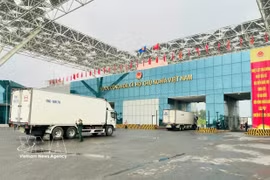
At Chi Ma border gate, about 200 vehicles clear customs daily. The mix is broader now, including consumer goods, farm produce and electronic components for Samsung, LG and VinFast batteries, not just Chinese medicinal herbs.
Trieu Quang Hoa, deputy head of the Chi Ma border gate customs team, pointed to weak transport infrastructure at some border gates as a challenge. The road linking National Highway 4B with Chi Ma border gate has been deteriorating for years. Lang Son has added repair and upgrade funding, but heavy traffic, including large container trucks, quickly damages the roadbed.
Today, hi-tech goods often bring components through Lang Son, move to Bac Ninh for assembly and finishing, then run along National Highway 5 to Lach Huyen Port in Hai Phong, about 300-400 km. The route from Dinh Lap in Lang Son to seaports in Quang Ninh and Hai Phong is much shorter and cheaper. National Highway 4B is complete, and the road from Chau Son commune in Lang Son to Ba Che in Quang Ninh opened in July 2024. If the roughly 24 km Ba Che-Ha Long link is completed, Lang Son will gain a convenient connection to Quang Ninh and Hai Phong ports, cutting 60 km of mountain road and more than an hour of travel.
That is the big upside as goods from Lang Son border gates could move through industrial clusters along the route, be assembled and finished, and reach Lach Huyen Port in Hai Phong for European, US and Japanese markets. Lower logistics and freight costs will lift the northeastern region's economic growth and mark a breakthrough in regional development and connectivity./.