Hanoi (VNA) – Vietnamese businesses are turning to the domestic market while diversifying export destinations to sustain growth in the months ahead amidst mounting global uncertainty.
Deeper integration into supply chain
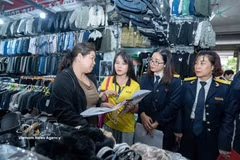
Garco 10 Corporation, one of the largest companies in Vietnam's textile and garment sector, has captured the domestic market by developing standard sizing charts for Vietnamese consumers while building high-end brands of their taste such as GrusZ, May 10 Expert, May 10 Series, May 10 Classic, and May 10 Classic Suit. The firm Veston and various other labels over the past 20 years have won recognition both at home and abroad due to superior quality, cutting-edge technology, and international standards.
Than Duc Viet, General Director of the corporation, said that Vietnamese designers are on par with their international peers. Thanks to advanced technologies and the internet boom, Vietnam accesses the latest trends from such fashion capitals as Paris, London, and New York.
Given market volatility, the firm has adopted a strategy of expanding exports into new and high-potential markets while seeing the domestic base as a pillar for its sustainable development. Garco 10 Corporation has embraced the Government’s “Made in Vietnam” programme, which emphasises innovation, design, and added value - a transformation from contract manufacturing to brand building, from pure production to sustainable development through intelligence.
Vietnamese firms should no longer just engage in contract manufacturing but they must dominate the game with quality brands and products, Viet said, to better control the marketplace.
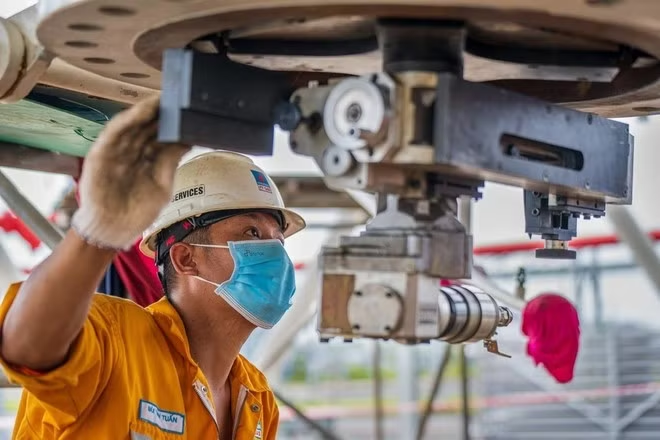
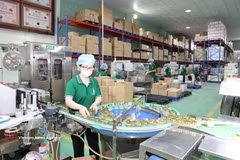
Other sectors echo this approach. MCNEX VINA Co.,Ltd in Ninh Binh province, a supplier to Samsung, has recovered strongly after the pandemic with export turnover of about 700 million USD. These numbers are 20% higher than pre-COVID levels, by upgrading technology, chasing larger orders, and improving product quality, according to its export-import head Nguyen Van Quyet.
The leather and footwear industry is also adapting. With an ambitious goal of 38–40 billion USD in exports by 2030, businesses are greening production to meet strict EU standards.
Small and medium firms will struggle unless they fundamentally upgrade capacity, said Phan Thi Thanh Xuan, Vice-Chairwoman and General Secretary of the Vietnam Leather, Footwear and Handbags Association, calling for stronger State support in technology, financing and workforce training.
According to insiders, leveraging market opportunities as well as capitalising on free trade agreements, particularly with the EU – Vietnam Free Trade Agreement (EVFTA), are the keys to bolstering export.
Statistics from the Ministry of Industry and Trade showed that Vietnam’s export turnover to the EU reached some 270 billion USD after the EVFTA came into effect five years ago. Key exports include electronics, garment and textile, aquatic products, and processed agricultural items posting two-digit growth.
Swift adaptation to market volatility
Vietnam’s trade numbers revealed positive gains in the first six months of 2025. Total import-export turnover reached 432.1 billion USD, up 16.1% year-on-year. Exports climbed 14.5% and imports jumped 17.9%. Textiles alone earned 21.8 billion USD, a 10.6% increase.
However, amidst global market fluctuation, Truong Van Cam, Vice Chairman and General Secretary of the Vietnam Textile and Apparel Association (Vitas), said the sector will focus on human resources training, AI application in design and production, and circular business, while diversifying markets, customers, products, and raw materials.
Along with traditional markets like the US, the EU, Japan, and the Republic of Korea, the sector will tap into potential markets such as Canada, Russia, the UK, and ASEAN as well as expand investment in eco-friendly industrial parks.
Today, Vietnamese garment and textile products reach 132 countries and territories, leveraging free trade deals such as the EVFTA and CPTPP to broaden access and cut tariffs.
Associate Professor Nguyen Thuong Lang of the National Economics University forecast that Vietnam’s import-export turnover could reach a record of 900 billion USD this year.
After nearly 40 years of reform, Vietnamese enterprises have grown far more agile and confident toward long-term stability with the application of advanced technology, digital transformation, and e-commerce, Lang observed./.