Vietnamese in Japan revive mother tongue among young generations

While the number of Vietnamese-origin children in Japan is surging, opportunities to actually speak Vietnamese in daily life are vanishing fast. Many children can understand the language but default to Japanese in response, gradually relegating their mother tongue to a secondary role, sometimes even treating it as a “second foreign language” inside their own houses.

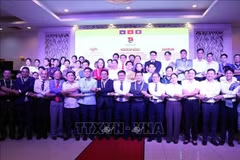
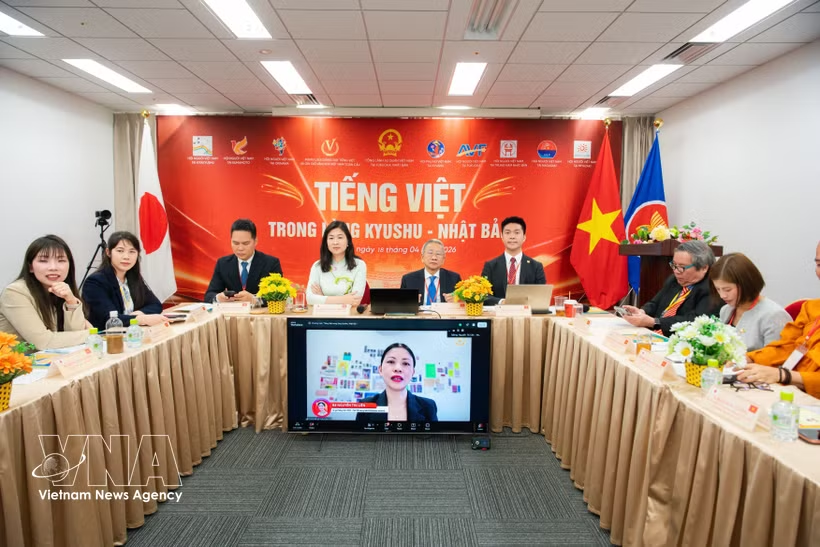
At the event “Vietnamese Language in the heart of Kyushu, Japan” (Photo: VNA)

Tokyo (VNA) - As Vietnamese community in Japan is growing, preserving the Vietnamese language among younger generations has become a pressing concern for families, community groups, and representative agencies.

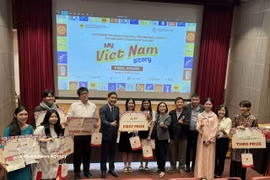
The Vietnamese Consulate General in Fukuoka, in coordination with the Global Network for Teaching Vietnamese Language and Culture, co-hosted the event “Vietnamese Language in the heart of Kyushu, Japan” in Fukuoka city on April 18.

Participants observed that while the number of Vietnamese-origin children in Japan is surging, opportunities to actually speak Vietnamese in daily life are vanishing fast. Many children can understand the language but default to Japanese in response, gradually relegating their mother tongue to a secondary role, sometimes even treating it as a “second foreign language” inside their own houses. The trouble has been noted in localities like Hiroshima, Kumamoto, and Okinawa, where parents watch their kids struggle to chat with relatives back in Vietnam.

Discussions spotlighted three major hurdles. The first is an acute shortage of qualified teachers as most classes rely on volunteers, with professionally trained educators possessing strong pedagogical skills still in short supply. The second is inadequate learning materials, with many textbooks imported from Vietnam failing to resonate with children growing up in multicultural, Japanese-dominant settings. Third, logistical and geographical constraints exist since families are spread across wide areas, schedules are packed, and Japanese permeates both school and daily life, leaving Vietnamese vulnerable unless actively reinforced.

Vietnamese Consul General in Fukuoka Trinh Thi Mai Phuong said keeping the language alive has long been part of diplomatic efforts. She called on local Japanese authorities to help with community spaces and learning venues.

Nguyen Duy Anh, member of the Vietnam Fatherland Front Central Committee and Secretary General of the Global Network for Teaching Vietnamese Language and Culture, said sustaining an existing Vietnamese class holds greater value than opening a new one, adding that preserving the mother tongue requires coordinated action from representative agencies, community groups, teachers, parents, and students themselves.
vnanet-j.jpg
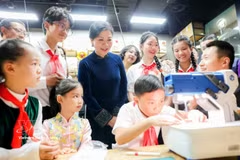
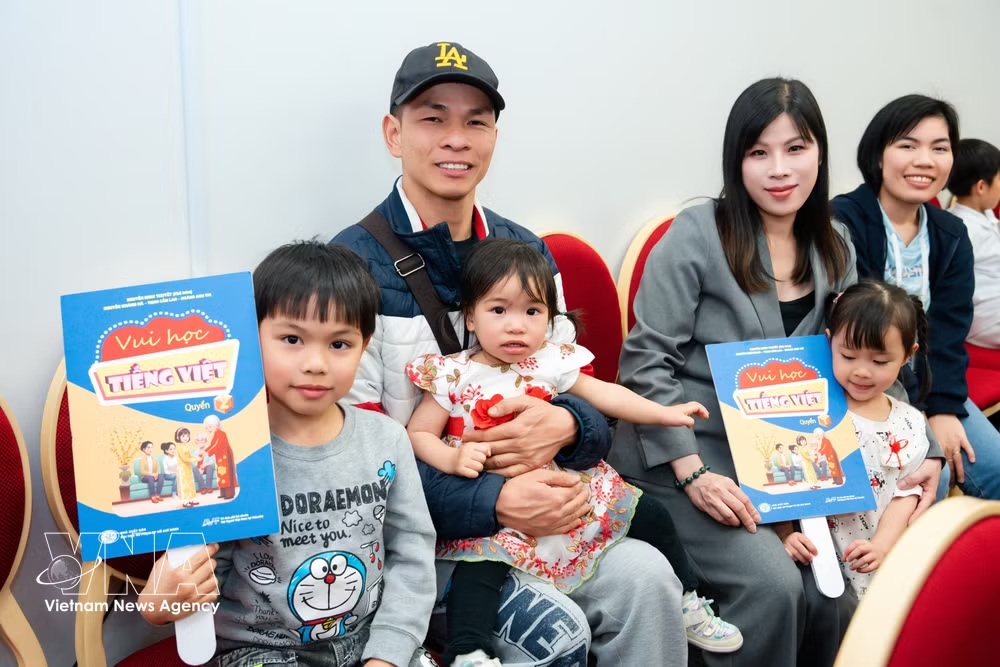
Families and kids at the event (Photo: VNA)

In fact, a number of models have been launched, including blended online–offline formats to overcome geographical barriers, and the integration of language lessons with cultural experiences such as making square glutinous rice cakes, playing folk games, and celebrating the Lunar New Year to engage children.

Some localities have rolled out the “language home” model, putting families front and centre and backing them with digital tools like videos, songs, and interactive games that allow learning anytime, anywhere. There is also a growing push for stronger inter-regional linkages to share best practices and run joint classes.

Participants agreed that Vietnamese language instruction needs to shift from fragmented, ad-hoc efforts to a more systematic, professional framework. This requires tighter collaboration among diplomatic agencies, professional networks, community associations, and families, plus better textbooks, teacher training, and plenty of cultural activities.

On the occasion, the contest “Learning Vietnamese with Joy, Remembering Uncle Ho” was also launched, inviting kids and families to jump in with storytelling, singing, drawing and video-making./.
VNA

See more

A tribute to Hung Kings in Ho Chi Minh City (Photo: VNA)

Hung Kings’ Commemoration Day 2026 to spread sacred values, foster national unity

Following the merger of Phu Tho, Vinh Phuc, and Hoa Binh provinces into the new Phu Tho province last year, the Hung Kings Temple Festival has taken on heightened significance. It now serves not only as a tribute to the ancestral homeland but also a unified cultural platform that extends sacred ancestral values to Vietnamese communities at home and abroad.

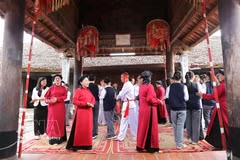
A traditional art performance at Bach Ma temple in Hanoi (Photo: VNA)

Traditional arts hold untapped economic power

Traditional arts embody deep aesthetic values, worldviews, and national identity, shaping the country’s distinctive “aesthetic identity” and foundational cultural tastes

A performance at the opening ceremony of the Hung Kings Temple Festival and the 2026 Ancestral Land Culture and Tourism Week on late April 17 (Photo: VNA)

Hung Kings Temple Festival, associated tourism week kick off

The annual festival serves as a major national cultural event, offering an opportunity for people across Vietnam and overseas Vietnamese communities to pay tribute to their ancestors, express gratitude, and strengthen the great national solidarity.

A ritual at Hue Nam Temple Festival (Photo: VNA)

Hue Nam Temple Festival: From imperial relic to distinctive cultural celebration in Hue

Historically known as Ngoc Tran Son Tu, the temple was renamed Hue Nam during the reign of King Dong Khanh in the late 19th century, symbolising royal gratitude to the Mother Goddess. It is also the only temple in Hue that harmoniously combines royal ceremonial elements with folk religious practices, creating a distinctive blend of court ritual and popular belief.

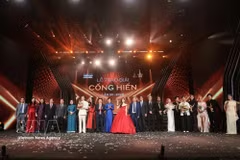
Participants in the 20th Cong hien (Devotion) Awards presentation ceremony in Hanoi on April 15 (Photo: VNA)

Devotion Awards mark two decades of honouring excellence in music, sports

Nguyen Thien Thuat, Editor-in-Chief of the The Thao & Van Hoa newspaper and Head of the organising board of the awards, said, noting that their achievements reflect the spirit of the Politburo’s Resolution No. 80, which emphasises preserving national cultural values while selectively absorbing the essence of world culture.

Artisans and students take part in cultural activities and exchanges in the Xoan singing performance space at Hung Lo ancient communal house in Phu Tho province (Photo: VNA)

Ancestral legends revived through contemporary performance

Beyond cultural value, well-organised festival programmes linked with tourism and media can contribute to the development of cultural industries and enhance Vietnam’s cultural soft power, positioning heritage-based events as distinctive national cultural brands in the international arena.

Khue Van Cac (Khue Van Pavilion) stands as a defining cultural symbol of Hanoi, closely associated with Vietnam’s long-standing tradition of valuing education and honouring knowledge. (Photo: VNA)

Greater efforts needed for heritage to shape Hanoi’s identity

As suggested by UNESCO experts, heritage should be approached as an integrated system encompassing space, people and everyday life. This perspective can inform urban planning, cultural tourism development and the creation of clear economic drivers.

Participants at the gathering (Photo: VNA)

Lao, Cambodian students welcome traditional New Year in Ho Chi Minh City

In his speech, Vice Chairman of the municipal People’s Committee Nguyen Manh Cuong said the municipal Party organisation, authorities and people always value the close ties and solidarity among Vietnam, Laos and Cambodia. He described the three nations’ longstanding ties, forged through shared hardships, as an invaluable spiritual asset and a bedrock for sustainable development.