Vietnam's 31-year ASEAN journey: From newcomer to rule shaper

According to former Deputy Foreign Minister Pham Quang Vinh, Vietnam's 31-year journey has seen it transform from a newcomer into a responsible, proactive and increasingly influential member. Its growing role reflects not only deeper regional economic and foreign integration but also its emergence as a key driver of ASEAN's development, resilience and global standing.

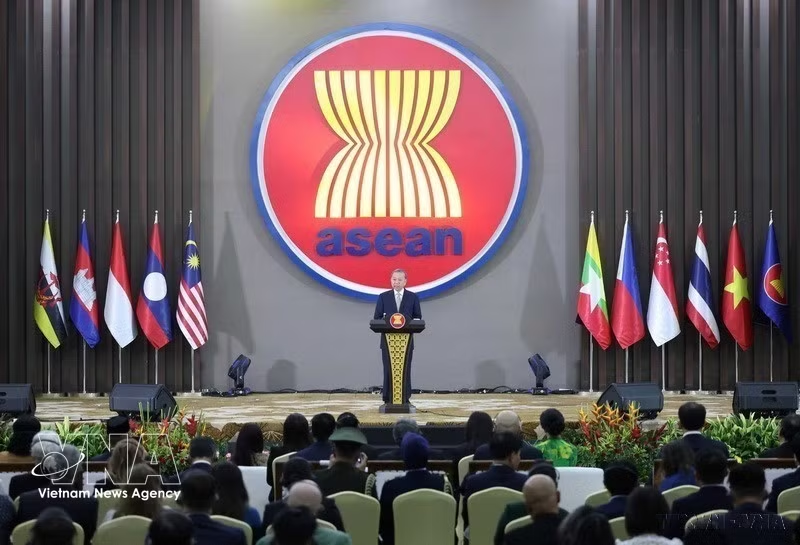
Party General Secretary To Lam delivers a speech at the ceremony commemorating the 30th anniversary of Vietnam's accession to ASEAN in Jakarta, Indonesia, in March 2025. (Photo: VNA)

Hanoi (VNA) – Vietnam’s accession to the Association of Southeast Asian Nations (ASEAN) in 1995 was a "strategic decision" for both the country and the bloc’s then six members, laying the foundation for a more united Southeast Asia, former Deputy Foreign Minister Pham Quang Vinh has said.

According to Vinh, the country’s 31-year journey has seen it transform from a newcomer into a responsible, proactive and increasingly influential member. Its growing role reflects not only deeper regional economic and foreign integration but also its emergence as a key driver of ASEAN's development, resilience and global standing.

Historic strategic decision

Vinh said that Vietnam’s decision to join ASEAN helped close a chapter of division and confrontation in Southeast Asia while opening a new era of regional cooperation.

In its early years, Vietnam focused on adapting to ASEAN’s working methods and accelerating regional integration. Despite being a newcomer, it quickly demonstrated its coordination ability by successfully hosting the 1998 ASEAN Summit in Hanoi.

The summit adopted the Hanoi Declaration, which set out key strategic goals, including narrowing the development gap between new and old members, advancing economic integration through a roadmap to reduce tariffs to near zero.

Between 2007 and 2020, Vietnam increasingly assumed a proactive role in shaping and promoting ASEAN’s development, Vinh said, stressing that the country contributed to drafting the ASEAN Charter, adopted in 2008, which established the bloc’s legal and institutional framework.
vnanet-tl2.jpg
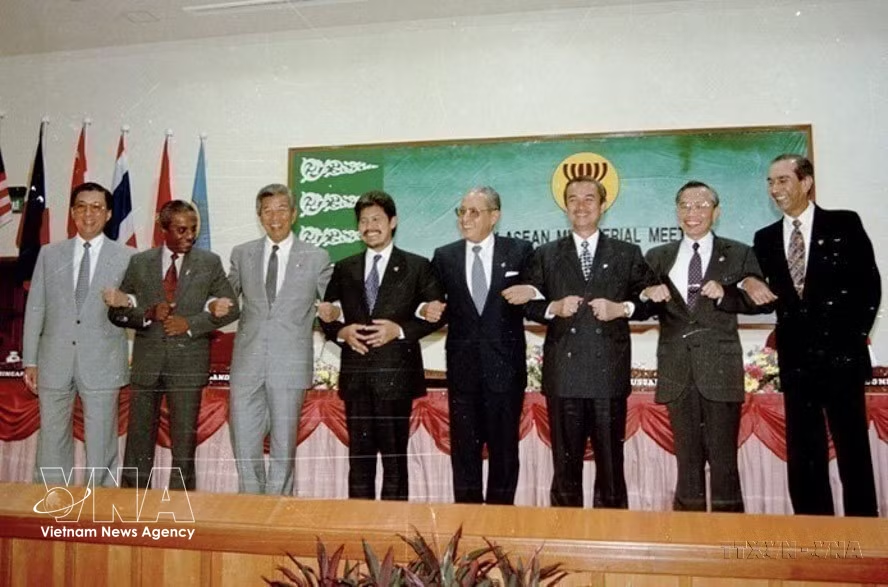
Foreign Minister Nguyen Manh Cam (second from right), the ASEAN Secretary-General and ASEAN foreign ministers at the ceremony admitting Vietnam as the seventh official member of the bloc in Bandar Seri Begawan, Brunei, on July 28, 1995. (Photo: VNA)

As ASEAN Chair in 2010, Vietnam oversaw the implementation of the Charter while helping secure a landmark decision to invite Russia and the US to join the East Asia Summit from 2011, reinforcing ASEAN’s central role amid growing engagement by major powers.

Vietnam’s leadership was again evident in 2020 when, as ASEAN Chair under the theme of "Cohesive and Responsive", it steered the bloc through the COVID-19 pandemic by promoting practical initiatives, including the COVID-19 ASEAN Response Fund, regional medical stockpiles and post-pandemic recovery plans.

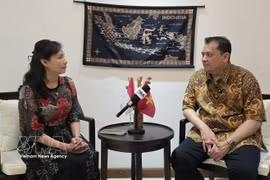
Speaking to the Vietnam News Agency correspondents in Jakarta, Beni Sukadis, Senior Coordinator at the Indonesian Institute for Defence and Strategic Studies (LESPERSSI) Strategic Studies, said that Vietnam's most important imprint is its commitment to promoting intra-bloc solidarity and protecting ASEAN's central role in an evolving regional architecture.

He underscored Vietnam's consistent commitment to respecting sovereignty, upholding consensus, and resolving disputes in the East Sea through peaceful measures in strict accordance with international law.

From participant to rule shaper

As Vietnam enters a new stage of development, its standing within ASEAN has reached new heights. The country's foreign policy direction following the 14th National Party Congress, together with the Politburo's Resolution No. 06-NQ/TW issued in May 2026, has shaped a proactive and self-reliant diplomatic mindset.

Addressing a national conference on June 11, Party General Secretary and State President To Lam outlined a strategic shift in diplomacy, calling for Vietnam to move from safeguarding development space to creating national development capacity, from integrating into markets to shaping them, from participating in international rules to contributing to rule-making, and from pursuing national growth alone to advancing together with ASEAN.

That vision was reflected at the 59th ASEAN Foreign Ministers’ Meeting (AMM-59) and related meetings held in Manila, the Philippines from July 20-24.

Deputy Foreign Minister Dang Hoang Giang said the Vietnamese delegation, led by Foreign Minister Le Hoai Trung, attended the meetings not merely as a participant but as a proactive contributor of initiatives and solutions.

As coordinator for relations between ASEAN with the UK and New Zealand, Vietnam successfully led negotiations on strategic plans of action aimed at strengthening regional resilience.

Philippine Ambassador to Vietnam Francisco Noel R. Fernandez III, whose country holds the ASEAN Chairmanship in 2026, described Vietnam as a capable middle power that consistently champions ASEAN’s central role while promoting the bloc as a pillar of regional political, security and economic development.

Sharing a similar view, Collins Chong Yew Keat, a foreign affair, security and strategy analyst at the University of Malaya, said Vietnam has evolved beyond being an active ASEAN member to become a key force shaping the bloc's future, serving as both a strategic pillar and a driving force advancing the implementation of the ASEAN Community Vision 2045.

Reflecting on Vietnam’s 31-year journey in ASEAN, Ambassador Vinh said the country’s approach has been defined by three core values - solidarity, responsibility and development-oriented leadership.

Against the backdrop of growing geopolitical uncertainty and intensifying major-power competition, Vietnam’s growing role reflects a seamless combination of its own national strength and ASEAN's strategic autonomy, he stressed.

Party General Secretary and State President To Lam has reiterated President Ho Chi Minh’s teachings that, “National strength is like the gong, while diplomacy is its sound. Only when the gong is strong can its sound resonate far”. He stressed that as the country enters a new era driven by science, technology and innovation, its independent and self-reliant diplomacy is expected to resonate even more strongly within ASEAN./.​

VNA

See more

The press briefing on the first extraordinary session of the 16th National Assembly (Photo: VNA)

NA's first extraordinary session to scrutinise 31 important matters

The first extraordinary session of the 16th National Assembly (NA) will deliberate 31 items, including the adoption of 15 draft laws, four draft resolutions, five major issues and first readings of seven additional bills, along with other matters within the NA's authority.

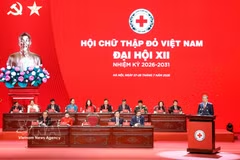
Party General Secretary and State President To Lam addresses the 12th National Congress of the Vietnam Red Cross Society for the 2026-2031 tenure on July 28. (Photo: VNA)

Top leader urges shift from emergency relief to community resilience

The Vietnam Red Cross Society must anchor operations in transparency, integrity, accountability, and openness. All donations must be managed and allocated as intended, with donors entitled to track use, beneficiaries, and outcomes, and recipients able to give feedback on relevance, fairness, and timeliness.

Assoc. Prof. Dr. Neak Chandarith, Director of the Institute for International Studies and Public Policy at the Royal University of Phnom Penh (Photo: VNA)

Top Cambodian lawmaker’s Vietnam visit further institutionalises legislative ties: Scholar

Talking with Vietnam News Agency correspondents in Phnom Penh, Assoc. Prof. Dr. Neak Chandarith, Director of the Institute for International Studies and Public Policy (IISPP) at the Royal University of Phnom Penh (RUPP), underscored the visit’s profound political and strategic significance for the two Southeast Asian neighbours’ traditional friendship, particularly in further institutionalising ties between their legislative bodies.

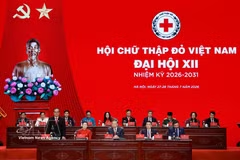
The 12th National Congress of the Vietnam Red Cross Society (VRCS) for the 2026–2031 term officially opens in Hanoi on July 28. (Photo: VNA)

Top leader becomes Honorary President of Vietnam Red Cross Society

For the new term, the Vietnam Red Cross Society will comprehensively reform its operations by placing people at the centre, communities as the foundation, digital transformation and innovation as the driver of development, and resource mobilisation as its primary approach to improve the quality and efficiency of humanitarian activities.

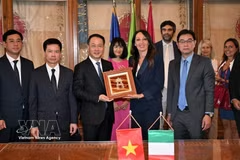
A Hanoi leader presents a gift to President of the Rome City Council Svetlana Celli at the meeting on July 27. (Photo: VNA)

Hanoi, Rome sign statement on advancing all-round ties

The two-year statement focuses on six priority areas, namely urban management and regeneration; environmental protection and sustainable development; education and culture; social development; integration and innovation; and the economy, trade and investment.

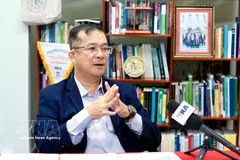
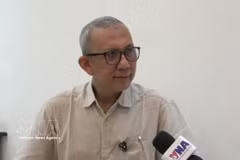
Beni Sukadis, Senior Coordinator at the Indonesian Institute for Defence and Strategic Studies, grants an interview to the Vietnam News Agency. (Photo: VNA)

Indonesian expert lauds Vietnam’s contributions to ASEAN community-building

As a proactive and responsible member, Vietnam has demonstrated its ability to build consensus, foster cooperation, and maintain balance amid an increasingly complex geopolitical environment in the region, said Beni Sukadis, Senior Coordinator at the Indonesian Institute for Defence and Strategic Studies (LESPERSSI)

National Assembly Chairman Tran Thanh Man addresses the fourth session of the NA Standing Committee. (Photo: VNA)

NA seeks consistency in military, defence legislation

The National Assembly (NA) Standing Committee continued its fourth session on July 27, reviewing a draft law amending and supplementing provisions to nine military and defence laws to ensure consistency across Vietnam’s legal framework.

A session of the NA Standing Committee (Illustrative image: VNA)

NA adjusts legislative programme for 2026

Under Resolution No. 11/2026/UBTVQH16, the NA Standing Committee added several draft laws to the 2026 agenda for both discussion and approval at the second session of the 16th NA, scheduled for October.

The presidium of the 12th National Congress of the Vietnam Red Cross Society, held in Hanoi on July 27–28 (Photo: VNA)

Vietnam Red Cross Society sets priorities for 2026–2031 term

The 12th National Congress of the Vietnam Red Cross Society will hold its formal session on July 28 morning, featuring the opening ceremony, presentation of the political report, discussions and remarks by representatives of the International Red Cross and Red Crescent Movement, and guiding remarks by Party and State leaders.

Deputy Secretary of the Party Committee and Chairman of the People’s Committee of Thanh Hoa province To Anh Dung speaks at the conference on July 27. (Photo published by VNA)

Thanh Hoa provincial People’s Committee has new Chairman

Dung pledged to continue improving his political mettle, ethics and leadership capacity, while working with the provincial leadership to strengthen solidarity, promote collective intelligence and reform leadership mindset and governance methods, proactively seize opportunities and overcome difficulties and challenges to realise the set targets.

Professor Zhu Chenming, Honourary Director of the Institute of South and Southeast Asian Studies under the Yunnan Academy of Social Sciences (Photo: VNA)

Four strategic priorities signal Vietnam’s next phase of development: Chinese scholar

According to Professor Zhu Chenming, Honourary Director of the Institute of South and Southeast Asian Studies under the Yunnan Academy of Social Sciences, the Vietnamese Party and State leader’s decision to outline new strategic directions immediately after the restructuring process reflects a clear understanding of Vietnam’s evolving development needs. Simply completing institutional reorganisation could create the misconception that the reform mission has been accomplished, while significant governance and development challenges remain.