Visa policy seen as catalyst for 500,000 Vietnamese tourists to RoK

The number of Vietnamese travellers to the Republic of Korea (RoK) has surged strongly, surpassing 500,000 arrivals in 2024, cementing Vietnam as one of the most important and promising source markets for Korean tourism.

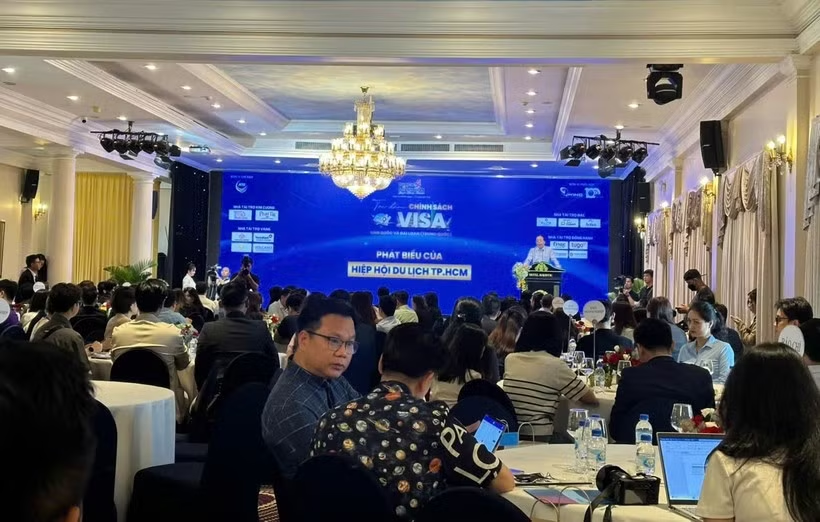
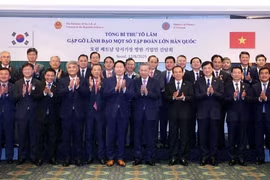
The seminar attracts over 250 delegates from travel agencies, hotels, and transport companies. (Photo: VietnamPlus)

Hanoi (VNA) – The number of Vietnamese travellers to the Republic of Korea (RoK) has surged strongly, surpassing 500,000 arrivals in 2024, cementing Vietnam as one of the most important and promising source markets for Korean tourism.

To capitalise on this momentum, the Ho Chi Minh City Tourism Association (HTA) on August 23 convened the second edition of its “Tourism and Entrepreneurs” dialogue series, spotlighting the visa policy as a key to attracting tourists to the RoK.

Part of the broader “Tourism & Entrepreneurs 2025” programme, the event aimed to strengthen cooperation in travel and hospitality between the two countries.

A highlight was the participation of representatives from the RoK Consulate General in Ho Chi Minh City, who shared first-hand insights with more than 250 delegates from tour operators, hotels, and transport firms.

Figures from the Korea Tourism Organisation (KTO) reveal that in just the first half of 2025, around 320,000 Vietnamese visitors entered the RoK, a 35% increase compared with the same period last year. This underscores the enduring appeal of the Northeast Asian destination among Vietnamese travellers.

1000006487.jpg
Vietnamese tourists chose famous destinations in the RoK for their families’ holidays. (Photo: VietnamPlus)

The seminar placed particular emphasis on recent reforms and adjustments in the RoK’s visa issuance process. Participants noted that timely and accurate updates are essential for Vietnamese outbound travel companies seeking to harness the rising wave of demand.

From an industry perspective, Doan Ngoc Thao, Deputy General Director of The Swing Travel & Sports JSC and Secretary-General of the Saigon Golf Tourism Association, pointed out that the international golf tourism segment has grown steadily in Vietnam, led by visitors from the RoK and Taiwan (China).

Golf travellers are typically high-spending guests who combine premium courses with luxury resort stays. Annual arrivals from the Korean and Taiwanese markets have been rising by 10–15% on average, with sharp increases in the post-pandemic period.

1000006484.jpg
The Rok attracted over 500,000 Vietnamese travellers in 2024. (Photo: VietnamPlus)

Thao further noted that Vietnam’s expansion of visa exemptions, extended stays, and adoption of convenient e-visa issuance have made it easier to attract more tourists, encouraging longer visits and repeat trips. If this favourable visa policy is maintained and broadened, Vietnam could soon emerge as one of Asia’s leading golf destinations for visitors from the RoK and Taiwan.

On the Korean side, authorities are also considering more flexible visa measures, with the ambition of welcoming over 700,000 Vietnamese visitors by 2026. Observers said this creates a “golden opportunity” for travel businesses to seize the trend.

Industry experts emphasised that understanding visa procedures allows firms to better prepare documentation, reduce processing times, and increase approval rates. This not only boosts their competitiveness but also enhances corporate credibility in the race to capture market share. A streamlined visa experience, they added, is the very first touchpoint that shapes visitor satisfaction and creates lasting impressions.

In addition, a flexible visa policy is regarded as a useful instrument for tourism promotion. It sends a strong welcoming message from the Korean government while also reinforcing the spirit of friendship and cooperation between the two nations.
1000006486.jpg
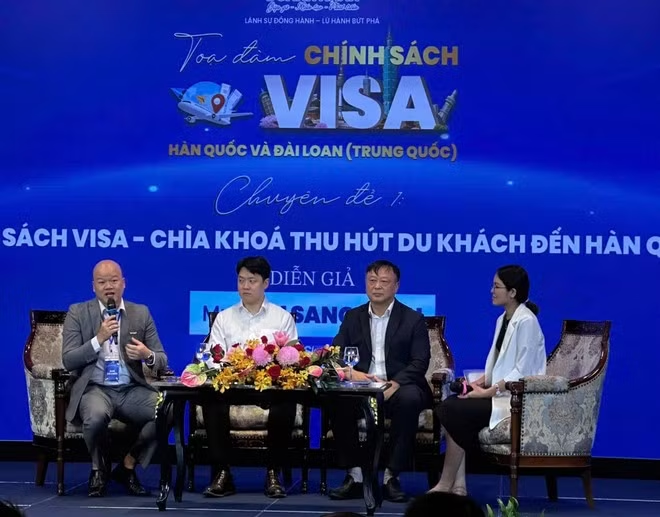
Vietnamese and Korean speakers at the session. (Photo: VietnamPlus)

Participants agreed that the seminar was more than just an information session. By bringing together officials, industry leaders, and entrepreneurs, it created a practical platform for dialogue and coordination. For many, the event equipped businesses with a “golden key” to unlocking access to the Korean market while also contributing to balanced and sustainable development of both inbound and outbound tourism.

As Vietnam and the RoK celebrate robust people-to-people exchanges, both sides recognise that visa facilitation plays a decisive role in driving growth. With over half a million Vietnamese already choosing the RoK in 2024, the trajectory suggests even stronger flows in the years ahead, provided supportive frameworks remain in place./.
VNA

See more

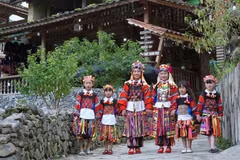
Visitors explore and experience the cultural space of Lo Lo Chai village in Lung Cu commune, Tuyen Quang province. (Photo: qdnd.vn)

Administrative expansion unlocks new momentum for tourism development

Nguyen Thi Hoai, Deputy Director of the Department of Culture, Sports and Tourism of Tuyen Quang, said the expansion of administrative boundaries has opened up new development space for the province, with key tourism products including cultural-historical tourism, ethnic cultural experiences, community-based tourism linked to scenic sites, spiritual tourism, and other distinctive experiential offerings.

At Thung Nham ecological tourism site in Ninh Binh province. (Photo: VNA)

Vietnam’s tourism defies fuel price shock with record Q1 “hat-trick”

According to data released by the National Statistics Office, foreign arrivals in March reached nearly 2.1 million, up 1.3% year-on-year. In total, Vietnam welcomed an estimated 6.76 million foreign tourists in the first quarter, a more than 12% jump from the same period in 2025 and the highest Q1 figure ever recorded.

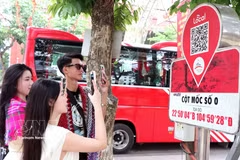
Visitors scan QR codes at Km0 Ha Giang to access tourism information. (Photo: VNA)

Technology powers tourism growth in mountainous province

Last year, Tuyen Quang welcomed over 3.9 million visitors, and is aiming to attract around 4.1 million arrivals, including around 600,000 foreigners, this year. Tourism continues to be identified as a key economic sector, with development oriented toward sustainability, green growth, and enhanced competitiveness through digitalisation.

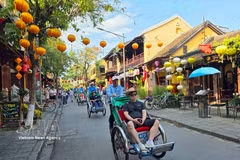
Tourists enjoy a rickshaw tour of Hoi An Ancient Town, Da Nang city. (Photo: VNA)

ITE HCMC 2026 to promote Vietnam’s tourism on global map

With its large scale, the ITE HCMC 2026 aims to promote tourism cooperation between Vietnam and priority markets such as Northeast Asia, Western Europe, North America, Southeast Asia, and Oceania while also boosting visitor arrivals from the Indian market

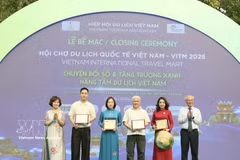
The organisers of VITM 2026 honour sponsors. ( Photo: VNA)

VITM 2026 boosts tourism demand ahead of peak season

According to the organisers, around 4,500 representatives from Vietnamese and international tourism enterprises attended the event, generating more than 25,000 business meetings and partnership exchanges. Approximately 15,000 discounted tours and travel products were offered to visitors.

Traditional dragon procession held on the river in Ninh Binh. (Photo: VNA)

Cultural heritage drives sustainable tourism growth in Ninh Binh

In the first two months of 2026, Ninh Binh welcomed over 5.4 million visitors, up 9.9% year-on-year, generating nearly 5.84 trillion VND (221 million USD) in tourism revenue, up 15.9%. During the 2026 Lunar New Year holiday alone, the province received 2.38 million visitors, an 81.4% increase from the previous year, ranking second nationwide.

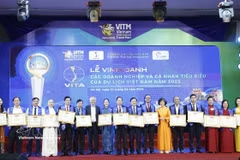
Outstanding individuals and firms honoured at VITM 2026 (Photo: VNA)

Outstanding individuals, firms honoured at Vietnam International Travel Mart 2026

In 2025, Vietnam’s tourism sector recorded its highest-ever number of visitors, welcoming more than 21.5 million international arrivals, up more than 20% from 2024, and serving over 135.5 million domestic travellers. Tourism revenue also surpassed 1 quadrillion VND (nearly 38 billion USD). The sector has become a bright spot of the economy, with Vietnam ranking among the world’s fastest-growing tourism destinations.

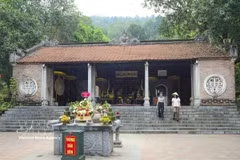
The Ba Trieu Temple in Thanh Hoa province (Photo: VNA)

Thanh Hoa taps digital transformation to boost heritage tourism

With 28 nationally-recognised intangible cultural heritage elements, Thanh Hoa province has prioritised integrating conservation with tourism development. Digital transformation, in particular, is seen as a crucial bridge connecting tradition with innovation, helping heritage sites become more accessible and engaging.

Pristine white-sand beach on Cu Lao Cham Island, Da Nang city, is a magnet for visitors. (Photo: VNA)

Vietnam – a safe destination amid global uncertainties

Despite global tourism headwinds linked to geopolitical conflicts, transport disruptions and surging travel expenses, Vietnam’s tourism sector has sustained strong growth, underscoring the destination’s resilience and rising international profile.

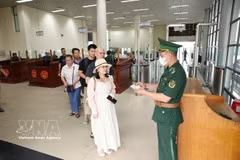
A border guard at the Mong Cai International Border Gate processes exit procedures for passengers at the Bac Luan 1 border gate in Quang Ninh province. (Photo: VNA)

Vietnam, China promote AI application in cross-border tourism cooperation

During the programme, participants will attend intensive courses delivered by AI technology experts, China–ASEAN policy researchers, and tourism specialists. The curriculum focuses on the application of big data in tourism policy planning, the development of cross-border tourism products, and the building of joint tourism brands.