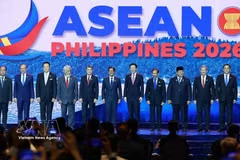
Hanoi (VNA) – The Association of Southeast Asian Nations (ASEAN) has reaffirmed its shared ambition to accelerate the region’s transition towards carbon neutrality and sustainable growth by 2030, according to the ASEAN Chair’s statement released on May 9.
The statement said that the bloc welcomes the progress in the implementation of the ASEAN Regional Investment Action Plan 2025–2030, which seeks to attract foreign investment in green transition and post-pandemic priority recovery sectors. These include carbon capture and storage, biofuels, medical devices, solar photovoltaic equipment, veterinary health care, and green and sustainable building materials.
“We noted that this will help position ASEAN as a single investment destination for sustainable investment, while accelerating the region’s green transition and inclusive economic growth,” the ASEAN Chair said.
The ASEAN leaders also reaffirmed their commitment to accelerating the implementation of the ASEAN Plan of Action for Energy Cooperation 2026–2030, which aims to strengthen the region’s energy security and resilience.
The plan emphasises diversifying of energy sources, scaling up renewable and emerging technologies, improving energy efficiency, and advancing cooperation in areas such as petroleum security, smart grid digitalisation, and carbon capture, utilisation, and storage (CCUS).
The leaders welcomed the new aspirational 2030 targets of a 40% reduction in energy intensity (from 2005 levels), a 30% renewable energy share in total primary energy supply, and a 45% renewable share in installed power capacity, underscoring ASEAN’s collective resolve to build a more sustainable and competitive regional energy system.
The regional bloc looks forward to the ASEAN Strategy for Carbon Neutrality Work Plan, which will operationalise the ASEAN Strategy for Carbon Neutrality through clear priorities, shared objectives and coordinated action to decarbonise regional value chains.
The association noted the strategy’s transformative potential in advancing sustainable and resilient economic growth, while strengthening the region's position as “an attractive and competitive destination for green investments to support an inclusive climate transition.”
“We acknowledged the regional commitment to harness the potential of our marine, ocean, seas, and freshwater resources through ongoing efforts to finalise the Roadmap of the ASEAN Blue Economy Implementation Plan 2026–2030,” the ASEAN Chair said.
The member states highlighted ongoing efforts to develop the roadmap, which will serve as a critical pathway to practical and context-specific initiatives to promote the physical, financial, human, social, and natural capital of ASEAN’s blue economy.
They expressed optimism about the positive outcomes of the ASEAN Blue Carbon and Finance Profiling project, which will map blue capital assets and identify sustainable investment opportunities to advance the region’s blue economy agenda./.

PM’s presence in ASEAN Summit spreads message of dynamic, strongly rising Vietnam: official
Deputy Foreign Minister Dang Hoang Giang said that the Vietnamese delegation made important contributions to the summit’s success, reflecting the foreign policy orientation set out by the 14th National Congress of the Communist Party of Vietnam, which continues to place ASEAN at the centre of Vietnam’s regional engagement, as well as its commitment to proactive, positive and responsible contributions to ASEAN Community-building process.