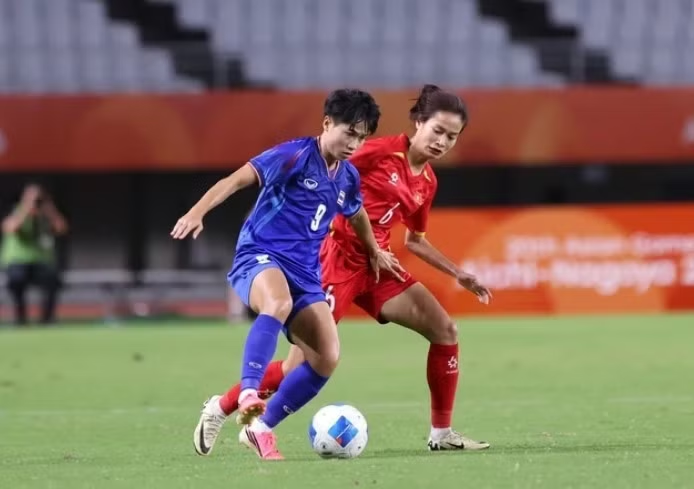
ASIAD 2026: Vietnam women’s team draws with Thailand, advances to quarterfinals

Vietnam drew 0-0 with Thailand in their final Group E match at the 2026 Asian Games (ASIAD)’s women's football competition, held on the evening of September 21 at Nagai Stadium in Osaka, Japan.

Vietnamese and Thai players vie for the ball at the final Group E match at ASIAD 2026 on September 21. (Photo: thanhnien.vn)

Hanoi (VNA) – Vietnam drew 0-0 with Thailand in their final Group E match at the 2026 Asian Games (ASIAD)’s women's football competition, held on the evening of September 21 at Nagai Stadium in Osaka, Japan.

The result secured Vietnam a place in the quarterfinals as one of the two best third-placed teams.

Before the match, both Vietnam and Thailand had failed to earn a point from their first two matches. Vietnam lost 2-1 to Chinese Taipei and 8-0 to Japan, while Thailand suffered an 8-0 defeat to Japan and a 1-0 loss to Chinese Taipei. Both teams had a goal difference of minus nine, but Vietnam ranked higher because they had scored one goal.

The situation became more favourable for Vietnam after Myanmar drew 0-0 with Bangladesh in an earlier Group F match. The result meant that Vietnam only needed a draw against Thailand to finish ahead of Myanmar in the race for one of the two quarterfinal berths reserved for the best third-placed teams./.

VNA

See more

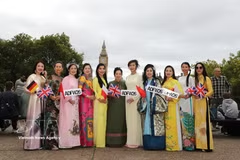
Participants in the Ao Dai Fashion Week London 2026 (Photo: VNA)

From La Khe looms to London runways, Vietnamese culture takes centre stage

Rather than presenting Ao Dai simply as a cultural symbol, organisers placed designers, collections, fabrics, craftsmanship and creative interpretations at the heart of the Ao Dai Fashion Week London 2026, putting Vietnam’s traditional dress into the language and professional standards of the international fashion industry.

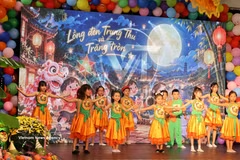
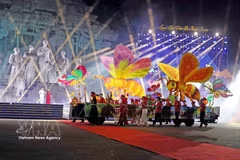
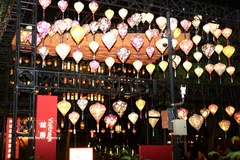
Mid-Autumn Festival lantern models on display at the opening ceremony of the Thanh Tuyen Festival 2026 on September 20. (Photo: VNA)

Thanh Tuyen Festival 2026 kicks off in Tuyen Quang

Held annually on the occasion of the Mid-Autumn Festival, the Thanh Tuyen Festival has evolved from a children's cultural celebration into a signature cultural and tourism product of Tuyen Quang.

A performance at the closing ceremony of the Thang Long-Hanoi Festival (Photo: VNA)

Thang Long-Hanoi 2026 Festival wraps up

Held from September 11-20 under the theme “Heritage Flow,” the festival featured more than 16 activities involving over 3,000 artists and performers, more than 100 artisans, and art troupes from Vietnam, the Republic of Korea, Japan, and India. The event attracted more than 250,000 visitors.

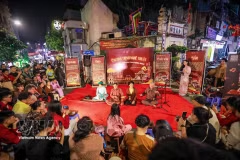
Excerpts from tuong (classical dramma), cheo (traditional Vietnamese opera), xam (blind buskers’ singing), and chau van (ritual singing) performed at the Traditional Arts Space in Hanoi’s Old Quarter have attracted great interest from local residents and tourists (Photo: VNA)

Traditional culture finds new life in contemporary Vietnam

Under Resolution 80-NQ/TW, dated January 7, 2026, November 24 was designated Vietnam Culture Day, to be observed annually. The occasion aims to give the public opportunities to participate in, create and enjoy cultural activities, helping spread positive values and foster pride in Vietnamese culture.

Vietnamese representative Le Nguyen Bao Ngoc and other Miss World 2026 contestants at the opening performance at the "Dances of the World" grand finale in Nha Trang ward, Khanh Hoa province, on September 5. (Photo: VNA)

"Beauty ambassadors" promote image of Vietnam to the world

The greatest value lies in the contestants themselves, who can become “beauty ambassadors” and authentic storytellers. Through their first-hand experiences and perspectives, they can naturally share Vietnam’s landscapes, culture and people with audiences around the world, said an organiser.

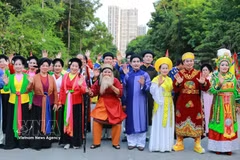
The programme opens with an artistic parade, with artisans and artists dressed in traditional costumes characteristic of Cheo, Tuung and Ca tru, creating an impressive festival scene. (Photo: VNA)

Traditional arts bring closer to public through “Music and Heritage” programme

The key message the organisers want to convey to the public and international friends is that heritage is not a collection of artefacts or values frozen in the past, but a living flow that continues to evolve, adapt and be enriched by each generation, Le Thi Anh Mai, Deputy Director of the Hanoi Department of Culture, Sports and Tourism, said.

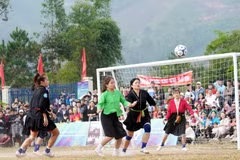
An action during the final between Lam Thuong (Lao Cai province) and Mong Duong (Quang Ninh) on December 7, 2025, as part of the 2025 Quang Ninh Open Ethnic Minority Women’s Football Tournament – VTV5 Cup. (Photo published by VNA)

Potential of ethnic minority women’s football

Women’s football movements in local communities have been quietly growing, but they’ve now built up enough momentum to inspire organisers to launch the first Vietnam Ethnic Minority Women’s Football – VTV Cup in 2026.

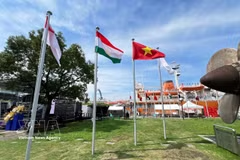
The national flag of Vietnam flies alongside the flags of other countries at the 2026 Asian Games. (Photo: VNA)

Vietnamese national flag flies at 2026 Asian Games

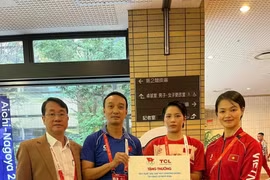
As the Vietnamese national anthem played, the red flag with a yellow star was raised at Nagoya Port, marking the official presence of the Vietnamese delegation at ASIAD 2026 and boosting the athletes’ morale ahead of the competitions.

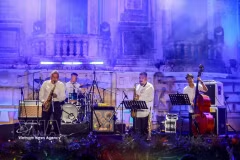
The Song Hong Jazz Band perform at the opening ceremony of the Hanoi International Jazz Festival 2026 on September 17. (Photo: VNA)

Hanoi International Jazz Festival 2026 kicks off

With open and free-of-charge activities held at both professional performance venues and public spaces, Hanoi Jazztival 2026 seeks to expand access to jazz and make the genre more visible in the capital’s urban cultural life.

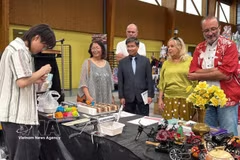
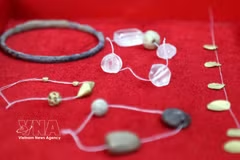
Glass beads, gold-coloured metal beads and leaf-shaped objects uncovered in the tombs. (Photo: VNA)

Archaeologists uncover artefacts in two 1,500-year-old tombs

Based on their structure, construction techniques and unearthed artefacts, the two tombs are identified as brick-built burial chambers. Such tombs, commonly known as brick tombs or Han tombs, were relatively widespread in areas along major rivers and waterways, including the Luc Dau, Bach Dang, Y Bich and Lam river systems, which served as important links between settlements and the sea.