Cross-border e-commerce opens new export path for Vietnam

The Ministry of Industry and Trade’s 2026–2030 support agenda has a blunt goal of turning online exports from a promising sales channel into real operating capability and durable value for Vietnamese goods.

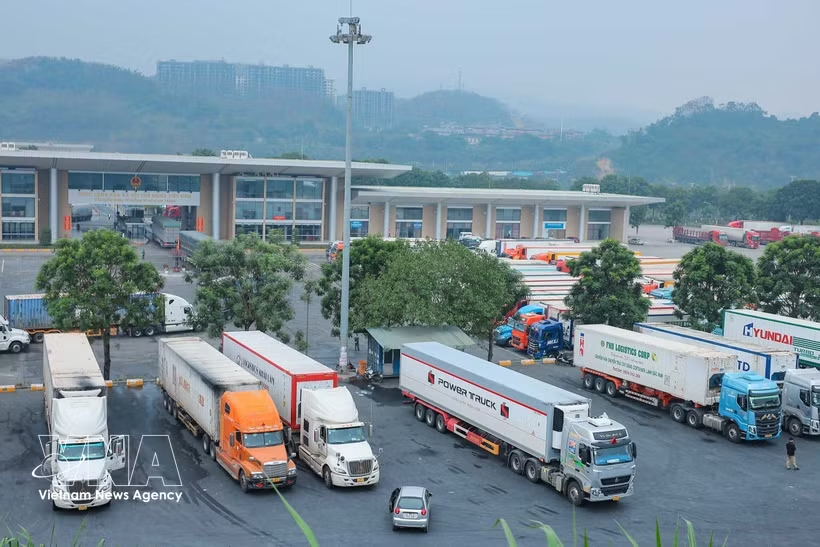
A digital border gate platform is under pilot since August 2023 at Kim Thanh International Land Border Gate No. 2 (Photo: VNA)

Hanoi (VNA) - Cross-border e-commerce is emerging as a new export lane for Vietnam, letting companies get closer to overseas shoppers, widen markets and build digital brands.

The Ministry of Industry and Trade’s 2026–2030 support agenda has a blunt goal of turning online exports from a promising sales channel into real operating capability and durable value for Vietnamese goods.

Lai Viet Anh, Deputy Director of the ministry’s Vietnam E-commerce Agency, said exporters must clear a long checklist at once, including market access, standards, branding, digital content, payments, logistics, insurance, customer service, data and legal rules in Vietnam and destination markets.

Anh said the national e-commerce development master plan for 2026–2030 calls for modern, sustainable growth, stronger competitiveness and more Vietnamese products sold online. To make cross-border e-commerce a genuine export driver, Vietnam needs a digital export ecosystem in which each player owns a critical link.

Tran Thuy Tien from the agency’s cross-border e-commerce division said Vietnam has 18 free trade agreements covering more than 65 markets. That, plus production and processing capacity and the export mix, gives companies a strong base for cross-border online sales. The gap is scale as cross-border e-commerce exports were only about 0.48% of Vietnam’s total export turnover in 2025, a small share that signals both weakness and large headroom.

Footwear and many consumer goods still have room to grow, and personal care, organic and natural herbal products look promising as overseas consumers shift toward natural-origin goods. Tien said market headroom becomes export turnover only when companies have the capability and a coordinated ecosystem behind them. The agency is rolling out online export measures under the 2026–2030 master plan and a draft cross-border e-commerce export promotion project. Support will run from basic awareness-building to deep consulting by company, product and market.

Discovery commerce is widening the opening. Short video and livestreaming put products in front of consumers and give lesser-known brands a route to market. Companies no longer need a broad distribution network before reaching customers; they can use digital content, consumer communities and gradual brand-building abroad, she said.

Tran Thi Tan, Director of Corporate Social Responsibility and Strategic Partnerships at TikTok Shop, said TikTok Shop’s experience in the US and China shows Vietnamese companies are already joining the model. Twenty Vietnamese businesses and sellers now operate in the TikTok Shop ecosystem in those two markets, and 10 have passed 1,000 orders.

TikTok Shop’s “Beyond Vietnam - Vietnamese Products Take Flight” programme aims to train and support 2,000 Vietnamese exporters in 2026–2028 to officially list products in the US and China ecosystems. It also targets 100 companies reaching their first 1,000 orders and 10 Vietnamese brands or sellers generating 1 million USD in revenue from discovery commerce.

The Vietnam E-commerce Association’s “Young entrepreneurs going global through e-commerce” programme with Amazon takes a similar line: digital skills, AI, cross-border e-commerce and links into the export support ecosystem. It targets companies with promising products, domestic online experience and international ambitions.

According to Anh, the master plan is designed for modern, sustainable growth, stronger competitiveness and more Vietnamese products sold through e-commerce. At the same time, Vietnam Go Global for 2026–2030 is meant to add tools for market expansion, competitiveness and overseas presence./.

VNA

See more

Phu Quoc welcomes an estimated 8.57 million-plus visitors in the first nine months of 2026, up 30.5% year on year, including more than 1.92 million international arrivals, an increase of 60.2%. (Photos: Sun Group)

Tourism powers nearly 40% economic growth in Phu Quoc

In the first nine months of 2026, Phu Quoc welcomed an estimated 8.57 million-plus visitors, up 30.5% year-on-year, with international arrivals exceeding 1.92 million, an increase of 60.2%. Tourism revenue reached approximately 45.976 trillion VND, up 47.7% and exceeding the full-year target by 1%.

Swedish Ambassador to Vietnam Johan Ndisi (Photo: VNA)

Vietnam poised to seize opportunities in technology, green investment: Foreign ambassadors

The presence of technology companies, new investments and emerging cooperation frameworks is laying the foundation for deeper bilateral ties. To capitalise on these opportunities, Vietnam needs to better connect available resources, strengthen domestic technological capabilities and prepare to meet the requirements of high-standard markets, according to Nordic countries' ambassadors to Vietnam.

At the Paris conference between Vietnamese and French companies (Photo: VNA)

Vietnam, France expand cooperation in industry, clean energy, hi-tech

In industry, Phu Tho wants hi-tech, supporting industries, electronics components, precision mechanics, automation, new materials and semiconductors, tied to R&D, technology transfer and domestic suppliers. In infrastructure and green growth, it seeks industrial park, logistics, modern management, energy efficiency and wastewater reuse projects, aiming at eco-industrial parks.

The first commercial flight lands on the new runway at the Phu Quoc International Airport (Photo: nhandan.vn)

Phu Quoc airport opens second runway after eight-month sprint

The new second runway of Phu Quoc International Airport, measuring 3,300 metres in length and 45 metres in width, meets the International Civil Aviation Organisation (ICAO) Code E standards, enabling it to accommodate wide-body aircraft such as the Boeing 787, Airbus A350 and Boeing 777, thereby enhancing Phu Quoc’s international air connectivity.

At an orchard in Bac Ninh city (Photo: VNA)

Bac Ninh hunts buyers for 118,000 tonne fruit crop

Bac Ninh Authorities are leaning on growing area codes for traceability and market access. As of October 16, 2026, the city had 91 codes covering 1,764.9 ha, including 80 for export, 11 for domestic sales.

Import and export goods at Lach Huyen Port in Hai Phong city. Photo: VNA

Vietnam’s trade surpasses 1 trillion USD in 10 months

Vietnam recorded a trade surplus of an estimated 6.8 billion USD in October, marking the second consecutive month of surplus and narrowing the cumulative trade deficit for the first 10 months to around 12.7 billion USD.

Vietnamese Trade Counsellor in Mexico Nguyen Thi Trang introduces Vietnam’s pavilion at the 32nd Mexican Foreign Trade Congress. (Photo: VNA)

Vietnam, Mexico step up trade connectivity

At the 32nd Mexican Foreign Trade Congress (Congreso COMCE 32), many Mexican businesses expressed interest in Vietnam as a potential sourcing market and sought information on its production capacity, product ranges and opportunities to connect with suppliers.

Delegates discuss potential Vietnam-China cooperation in supply chains at the seminar. (Photo: VNA)

AEF 2026: Vietnam, China step up supply chain cooperation

With Vietnam-China trade reaching USD 256.4 billion in 2025 and the two economies having complementary strengths, the two countries' businesses have ample opportunities to become more deeply involved in regional and global production networks.