Economy needs 11.7% growth in H2 to reach 10% target: Statistics Office

Vietnam’s economy needs to accelerate sharply and achieve an average growth rate of 11.7% in the second half of 2026 to reach the Government’s annual growth target of 10%, according to the National Statistics Office (NSO) under the Ministry of Finance.

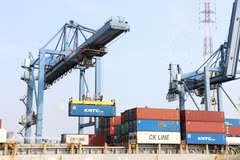
The industry and construction sector remains a key growth driver, expanding 9.81% in H1. (Photo: VietnamPlus)

Hanoi (VNA) – Vietnam’s economy needs to accelerate sharply and achieve an average growth rate of 11.7% in the second half of 2026 to reach the Government’s annual growth target of 10%, according to the National Statistics Office (NSO) under the Ministry of Finance.

Nguyen Thi Mai Hanh, head of the System of National Accounts Department under the NSO, has granted an interviewed to VietnamPlus, mentioning the challenges facing the economy for the remainder of the year.

She said that, based on the H1 GDP growth, the NSO updated the detailed growth scenario for 2026. The growth stood at 7.94% in Q1and 8.39% in Q2, bringing H1 expansion to 8.18%. To achieve the 10% full-year target, third-quarter growth will need to reach 11.16%, bringing nine-month growth to 9.19%, while fourth-quarter growth will have to reach 12.09%.

This will put considerable pressure on the economy, requiring an average pace of 11.7% in the final six months, Hanh noted.

However, the H1 growth rate of 8.18%, 0.55 percentage points higher than the 7.63% recorded in the same period last year, demonstrated a relatively steady recovery and provided a foundation for stronger growth in the months ahead.

On the supply side, all three major economic sectors contributed positively. The agro-forestry-fishery sector grew 3.87% in the first six months, continuing to provide a stable support pillar for the economy thanks to effective structural transformation, greater application of high technology and tighter management of production unit codes to meet export requirements.

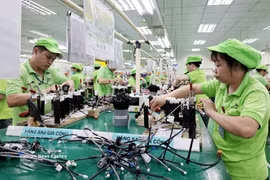
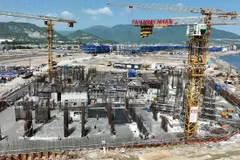
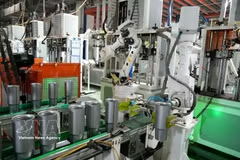
The industry and construction sector remained a key growth driver, expanding 9.81% in H1. Manufacturing and processing expanded 10.23% and contributed 2.73 percentage points to overall GDP growth, supported by the recovery of orders for electronic components and computers. Mineral mining maintained continuous growth since the third quarter of 2025, rising 7.59% in the second quarter of 2026. Meanwhile, construction accelerated 10.28%. Electricity production and distribution increased 12.19% in the second quarter, ensuring energy supply for production.

mai-hanh.jpg
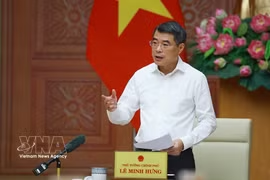
Nguyen Thi Mai Hanh, head of the System of National Accounts Department under the National Statistics Office, says that Vietnam’s economy needs to accelerate sharply and achieve an average growth rate of 11.7% in the second half of 2026 to reach the Government’s annual growth target of 10%. (Photo: VNA)

The service sector also posted solid growth of 8.09% in H1, with transport and warehousing rising 10.18% and wholesale – retail 9.67%. Meanwhile, public administration and social security activities contracted 9.71% in the second quarter amid cuts in recurrent public spending.

From the demand side, final consumption increased 8.15% in H1, with household consumption rising 9.48% as purchasing power improved and consumers increasingly shifted toward environmentally friendly products. Meanwhile, government consumption edged down 0.05%.

Gross capital formation increased 15.2%, while inventory accumulation surged 173.21% as businesses imported components for subsequent production.

Total foreign trade turnover rose 27.1%. Although exports of goods and services increased 21%, imports grew faster at 33.4%, largely reflecting demand for those serving artificial intelligence technology and data centres.

The trade deficit could put some pressure on the net contribution of the external sector to GDP growth, Hanh noted.

For the coming period, the official said the economy will face challenges from both external and domestic factors. Rising trade protectionism and weaker aggregate demand in major export markets could slow exports. Meawhile, higher logistics costs and elevated international interest rates could place additional pressure on the exchange rate and imported inflation.

Domestically, despite improvements in public investment disbursement, difficulties remain in site clearance and supplies of construction materials in some localities. Businesses, particularly small- and medium-sized enterprises, continue to face cash-flow constraints and limited access to credit. An uneven property-market recovery and pressure to manage prices of State-regulated goods and services are also major challenges.

To achieve the growth target, Hanh said Vietnam needs to combine traditional growth drivers with new ones. Public investment will remain a key driver, particularly major transport infrastructure projects such as the Lao Cai-Hanoi-Hai Phong railway and metro lines in Hanoi. The larger projects are expected to generate spillover effects for construction and services.

Domestic consumption should also be stimulated through year-end shopping programmes, and the recovery of manufacturing and processing should be sustained.

At the same time, attracting high-quality foreign direct investment into high-tech industries, semiconductors, artificial intelligence and data centres will create new production capacity in the medium and long term. Science – technology and the digital economy, including e-commerce and digital payments, can help reduce production costs and improve labour productivity.

Institutional reform and administrative procedure simplification will also be essential to removing bottlenecks related to land and investment, unlocking social resources and creating a stronger stepping stone for faster and more sustainable economic growth, she concluded./.
VNA

See more

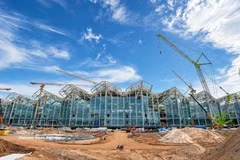
A new urban project is under construction in Nam Nha Trang ward, Khanh Hoa province. (Photo: VNA)

Vietnam posts GDP growth of 9.95% in Q3

In the first nine months, Vietnam's GDP was estimated to increase 9.01% from the same period last year. Agriculture, forestry and fisheries grew 4.02%, contributing 5.35% to overall gross value added growth; industry and construction rose 11.21%, contributing 49.62%; and services expanded 8.69%, contributing 45.03%.

Customers transact at the headquarters of Bao Viet Securities Company in Hanoi. (Photo: VNA)

Deputy Minister highlights measures to improve quality of Vietnam's stock market

The Ministry of Finance will expand the supply of capital and diversifying market products. It has submitted to the Government regulations on initial public offerings (IPOs) linked to listing, making it easier for businesses to list shares, while encouraging large companies with sound corporate governance to list on the stock market.

An automated robot operates on the production line at CAYI Technology Vietnam Co., Ltd. in Yen Phong II-C Industrial Park, Bac Ninh city. (Photo:VNA)

FDI disbursement hits five-year high in nine months

Vietnam attracted 50.36 billion USD in registered foreign direct investment (FDI) in the first nine months of 2026, up 76.4% year-on-year, while disbursed FDI reached 21.07 billion USD, the highest nine-month level in five years.

Transporting and loading commercial rice for export by the Southern Food Corporation. (Photo: VNA)

Vietnam posts trade surplus after nine months of deficit

Vietnam's total export and import turnover reached 117.69 billion USD in September, up 7.3% from the previous month and 42.4% year-on-year. Notably, the goods trade balance returned to a surplus of 1.27 billion USD after nine consecutive months of deficit.

Prime Minister Le Minh Hung concludes the Government’s regular September meeting and the Government’s online conference with localities. (Photo: VNA)

Prime Minister requests stronger efforts to tap growth potential

Prime Minister Le Minh Hung on October 3 called on ministries, sectors and localities to more effectively tap available growth potential, remove bottlenecks and maximise growth drivers in the final months of 2026, with the aim of achieving the year’s socio-economic development targets and creating momentum for 2027.

The groundbreaking ceremony for the Lien Ha Thai Industrial Park Project – South Zone (Green iP-3). (Photo: VNA)

Hung Yen expands industrial space to attract new investment

Local industrial parks and clusters will focus on attracting investment in light industry, multi-sector industries and environmentally friendly projects, as well as safe industrial products and services, cybersecurity products and services, and big data and cloud computing products and services, including AI applications based on national big data.

A consumer shops at a supermarket. (Photo: VNA)

Hanoi’s CPI rises 0.81% in September

Vegetable prices soared during the month, mainly due to prolonged heavy rains in Hanoi and northern provinces, which flooded and damaged vegetable farming areas and reduced supplies.

Tehmina Khan, the World Bank's Lead Economist for Vietnam, Cambodia and Laos, speaks at the event (Photo: VNA)

Vietnam develops capital market to support double-digit growth

At a special session on Vietnam themed “Investing in Vietnam – Rising to a new era,” Chairwoman of the State Securities Commission (SSC) Vu Thi Chan Phuong said Vietnam is entering a new development period with strong demand for capital for growth, infrastructure development, energy transition, high technology and new industries.

The Vietnam Sea Forum 2026 wraps up in Hanoi on October 2 (Photo: VNA)

Vietnam Maritime Forum 2026 concludes in Hanoi

The forum focused on mobilising resources and strengthening international connectivity for sustainable marine development, science, technology and marine governance in the new era, and enhancing international cooperation to protect the environment and promote the values of coastal communities.

Nguyen Duy Hung, Deputy Head of the Party Central Committee's Commission for Policy and Strategy, speaks at the event. (Photo: VNA)

2026 forum seeks to turn Vietnam into strong maritime nation

The Politburo’s Resolution 20-NQ/TW marks a strategic shift in how Vietnam views the sea, casting it as a pillar of national strength. Building a strong maritime nation is a long-term strategy tied to the country’s drive to rise and prosper.