Energy imports surge in first quarter of 2026

Data from Vietnam Customs shows that the country spent approximately 2.93 billion USD importing nearly 3.37 million tonnes of petroleum products in the first quarter of 2026, an increase of 77.8% in value and over 44% in volume compared to the same period last year.

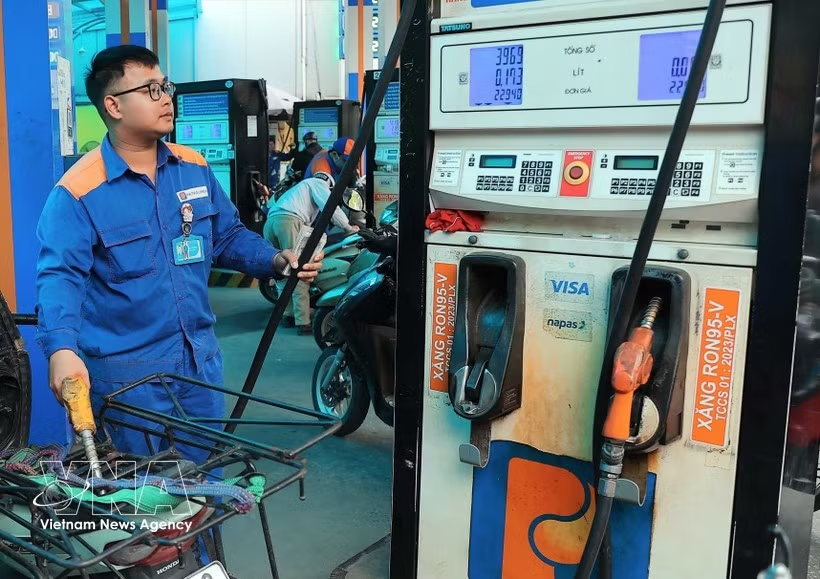
A Petrolimex worker refuels a motorbike. (Photo: VNA)

Hanoi (VNS/VNA) – Vietnam's energy imports increased sharply in the first three months of 2026, reflecting a rapid recovery in domestic consumption demand along with pressure to secure supply in the face of geopolitical instability and global energy price fluctuations.

Data from Vietnam Customs shows that the country spent approximately 2.93 billion USD importing nearly 3.37 million tonnes of petroleum products in the first quarter of 2026, an increase of 77.8% in value and over 44% in volume compared to the same period last year.

Aside from refined petroleum products, many other energy products also recorded a sharp increase, including coal imports, which rose by 76.4% to nearly 2.8 billion USD, and crude oil, which surged by 381% to 2.4 billion USD.

In the first half of April, the upward trend in imports continued, with import value of crude oil and petroleum products approaching 1.25 billion USD.

Experts attributed the sharp increase in energy imports this year to the rebound of domestic consumption in the wake of recovered industrial production. The steel, cement, chemical, thermal power and transportation sectors have all recorded higher fuel consumption compared to the same period last year.

Meanwhile, domestic energy supply has not met demand. Domestic crude oil production has been declining for many years due to major fields entering a natural depletion phase.

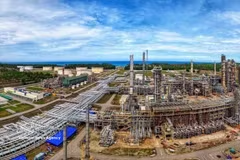
At the same time, the country's two main refineries, Dung Quat and Nghi Son, although operating, are still insufficient to fully meet market demand, especially during periods of significant global oil price fluctuations.

Another factor causing the surge in energy imports was the impact of global geopolitical instability. Conflict in the Middle East in the first quarter caused international oil prices to surge at times, leading to escalating energy import costs. According to the Ministry of Industry and Trade, key businesses have had to significantly increase imports since March to ensure domestic supply and maintain safe inventory levels.

Experts forecast that the trend of sharply increasing energy imports will continue for the next few years as the economy maintains its high growth target, while many gas-fired power, petrochemical and heavy industry projects are put into operation. This will put a significant pressure on trade balance as well as national energy security strategy./.

VNA

See more

A perspective of the Quang Ninh 1 Wind Power Plant project (Photo: Quang Ninh provincial Department of Construction)

Quang Ninh gives nod to first offshore wind power plant

The project is expected to have a designed capacity of 50 MW and will be implemented in nearshore waters of the Co To special zone. It will be the first offshore wind power project in the province, playing a pioneering role in tapping Quang Ninh’s abundant renewable energy potential.

Viettel launches the Unitel Logistics brand in Laos. (Photo: VNA)

Vietnamese firms expand global footprint

The Government recently approved the “Go Global” programme for 2026-2030, which identifies the private sector as a key driving force in Vietnam’s international expansion process. It aims to help Vietnamese private enterprises strengthen their overseas presence in a comprehensive, effective and sustainable manner through international investment, business activities and deeper integration into regional and global supply and value chains.

Vietnam and Cambodia are seeking to strengthen supply chain connectivity and promote sustainable border trade at a trade promotion conference in Vietnam's Mekong Delta province of Dong Thap on May 15. (Photo: https://thoibaonganhang.vn/)

Vietnam, Cambodia eye stronger border trade, supply chain connectivity

Vietnam–Cambodia trade ties have grown rapidly in recent years, becoming one of the major pillars of economic cooperation in the Mekong sub-region. The two countries share a 1,137-km border and an increasingly developed network of international and secondary border gates, facilitating cross-border trade, logistics and investment.

Illustrative image. (Photo: VNA)

Three proposals to connect overseas Vietnamese resources with private economy at home

There are currently many Vietnamese IT specialists working in technology corporations, banks, start-ups and innovation ecosystems across Canada. With appropriate mechanisms in place, this workforce could become a technology bridge, helping Vietnamese enterprises access management expertise, technical solutions, international standards and partnership networks in North America.

The Nguyen Van Linh–Nguyen Huu Tho intersection fully opens both underpasses to traffic, helping ease congestion in the area. (Photo: VNA)

Ho Chi Minh City pushes for full public investment disbursement

Ho Chi Minh City was allocated a record 147.599 trillion VND (5.6 billion USD) in public investment capital for 2026, up 22.6% from last year and accounting for nearly 14.6% of the nation’s total public investment budget. However, disbursement by the end of April remained below the national average.

Visitors explore Quang Tri province’s OCOP products (Photo: VNA)

Quang Tri links OCOP products with tourism to expand farm produce markets

The central province currently has 160 OCOP products developed by cooperatives, cooperative groups and businesses, including two five-star and 31 four-star products. These locally distinctive products are gradually becoming "ambassadors" showcasing Quang Tri’s culture and identity to domestic and international visitors.

Work starts on Hanoi’s Red River Landscape Boulevard Axis project on December 19, 2025. (Photo: VNA)

Hanoi approves nearly 28-bln-USD Red River landscape boulevard project

Covering more than 11,400 hectares and requiring an estimated 736.96 trillion VND (nearly 28 billion USD), the project is expected to reshape urban development along both banks of the Red River over the coming decades while improving transport connectivity and public spaces in the capital.