Hanoi (VNA) – A wave of increasingly stringent technical barriers and green standards imposed by major markets is forcing the export-import sector to undergo stronger transformation to sustain growth.
Although Vietnam’s exports recorded growth of 21% year-on-year in the first six months of 2026, reaching 266.52 billion USD, the country’s foreign trade outlook still faces challenges, with the trade deficit nearing 17 billion USD.
Higher barriers in export markets
In the first half of 2026, Vietnam’s goods exports reached 266.52 billion USD, up 21% year-on-year. However, behind this strong performance, the country’s foreign trade sector is facing increasingly complex geopolitical challenges and higher market standards.
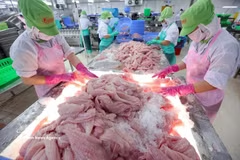
In the UAE, although logistics conditions via the Red Sea and the Strait of Hormuz have gradually improved, the market has introduced a series of new regulations. Vietnam Trade Counsellor in the UAE Truong Xuan Trung said the UAE is tightening Halal certification procedures, applying artificial intelligence (AI) in post-clearance inspections and requiring the use of biodegradable or recyclable packaging.
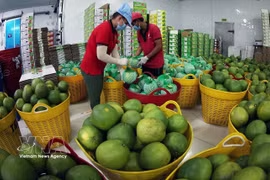
The EU market is also shifting from product quality control to comprehensive supply-chain management. Vietnam Trade Counsellor in the Netherlands Vo Thi Ngoc Diep said the EU continues to expand the Carbon Border Adjustment Mechanism (CBAM), promote anti-deforestation regulations, tighten controls on pesticide residues and place greater emphasis on ESG standards. These long-term requirements require businesses to invest systematically, from raw material areas to environmental responsibility.
Similarly, in the US, although growth remains in many sectors, Vietnam Trade Counsellor in the US Do Ngoc Hung warned that the second half of the year will face greater pressure from tariff policies and trade defence measures. The US is stepping up investigations into labour, environmental, intellectual property and origin-related issues, requiring businesses to prepare thorough traceability documentation to maintain market share.
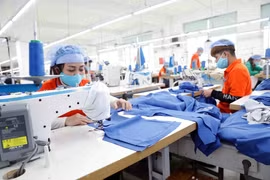
Sector-specific challenges are becoming increasingly evident. Truong Van Cam, General Secretary of the Vietnam Textile and Apparel Association (Vitas), said textile and garment exports grew by only 1.7% in the first half of the year. Despite maintaining a trade surplus of 9.2 billion USD thanks to a certain level of self-reliance, the sector is facing fierce competition from low-cost producers such as Bangladesh and Indonesia, as well as mounting pressure from green transition requirements.
Alongside market-standard challenges, Vietnam recorded a trade deficit of nearly 16.66 billion USD in the first half of the year.
Nguyen Anh Son, Director of the Foreign Trade Department under the Ministry of Industry and Trade, described the figure as a matter of concern, contrasting sharply with the trade surplus of 8 billion USD recorded in the same period of 2025.
Given that the trade surplus exceeded 20 billion USD in 2025, pressure on the second half of 2026 is extremely high. To achieve the goal of balancing the trade balance, the country would need to record an average monthly trade surplus of 3 billion USD, which is a major challenge for the entire system. From now until the end of the year, achieving both export growth and trade balance is a difficult task, Son said.
Enhancing trade promotion effectiveness
To contribute to the goal of double-digit economic growth, Vietnam’s import- export system, from management agencies to the business community, is shifting from a defensive approach to adaptation.
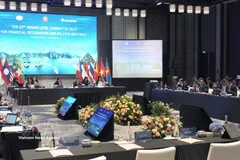
Representatives of Vietnam’s overseas trade offices said trade promotion activities need to closely align with the needs of each sector. The focus is shifting towards regular connections between buyers and suppliers, supporting partner verification, providing early warnings and making full use of digital platforms.
In response to emerging challenges, the Ministry of Industry and Trade will in the second half of the year promote exports, improve trade growth quality, diversify markets, utilise free trade agreements (FTAs), help businesses meet new standards and strengthen trade defence capacity.
Tran Thanh Hai, Deputy Director General of the Import-Export Department, said the ministry will continue to enhance the utilisation of FTAs, intensify trade promotion activities and leverage Vietnam’s overseas trade offices to connect domestic enterprises with international importers and distribution networks.
The ministry will also strengthen controls over trade fraud and origin fraud, enhance origin verification for major export groups, closely monitor imports of energy products and production inputs, and implement appropriate management measures to achieve more sustainable growth and a better-balanced trade position in the remaining months of the year./.