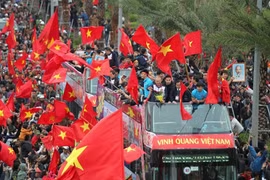
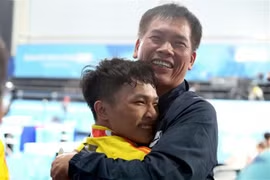
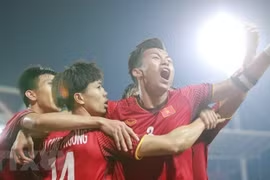
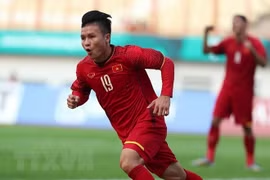
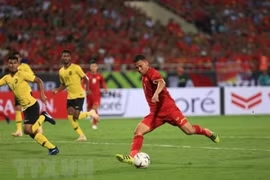
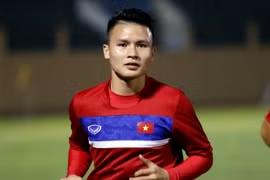
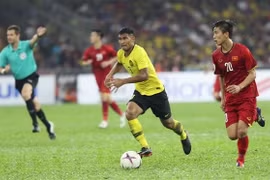
Vietnam's players celebrate with Prime Minister Nguyen Xuan Phuc (centre) after winning the AFF Suzuki Cup 2018 championship trophy (Source: VNA)
Hanoi (VNA) - Vietnamsigned over 50 cooperation agreements and treaties with countries, territories,and international sports organisations around the world during 1998 to 2016, a period thathas seen the most thriving development in the sporting sector, said vicehead of the Vietnam Sports Administration (VSA) Le Thi Hoang Yen.
In a recent interview granted to the Vietnam News Agency, Yen stressed that dueattention has been paid to promoting sports development and physical education, focusing on expanding internationalcooperation – one of the toppriorities towards realising goals set in the national strategy fordevelopment of physical education and sports to 2020, with a vision to 2030.
With its efforts to enhance internationalcooperation and integration in the period, Vietnam was credited by international sports organisationssuch as the Olympic Council of Asia (OCA) and the Southeast Asian GamesFederation for hosting regional and continental sports events, includingthe 22nd SoutheastAsian Games (SEA Games 22) in 2003, theAsian Indoor Games in 2009, the fifth Asian Beach Games in 2016, Yen noted.
Thesesports events offered a chance for Vietnam to promote its image to the world,leaving a deep impression of a peaceful, prosperous, and hospitable nation inthe hearts of international friends, contributing to further upgrading itsall-round relations with many countries worldwide, Yen said.
 The opening ceremony of the eight National Sports Festival takes place at My Dinh National Stadium in Hanoi on November 25 (Source: VNA)
Vietnam’sentrance into the international sports movement
In 1976,the Vietnam National Olympic Committee (NOC) wasestablished underDecision No.500 TGG by Prime Minister Pham Van Dong. It wasofficially recognised as a member of the International Olympic Committee (IOC)in 1980, enabling Vietnam to participate in Olympic Games,continental sports events, and those in Southeast Asia.
Previous story: [Vietnamese sport, more than games]
According to Yen, Vietnam’s participationin the Olympic Games in Moscow, Russia in 1980marked a milestone of international collaboration for the Vietnamese sportssector, paving the way for the country to take part in events of this kind foryears to come.In 1982, for the first time, the Vietnamese sports delegationparticipated in the Asian Games (ASIAD) in India. Vietnam has since sent its sportingdelegations to this continental sports event consistently every four years.
After the sixth National Congress of theCommunist Party of Vietnam in 1986, Vietnam’s sports sector began to promoteinternational exchange and competitions, striving to become an active member ofthe IOC.
 Vice head of the Vietnam Sports Administration (VSA) Le Thi Hoang Yen (third, right) at the ceremony to see off Vietnamese athletes to SEA Games 29 in Kuala Lumpur, Malaysia (Photo provided by VSA)
The country took part in the 15th Southeast Asian Games (SEA Games 15) inMalaysia in 1989.Since then, it has been participating in this regional sports arena every twoyears.
Besides regular attendance in regional, continental,and international sports events, Vietnam’s sports delegations have showed theirsignificant progress and achieved high rankings at those gatherings.
Yen said that the remarkableachievements of the sports sector are greatly attributable to the exchange of sportsdelegations, training of athletes and coaches, and application of science andtechnology in the field of sports and physical training.
International cooperation
Accordingto the VSA, Russia is one of the most important strategic partners of Vietnamin many aspects, with sports being the priority field. Vietnamreceived huge support from Russia for its presence at the Olympic Games inMoscow, Russia in 1980.
Thelatest memorandum of understanding (MoU) on sports cooperationbetween the two countries was inked by the Vietnamese Ministry ofCulture, Sports, and Tourism and the Russian Ministry of Sports in Sochi,Russia in 2014. It aims to consolidate mutualsupport in sports.
 The Vietnamese Ministry of Culture, Sports and Tourism and the Russian Ministry of Sports signed a Memorandum of Understanding on sports cooperation in Sochi, Russia in 2014 (Source: bvhttdl.gov.vn)
Accordingly,both sides have encouraged and supported their sports universities to enhance bondsin training and organising sports-related conferences. The two sides have also expandedthe exchange of coaches and athletes and fostered cooperation among their sportsleagues and associations.
TheRussian Government promised to provide scholarships for Vietnamese students topursue study in sports and physical training in Russia.
Besides Russia, Vietnam also had signed MoUs with other countries like the Czech Republic,Azerbaijan, Hungary, and Kazakhstan, mainly focusing on the exchange of sports delegations.
Yen said sports cooperation between Vietnam anddeveloped countries was also one of Vietnam’s prioritised policies to expandexchange and multifaceted relations with foreign nations.
The typical example of this was China. With its fastdevelopment in sports, China actively supported Vietnam in this field
According to the VSA, Vietnam has regularly sent itsathletes and coaches to sports training centres in China before importantsports events like ASIAD or SEA Games, while China has also sent experiencedcoaches in some sports to Vietnam to support Vietnamese coaches or directlytrain Vietnam athletes. These have provided Vietnamese athletes with goodopportunities to contact and exchange with professional and world-classathletes.
Some Chinese sports firms have sponsored Vietnameseteams in sports events, for example Li-Ning Co., providing clothes, shoes, andother training equipment.
A number of international organisations, such as the globalfootball governing body FIFA and UNESCO, whohave also supported the development of Vietnam’s sports sector.
Previous story: [Vietnam has high hopes for young athletes]
As a member of FIFA and the AsianFootball Confederation (AFC), Vietnam’s footballteams have received financial assistance and support for training and sports infrastructuredevelopment from the organisations. VFF President Le Hung Dung (R) and FIFA President Gianni Infantino (Source: VNA)
President of the world football governing body FIFA Gianni Infantinorecently pledged to support football development programmes in Vietnam.
FIFA will continue supporting the FIFA Goal Project in Vietnam by providingfinancial resources, the building of a laboratory and high-quality trainingroom, and referee training, he said.
It has selected Vietnam as one of the participants in a pilot project todevelop women’s football over a course of 18 months, sending its experts tohelp the Vietnam Football Federation build a long-term programme for theproject.
 Vietnamese female footballers (in red) in an intense soccer competition (Source: the-afc.com)
By a different way, UNESCO also shown its interest inVietnam’s sports development, especially its efforts to ensure a fair andequitable playing field and to protect young people involved in sports, fundingthe project called “Fund for the elimination of doping in sports” in 2013 and 2014in Vietnam.
The projects included seminars in Hanoi, Ho Chi Minh City,and Da Nang, to the benefit of hundreds of athletes and coaches in differentsports.
Many other developed countries like Japan, the UK, and especially the Republicof Korea (RoK) have also committed to supporting Vietnam in hosting big sports events.
Japan has promised to support Vietnam, not only inpreparing for its hosting of regional sports events, but also in sports developmentin general.
According to head of the athletics sectionof the VSA Duong Duc Thuy, young Vietnamesefootball players have been offered the chance to go to Japan for long-term training.
This is expected to help Vietnam realise its targetsat the Tokyo Olympics 2020, Thuy said.
Recently, the Vietnam Football Federation (VFF) and the Japan FootballAssociation (JFA) signed a MoU on bilateral football cooperation.
Accordingly,the VFF and JFA will support each other at regional and international footballforums, exchange human resources for football development, and provideassistance and training opportunities to their national football teams.
The twosides also pledged to share experience in football equipment management andfootball-related legal issues, while enabling each other’s trainers, referees,and officials to attend seminars held in each nation to exchange knowledge onfootball.
Early this year, the VFF signed a MoU with the RoK’s FootballAssociation (KFA) in Hanoi, which will foster bilateral cooperation in regionaland international football activities, exchange personnel, and send moreexperts to the two countries’ football events.
 At the signing ceremony between the Vietnam Football Federation (VFF) and the Republic of Korea (RoK)’s Football Association (KFA) (Source: vff.org.vn)
The two sides agreed to send experienced trainers to support thenational football academies, share experience in football management andregulations, as well as knowledge on sports medicine and rehabilitation.
VFF President Le Hung Dung stressed the great contributions made by RoKcoach Park Hang-seo – head coach of Vietnam’s national men’s footballteam – and his assistants from the RoK towards the team’s silver medal at theAsian Football Confederation (AFC) U23 Championship in January this year.
KFA President Chung Mong-gyu said the deal will help boost Vietnam-RoKcooperation in personnel, young player training, and other issues. He vowedthat his association will provide support for Vietnam’s football development.
 A Vietnamese football fan raises Vietnamese and RoK flags at the second-leg final match of the AFF Suzuki Cup 2018 on December 15, 2018 (Source: VNA)
Recently, RoK’s new visa policy forVietnamese citizens is hoped to promote all-round ties between the twocountries, including sports exchange.
RoK Ambassador to Vietnam Kim Do-hyon said that seeing Vietnamese people’slove for coach Park Hang-seo inspired the RoK Government to make its visaallowance decision.
 Head coach Park Hang-seo (C) in the flag-saluting ceremony before the first-leg of the AFF Suzuki Cup 2018 in Kuala Lumpur, Malaysia on December 11, 2018 (Source: VNA)
The recentprominent achievements of Vietnam’s women’s and men’s football teams atregional events, and their rising positionsin FIFA rankings, have shown theeffectiveness of international partnerships in sports.
Vice head of the VSA Le Thi Hoang Yen stressed that the strong internationalcooperation contributes to not only improving the professionalism andperformance of athletes, but also bettering the organisation and managementcapacity of managers, coaches, referees, and health workers in the sector.
It helpsVietnam map out specific policies for seeking out and training promising athletes,which requires a long-term, systematic, and scientific process, she noted.
Partnershipformation with countries around the world, especially those with strong sports development,brings many benefits, contributing to attracting many international organisationsand businesses to invest in sport, promoting the application of technology intraining and the building of sports infrastructure facilities, she added.
 At a ceremony to commend Vietnamese rowing athletes after ASIAD 2018 in Indonesia (Photo provided by VSA)
However,experts have said that the limited foreign language proficiency of athletes andmanagement staff makes it difficult for them to acquire knowledge andexperience when attending training courses in foreign countries or incommunicating with foreign experts and athletes.
They also mentioned financial difficultiesin the international cooperation work, saying that this has a great impact onexchange and cooperation with developed countries such as the US and Europeancountries due to the high cost of training activities.
Accordingto the International Cooperation Department under the Ministry of Culture,Sports, and Tourism, the agency has built and submitted a strategy forinternational integration and cooperation until 2025 to leaders of the VSA.
Thestrategy focuses on training human resources with good foreign languageproficiency; increasing support for bringing Vietnamese athletes and coaches tointernational sports events; promoting the organisation of international sportsevents in Vietnam; looking for more financial assistance from internationalorganisations for sports development; and expanding collaboration in the applicationof science and technology in this field.
Vietnamprepares for international sports events
Accordingto vice head of the VSA Tran Duc Phan, Vietnam’s sports sector is activelypreparing for three upcoming regional and international sports events, whichare the SEA Games 30 in the Philippines in November 2019, the 2020 Summer Olympics in Japan, and ASIAD 2022in China
 Vice head of the VSA Tran Duc Phan (C) at a reception for representatives from the General Administration of Sports of China in 2016 (Source: tdtt.gov.vn)
The SEAGames is viewed as the most important arena for Vietnam at the moment becauseof its suitability for most of the country’s athletes at present, as well as providingmotivation and preparation for the bigger arenas of the upcoming ASIAD and Olympics.
Notably,as the host of SEA Games 31 in 2021, Vietnam isexpected to set itself ambitious targets, he noted. –VNA
VNA