Mexico City (VNA) - Major Mexican newspapers on April 29 (local time) ran articles highlighting Vietnam’s historic victory in the resistance war for independence and national reunification 50 years ago, and the country’s remarkable transformation into an emerging global player of growing influence.
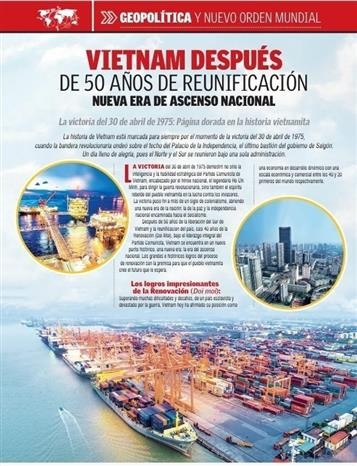
Voces Del Periodista, a key academic platform and the voice of Mexico’s journalism community, headlined its article titled Vietnam after 50 years of reunification: the nation’s era of ascent.
It underscored how the revolutionary flag flying over the Independence Palace marked not only the end of over a century of warfare, but also ushered in a new era of peace, unity and the path toward socialism for Vietnam.
The outlet asserted that the victory of April 30, 1975, was not solely for the Vietnamese people but has become a radiant symbol of resilience, indomitable will, and desire for freedom. It holds special significance for the global progressive movement and peace-loving nations around the world.
Highlighting Vietnam’s development journey, Voces Del Periodista, representing a network of 45,000 professional journalists, noted that five decades since reunification and nearly 40 years into the Doi Moi (Renewal) reforms, Vietnam has entered a new stage of progress – an era defined by national aspiration and global ambition.
From a war-ravaged, impoverished country, Vietnam has emerged as one of the region’s most dynamic developing economies. Its GDP surpassed 476 billion USD in 2024, ranking 33rd globally and placing Vietnam among the world’s top 20 countries in trade and foreign investment attraction.
Beyond economic growth, Vietnam has asserted itself as a responsible, peace-loving nation committed to global integration. Today, it maintains diplomatic relations with 194 countries and strategic or comprehensive partnerships with 30, including all major powers and the five permanent members of the UN Security Council.
Vietnam is increasingly recognised as a pillar of regional stability and sustainable development. Its contributions to UN peacekeeping, and its proactive stances on climate change, food security, and global health have been widely praised. The country is seen as a leader in advancing the UN’s Sustainable Development Goals and has pledged net-zero carbon emissions by 2050, it said.
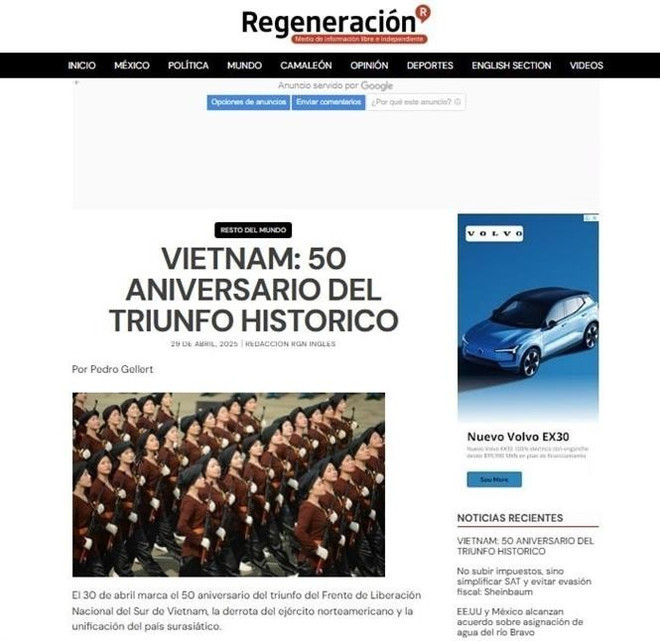
Meanwhile, Regeneración, the official media outlet of the ruling National Regeneration Movement (Morena), described April 30 as a sacred day of peace, unity, and national pride for the Vietnamese people.
In a feature titled Vietnam: 50 years since the historic victory, the publication stressed that for millions who joined the global anti-war movement, this was not merely a military win, but “the triumph of all triumphs,” a symbol of justice that inspired an entire generation fighting for self-determination across five continents.
The author, veteran journalist Pedro Gellert, wrote that Vietnam’s victory proved two key truths. First, that imperialism can be defeated; and second, that international solidarity can become a decisive force in altering the fate of an entire nation. He recalled that the Communist Party of Vietnam and President Ho Chi Minh always viewed global unity as a spiritual cornerstone of the revolution.
Assessing Vietnam’s Doi Moi cause, launched at the 6th National Party Congress in 1986, Gellert described it as a historical turning point. The shift reflected a deep understanding - there is no one-size-fits-all model for development across all nations and all times.
Specifically, Vietnam's Doi Moi cause opened a path for harmonising market dynamics with socialist orientation, empowering the private sector while preserving the state’s guiding role, with the aim of building a fair, civilised, and compassionate society.
Looking on the path ahead, the journalist affirmed that today’s Vietnam is a nation of peace, stability, and growth, where a proud past serves as the foundation for a promising future. With a vision to become a high-income, developed nation by 2045, Vietnam is writing its next glorious chapter with intelligence, solidarity, and patriotic resolve, he concluded./.