Ministry of Health asks for faster identification of martyrs’ remains

The Ministry of Health has called for accelerated efforts to identify the remains of fallen soldiers within the 500-day campaign, stressing that speed must go hand in hand with absolute accuracy so that martyrs can return to their families and hometowns.

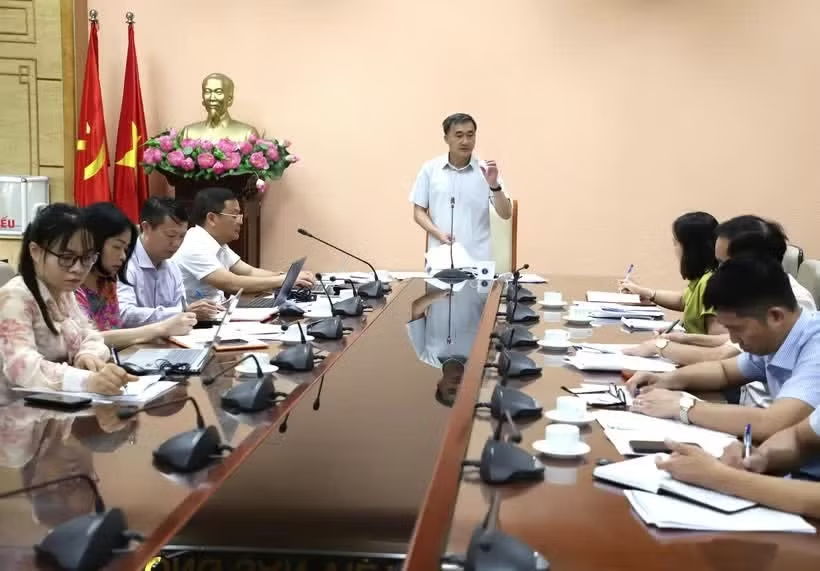
Deputy Minister of Health Tran Van Thuan chairs a meeting to review and expedite the implementation of tasks under the campaign. (Photo: VietnamPlus)

Hanoi (VNA) – The Ministry of Health has called for accelerated efforts to identify the remains of fallen soldiers within the 500-day campaign, stressing that speed must go hand in hand with absolute accuracy so that martyrs can return to their families and hometowns.

Deputy Minister of Health Tran Van Thuan, who is Chairman of the National Medical Council, made the request while chairing a hybrid meeting on June 5 to review progress in the implementation of the 500-day campaign to step up the search, collection and identification of martyrs’ remains. The meeting also assessed the work during the first six months of 2026 and set priorities for the remaining months of the year.

The campaign focuses on three key areas - reviewing and standardising data; stepping up the search and collection of remains at home and abroad; and expanding DNA testing while connecting genetic databases of martyrs’ remains with their families.

During the first half of 2026, the Ministry of Health carried out many important tasks. It issued a plan for collecting samples for DNA testing and urged localities and relevant agencies to coordinate implementation.

Four units nationwide are currently capable of conducting DNA testing: the National Institute of Forensic Medicine (NIFM) and forensic centres in Hanoi, Ho Chi Minh City and Thai Nguyen, with a combined estimated capacity of about 6,700 samples annually.

The NIFM serves as the focal point, having prepared personnel, equipment and implementation plans to conduct tests upon requests from competent authorities. It has also provided professional training for personnel involved in the work.

Participants at the meeting stressed that identifying remains is not merely a technical task, but also a profound political, social and humanitarian responsibility, helping return fallen heroes to their names, hometowns and families.

However, the implementation still faces shortages of specialised equipment, limited specialised personnel, delays in funding allocation and the need to refine technical procedures to ensure highly accurate testing.

In the second half of 2026, the Ministry of Health will continue the campaign, strengthen DNA testing capacity, promote the application of science and technology, and improve professional procedures. It will also closely coordinate with relevant ministries, sectors and localities to ensure the campaign’s progress and quality.

Thuan said the campaign had entered an accelerating phase, requiring concerted efforts nationwide. He described the work as a sacred mission and a practical expression of the tradition: "When drinking water, remember the source,” to remember one’s homeland and upbringing.

He stressed that identifying martyrs’ remains is a specialised task requiring stringent professional standards, quality control and absolute accuracy.

“Maximum efforts must be made to identify the fallen heroes and return them to their hometowns as quickly as possible, with absolute accuracy,” he said.

The Deputy Minister ordered relevant units to closely review progress, identify and solve problems, and coordinate with the Ministry of National Defence to accelerate the campaign./.
VNA

See more

Cuban journalist Luis Manuel Arce Isaac, author of the article published in Mexico’s Voces del Periodista magazine. (Photo: Screenshot/VNA)

Mexican journalist praises Vietnam’s profound transformation

According to the article, Vietnam’s progress over the past decades has turned President Ho Chi Minh’s aspiration for a country that would be more dignified and more beautiful into reality in ways that have far exceeded what was initially envisioned.

The Liaison Board of the Vietnamese Community in Singapore organises the annual Mid-Autumn Festival to strengthen community bonds and spread Vietnamese language and culture. (Photo: VNA)

Continued efforts made to nurture love for homeland through mother tongue

From language classrooms and community activities to digital platforms, Vietnamese is being preserved through increasingly diverse approaches. More than a means of communication, the mother tongue carries memories, culture and affection for the homeland. Ensuring that Vietnamese remains naturally present in the daily lives of overseas Vietnamese is therefore an important way to nurture their lasting bond with the Fatherland.

Deputy General Director of the Vietnam News Agency Doan Thi Tuyet Nhung (fifth, right) and representatives of regional news agencies and media organisations attend the launch of the Asia-Pacific Media Partnership Organising Committee at the Asia-Pacific Media Forum. (Photo: VNA)

VNA attends Asia-Pacific Media Forum in Shenzhen

Participants in the forum highlighted the need to increase coverage of the region's rapid opening-up and integration, provide comprehensive information on the progress and achievements of cooperation among economies across various fields, and help create a favourable environment for regional development.

Ngo Phuong Ly (right), the spouse of General Secretary of the Communist Party of Vietnam Central Committee and President To Lam, and Kyu Kyu Hla, the spouse of Myanmar President Min Aung Hlaing, visit Van Phuc silk village on September 5. (Photo: VNA)

First ladies of Vietnam, Myanmar visit Van Phuc silk village

Ngo Phuong Ly, the spouse of General Secretary of the Communist Party of Vietnam Central Committee and President To Lam, said the two countries share similarities in silk weaving and can enrich their cultural heritage through exchanges and experience sharing.

Prime Minister Le Minh Hung join students and teachers of the Muong Khuong Inter-level Primary and Secondary Boarding School, Lao Cai province, in the opening ceremony of the 2026–2027 academic year on September 5. (Photo: VNA)

PM urges substantive education reform in 2026–2027 school year

PM Le Minh Hung called on the education sector to continue making strong changes in management mindset and teaching methods, putting learners at the centre, and viewing schools as the foundation, teachers as the driving force, families as a source of support and society as a resource accompanying education development.

General Secretary of the Communist Party of Vietnam Central Committee and President To Lam (Photo: VNA)

Top leader extends message to education sector on new school year

Party General Secretary and President To Lam expressed confidence that with the nation’s traditional fondness for learning, the dedication of teachers and the aspirations of the younger generation, the 2026–2027 academic year will open a new chapter of progress for the country’s education sector.

Students attend the opening ceremony for the 2026–2027 academic year at the primary school campus of the Gia Quat Primary and Secondary School in Hanoi on September 5, 2026. (Photo: VNA)

Students across Vietnam begin 2026–2027 academic year

This milestone school year marks a pivotal transition from laying the groundwork for reform to delivering substantive changes as the country pushes ahead with implementing Politburo Resolution No. 71-NQ/TW on breakthroughs in education and training development.

Team K91 members depart to carry out their mission. (Photo: VNA)

Search efforts continue for Vietnamese fallen soldiers in Cambodia

During the 2026-2027 dry season, Teams K70, K71, K72 and K73 will continue their search and repatriation mission, striving to fulfil the target based on 185 pieces of information concerning 761 graves. Each team is expected to collect at least 100 sets of remains during each deployment.

Mai Nguyen Tuyet Hoa, First Secretary in charge of education affairs at the Vietnamese Embassy in Russia speaks at the closing ceremony (Phôt: VNA)

AI application boosts Russian language training in Vietnam

The programme introduced updated methods for teaching Russian as a foreign language while focusing on the application of digital technology and AI in lesson design to enhance the professional capacity and adaptability of Russian-language teachers amid changes in modern education.

A resident accesses the iHanoi app. (Photo: VNA)

Hanoi launches real-time flood and rainfall map on iHanoi

The map uses a standard colour scale to provide a visual assessment, enabling residents to gauge the level of danger within seconds. The application is expected to strengthen the capital’s disaster response capacity while helping residents plan safer routes during the rainy and stormy season.