Vietnam remains market of interest for Australian education providers

For Vietnamese students, Australia's new migration rules create greater pressure to prepare more thoroughly and develop clearer study plans, while also opening opportunities for those with relevant professional skills, clear career goals and the ability to adapt to Australia’s rapidly evolving migration policies.

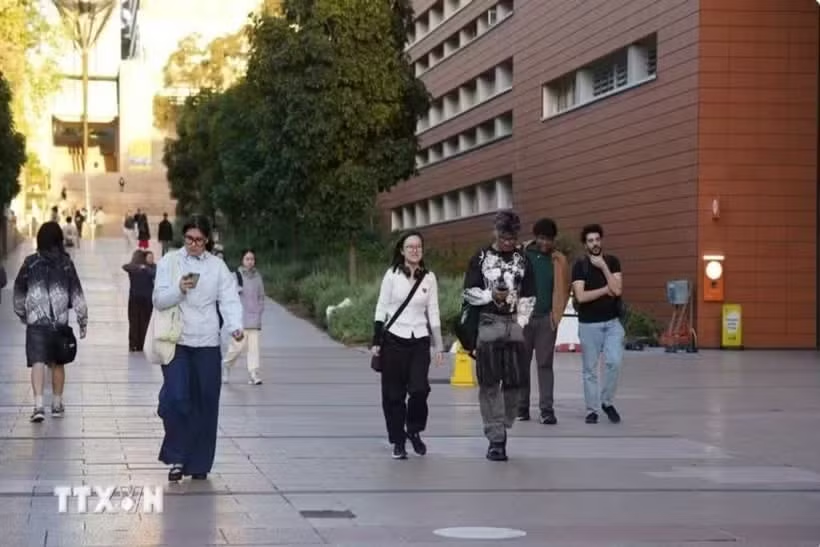
Students at the University of New South Wales in Sydney. (Photo: VNA)

Sydney (VNA) – Vietnam remains a market of interest for Australian education providers, according to Jane Tran, Board Director of the Vietnam-Australia Scholars & Experts Association (VASEA), following Australia’s announcement of the next phase of reforms to its migration system.

On September 17, Australian Home Affairs Minister Tony Burke announced new measures that will limit accompanying family members for most student and post-study work visa holders, a crackdown on “visa hopping” by tightening rules on switching courses and visa types to extend stays, apply “No Further Stay” conditions to visitor visas, and prioritise skilled worker visa applications in industries with labour shortages.

Speaking to Vietnam News Agency correspondents in Sydney, Brian Quang Dinh, Director of Edunetwork Australia, said the key message from the latest changes was that Australia still needs international students and skilled workers, but wanted to ensure temporary visas are used for their intended purposes.

He said Burke’s announcement specifies that ASEAN countries and Pacific island nations, along with certain groups of students such as PhD candidates, would be exempt from some of the new restrictions. Vietnamese passport holders are currently among those allowed to continue bringing family members, subject to applicable conditions.

Based on the figures she has been monitoring, Jane Tran said the student visa grant rate for Vietnamese applicants remains relatively positive compared with the overall picture, while Australian universities value the study attitudes and quality of many Vietnamese students.

Drawing on her direct experience supporting Vietnamese students, she noted that the ability to bring family members along was one of the factors that made Australia an attractive destination for many postgraduate students.

Both experts said the new adjustments should not be interpreted as meaning that Australia is no longer welcoming international students.

Another notable feature of the latest reforms is that while Australia is tightening some temporary visa streams, it is giving greater priority to skilled workers in sectors facing labour shortages.

According to the government announcement, sectors prioritised for skilled visa processing include healthcare, construction, education, law enforcement, defence, resources, agriculture, aquaculture and fisheries. Certain occupations in construction, healthcare and teaching have been given the highest priority.

Jane Tran mentioned that this approach could open up more opportunities for Vietnamese students and professionals with the right qualifications. It could benefit not only recent graduates but also former Vietnamese students who studied in Australia and have since returned to Vietnam, as long as they meet the requirements for the relevant skilled visa streams.

Overall, the views indicate that the September 17 changes do not alter the reality that Australia continues to need international students and skilled migrant workers. The major change lies in how the country selects and manages migration flows: limiting pathways primarily aimed at extending stays, while directing international students and workers more towards skills that the economy genuinely needs.

For Vietnamese students, this creates greater pressure to prepare more thoroughly and develop clearer study plans, while also opening opportunities for those with relevant professional skills, clear career goals and the ability to adapt to Australia’s rapidly evolving migration policies. /.

VNA

See more

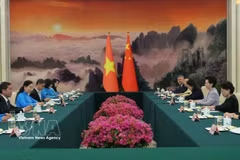
The meeting between representatives of the Vietnam Women's Union and the All-China Women's Federation in Beijing on September 17 (Photo: VNA)

Vietnamese, Chinese women step up exchanges, cooperation

Regarding directions for future collaboration, the Vietnamese official proposed that the two organisations continue to innovate and diversify forms of cooperation, strengthen connections between local-level chapters – particularly in border provinces, and expand exchanges among young women, female intellectuals, and businesswomen.

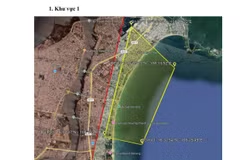
An airspace zone for organisations, associations and clubs operating unmanned aircraft in Da Nang City. (Photo published by VNA)

Da Nang establishes four airspace zones for unmanned aircraft

The central city of Da Nang has established four airspace zones for organisations, associations and clubs operating unmanned aircraft. The zones have been defined using the WGS-84 coordinate system. All flights involving unmanned aircraft and other aerial vehicles, including test flights for the development of the low-altitude space economy, must be licensed by competent authorities.

Counterfeit books are no longer simply low-quality copies that can easily be identified by the naked eye (Illustrative image. Source: VNA)

Publishing copyright caught in crossfire of piracy, AI

Publishing copyright is entering an entirely new phase. As AI becomes increasingly capable of generating text, summarising books, mimicking writing styles and producing content at enormous speed, ensuring copyright protection is becoming more difficult.

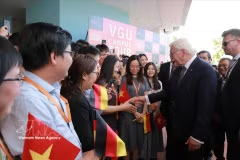
On January 24, 2024, President of the Federal Republic of Germany Frank-Walter Steinmeier visits Vietnam-Germany University in Binh Duong province. (Photo: VNA)

Vietnam, Germany promote digital workforce training

A notable feature of the programme is that, alongside information technology skills, participants were trained in managing the digital transformation process, developing digital learning environments, and engaging teaching and administrative staff in the process.

A resident of Tran Phan commune, Ca Mau province, is guided in carrying out administrative procedures. (Photo: VNA)

Ca Mau step ups 100-day digital transformation campaign

Ca Mau province is stepping up a 100-day campaign to remove bottlenecks in digital transformation and improve public services, with local authorities focusing on online administrative procedures, digital data and digital infrastructure.

Director General of the Lao News Agency (KPL) Vannasin Simmavong in an interview with the Vietnam News Agency. (Photo: VNA)

Vietnam News Agency accompanies national development journey: KPL leader

Director General of the Lao News Agency (KPL) Vannasin Simmavong said over its 81-year history, VNA has not only fulfilled its role as a national news agency by providing timely and reliable information, but also accompanied the Party, State and people through important periods of the country’s revolutionary history.

Joint exercise to arrest armed drug trafficking and transportation offenders crossing the Vietnam–Laos border. (Photo: VNA)

Vietnam, Laos coordinate efforts to combat drug crime

In recent years, the Vietnam Border Guard and Laos's law enforcement forces have effectively maintained mechanisms for information exchange and coordinated patrols, inspections and efforts to combat various types of crime, helping maintain stability along the border and creating favourable conditions for people on both sides to develop their socio-economic activities.

A view of a workshop on advancing gender equality in the public sector amid the restructuring and streamlining of the political system in Hanoi on September 15 (Photo: VNA)

Vietnam seeks to advance gender equality amid public-sector reform

Organisational restructuring presents an opportunity to review personnel standards, procedures and working methods. If gender considerations are integrated into the process, it can help remove long-standing barriers, make better use of female talent and build a fairer and more accountable working environment.