Offshore wind service vessel highlights Vietnam’s shipbuilding capabilities

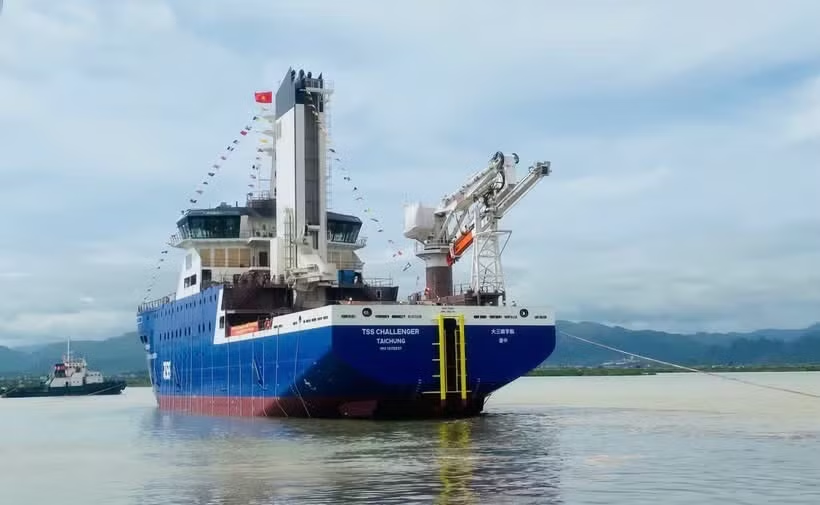
On July 28, Ha Long Shipbuilding Company Limited, a member of the Vietnam Shipbuilding Industry Corporation (SBIC), successfully launched CSOV 9020, an offshore wind operations and maintenance service vessel.

CSOV 9020, an offshore wind operations and maintenance service vessel built by Ha Long Shipbuilding Company Limited (Photo: VietnamPlus)

Hanoi (VNA) – The successful construction and launch of a modern offshore wind service vessel has demonstrated the growing capabilities of Vietnam’s shipbuilding industry and its ability to meet international standards in the global maritime sector.

On July 28, Ha Long Shipbuilding Company Limited, a member of the Vietnam Shipbuilding Industry Corporation (SBIC), successfully launched CSOV 9020, an offshore wind operations and maintenance service vessel.

Speaking at the launch ceremony, General Director of Ha Long Shipbuilding Nguyen Van Manh said the successful launch of CSOV 9020, the seventh among the 14 ordered units, once again affirms the skills and determination of the company’s shipbuilders.

Behind the moment the vessel slid down the slipway into the water is a journey marked by numerous challenges surmounted and efforts made by Ha Long’s staff, he said.

Amid SBIC’s ongoing restructuring process under the Government’s Resolution No. 220/NQ-CP, Manh stressed that every contract completed on schedule and every product meeting international standards not only brings economic value but also serves as clear evidence of Vietnam’s internal capacity, resilience and determination to maintain its shipbuilding brand.

The successful construction of CSOV 9020 shows that Ha Long Shipbuilding’s engineers and workers have mastered advanced shipbuilding techniques and can meet strict requirements set by leading international shipowners.

From quality management, steel structure fabrication and equipment installation to system integration and technical control, all stages were carried out in line with international procedures under close supervision from international classification organisations, Manh said.
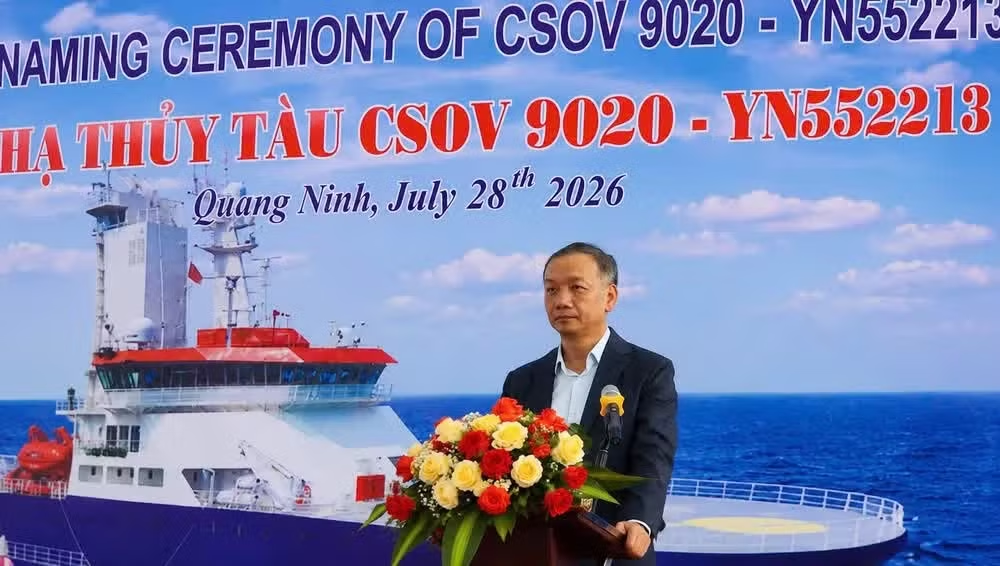
dat-pho-tgd-sbic.jpg
The vessel’s successful completion marks another step in affirming the position of Vietnam’s shipbuilding industry on the global maritime map, according to SBIC Deputy General Director Nguyen Tien Dat (Photo: VietnamPlus)

SBIC Deputy General Director Nguyen Tien Dat described the launch as one of the most important milestones in the construction of a new vessel, saying the achievement came as a result of hundreds of thousands of hours of dedicated labour and close coordination among the shipowner, Damen Group, international classification organisations, contractors, suppliers and Ha Long Shipbuilding’s managers, engineers and workers.

CSOV 9020 is a modern specialised service vessel designed for the construction, operation and maintenance of offshore wind farms – a rapidly growing sector worldwide that requires advanced capabilities in ship design and manufacturing.

The vessel’s successful completion marks another step in affirming the position of Vietnam’s shipbuilding industry on the global maritime map, Dat said.

As SBIC is accelerating its restructuring process under the Government’s Resolution No. 220/NQ-CP, the continuous completion of high-tech products that meet stringent requirements from international shipowners shows that Vietnam’s shipbuilding industry has maintained and developed its core capabilities, he added.

Dat requested Ha Long Shipbuilding Company to continue maximising resources to complete the remaining work, closely coordinate with the shipowner, Damen Group and classification organisations during sea trials and handover, ensuring the vessel is delivered on schedule with absolute compliance with committed quality and technical requirements.

CSOV 9020 is 88 metres long, 19.7 metres wide and has a moulded depth of 8.2 metres and a design draught of 5.4 metres. The vessel has a maximum speed of 12.5 nautical miles per hour and a gross tonnage of about 6,700 tonnes. It is equipped with 90 cabins capable of accommodating up to 120 people.

Notably, the ship s equipped with a propulsion system comprising four 360-degree rotatable electric-hydraulic thrusters, along with a specialised tower system serving offshore wind farm construction.

These systems require extremely high levels of precision, system integration capability, stability and safety throughout the manufacturing, installation and operation processes./.
See more

Ben Thanh Market in Ho Chi Minh City attracts a large numbers of domestic and international visitor.( Photo: VNA)

Vietnam targets 50 million international visitors by 2030

The Ministry of Culture, Sports and Tourism has outlined three scenarios for 2027–2030. Under the high-growth scenario, international arrivals would rise 15–18 percent annually to reach 45–50 million, while domestic tourism would reach around 160 million trips. Total tourism revenue is projected at 80–90 billion USD.

Factories and production facilities in the Chu Lai Open Economic Zone, Da Nang city, are equipped with modern production lines. (Photo: VNA)

Ready-built factories gain from new manufacturing FDI wave

Ready-built factories attracted 73% of new manufacturing FDI in northern Vietnam over the past two quarters, as foreign investment continued to surge at the region's industrial hubs during the first eight months of 2026. The trend points to growing demand for premises that can be put into operation quickly.

Vietnamese durian industry pivots from volume to value

Vietnamese durian industry pivots from volume to value

Durian has morphed from a high-value crop into a strategic Vietnamese export. But as output climbs and importing markets tighten rules on quality, food safety and traceability, the industry must pivot from volume growth to sustainable value chains, better quality and diversified markets.

A display area for Mid-Autumn Festival cakes at a supermarket (Photo: VNA)

Mid-Autumn Festival cake market heats up at affordable end

Industry insiders say competition is no longer just about the cake itself. Product quality, packaging, brand reputation, delivery services and personalisation are increasingly shaping consumer choices in a market crowded with both domestic and foreign players.

Minister of Foreign Affairs Le Hoai Trung (Photo published by VNA)

Vietnam, India set 25 billion USD trade goal

Vietnam and India agreed to make better use of complementary strengths, ease market access difficulties and facilitate business activities toward achieving the 25 billion USD bilateral trade target.

Delegates at the meeting between Vietnamese businesses operating in Cambodia and the Council for the Development of Cambodia (CDC) on September 14. (Photo: VNA)

Vietnamese businesses seek to expand investment in Cambodia

Vietnam currently has 223 investment projects in Cambodia with total registered capital of nearly 3.4 billion USD. Vietnamese companies operate in agriculture, particularly large-scale farming, finance and banking, telecommunications, aviation, processing, trade and services.

Children visit President Ho Chi Minh's hometown and learn about his childhood. (Photo: VNA)

Vietnam's tourism sector faces labour shortage

A 2026 survey by Hoteljob.vn found that nearly 90% of tourism businesses planned to recruit. In Ho Chi Minh City alone, 89.7% of businesses were hiring, while 71.8% said recruitment was difficult or very difficult. The biggest shortages were among frontline workers, particularly in housekeeping, engineering, food service, front-office operations, and kitchens.

Octopus processing for export at Huy Nam Company in An Giang province. (Photo: VNA)

New opportunities for Vietnam’s seafood exports

The Vietnam-EFTA Free Trade Agreement brings together two groups of highly complementary economies. EFTA members Switzerland, Norway, Iceland and Liechtenstein have strengths in technology, innovation, finance, clean energy and sustainable development, while Vietnam is one of Asia’s most dynamic economies and is emerging as a major regional manufacturing, trade and investment hub.

The saponin content of Lai Chau ginseng can reach as high as 23.85% in its natural state, a remarkably high level compared to many other ginseng species. (Photo: baolaichau.vn)

Lai Chau ginseng development gains momentum

Blessed with rare and distinctive ecological values, the northern mountainous province of Lai Chau is stepping up efforts to conserve and develop its native ginseng, with the medicinal plant expected to play a growing role in the forest-based economy and local livelihoods.