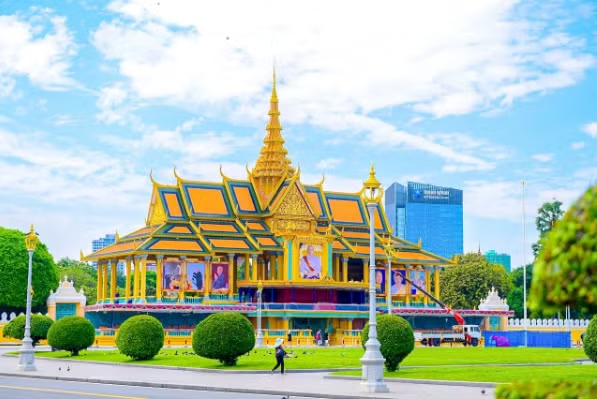
Phnom Penh aims to become leading regional urban tourism destination

Phnom Penh is not only Cambodia’s political, administrative, economic, commercial and cultural centre, but also an important international tourism gateway and a modern, vibrant and cosmopolitan destination connecting visitors with attractions across the country.

The Royal Palace of Cambodia in Phnom Penh (Photo: visittocambodia.com)

Hanoi (VNA) — Cambodia’s Ministry of Tourism, in collaboration with the Phnom Penh Capital Administration, has launched the Phnom Penh Tourism Development Plan 2026–2030, aiming to position the capital as one of the region’s prominent urban tourism destinations.

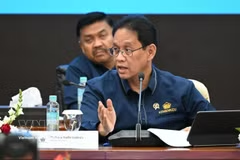
The plan was launched at a ceremony in Phnom Penh on August 17, chaired by Tourism Minister Huot Hak and Phnom Penh Governor Khuong Sreng.

The ministry said the plan is not only a strategic document but also a practical roadmap for mobilising stakeholders to jointly develop Phnom Penh’s tourism sector and enhance the capital’s competitiveness, according to the Cambodian news agency Agence Kampuchea Presse (AKP).

The plan focuses on building Phnom Penh as a “Clean, Smart and Green” destination, while improving tourism quality and attractiveness.

Speaking at the event, Huot Hak praised the active support of relevant stakeholders for the Visit Cambodia Green Season campaign, which began in 2025 and will continue throughout 2026.

He said Phnom Penh is not only Cambodia’s political, administrative, economic, commercial and cultural centre, but also an important international tourism gateway and a modern, vibrant and cosmopolitan destination connecting visitors with attractions across the country.

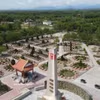
The capital has a distinctive identity, rich cultural heritage and diverse tourism potential. Among its emerging attractions is the Chaktomuk Pedestrian Walkway, one of Phnom Penh’s newest tourism products, which is gaining popularity among visitors.

Huot Hak stressed that amid growing tourism competition in the region and rapidly changing traveller preferences, Cambodia cannot rely solely on its existing tourism resources. The country needs to develop new tourism products, improve service quality, enhance destination appeal, and strengthen security and safety for visitors, he said.

These efforts are expected to help Phnom Penh better meet the expectations of a new generation of travellers while keeping pace with the changing competitive landscape among major tourism cities in the region and worldwide./.

VNA

See more

The forum on ASEAN's role in the Indo-Pacific region and prospects for cooperation with Argentina takes place on September 10 (Photo: VNA)

ASEAN highlights its central role in Indo-Pacific

The Ambassador of Indonesia, the country holding the rotating chairmanship of ASEAN in Argentina, stressed that maintaining peace and stability, along with an open, transparent regional environment based on mutual respect, are fundamental conditions for a peaceful, inclusive, and prosperous Indo-Pacific.

A street in Bangkok, Thailand. (Illustrative photo: Xinhua/VNA)

Thailand’s business activity shows signs of gradual recovery

As of August 31, Thailand had more than 1 million active legal entities with total registered capital of 24.13 trillion THB. The service sector accounted for the largest share, with 552,830 entities, or 54.48%, followed by wholesale and retail with 332,791 entities (32.79%) and manufacturing with 129,215 (12.73%).

Prime Minister Hun Manet (front row, centre) and Labour and Vocational Training Minister Heng Sour (front row, right) visit a garment factory in Preah Sihanouk province. MLVT (Photo: khmertimeskh.com)

Cambodia records 7,458 more enterprises in three years

A Cambodian official said that the growth should not be assessed solely by the number of newly established enterprises and facilities, but also by their contributions to investment, production, job creation and household incomes.

The ASEAN Senior Officials’ Meeting (SOM) convenes in Manila, the Philippines, on September 9. The Vietnamese delegation is led by Deputy Minister of Foreign Affairs Dang Hoang Giang (fifth, left), head of the ASEAN-Vietnam SOM.(Photo: asean.org)

Vietnam calls for stronger ASEAN unity, resilience

Deputy Minister of Foreign Affairs Dang Hoang Giang urged ASEAN to make full use of existing mechanisms to enhance dialogue, build trust and prevent risks and conflicts, particularly by strengthening the Treaty of Amity and Cooperation in Southeast Asia (TAC), the Southeast Asia Nuclear Weapon-Free Zone Treaty (SEANWFZ), and cooperation based on international law.

Timor-Leste President Jose Ramos-Horta (Photo: VNA)

Timor-Leste diversifies economy, seeks to attract investment

The President noted Timor-Leste is pursuing sustainable development, stronger regional connectivity and expanded international cooperation while seeking investment opportunities in energy, tourism and emerging economic sectors to reduce its dependence on oil and gas revenues.

Minister Counsellor Nguyen Hai Luu, Deputy Permanent Representative of Vietnam to the UN (Photo published by VNA)

Vietnam cooperates with UN to advance gender equality

Minister Counsellor Nguyen Hai Luu highlighted Vietnam’s positive achievements in promoting gender equality, noting that 13 of the 20 targets under the national strategy on gender equality had been met or exceeded by 2025.

General Secretary of the Communist Party of Vietnam Central Committee and President To Lam meets with Russian President Vladimir Putin in Moscow on September 9, 2026. (Photo: VNA)

Russian public, experts praise top Vietnamese leader’s visit

Positive reactions to General Secretary and President To Lam’s visit have reaffirmed Vietnam’s steady foreign policy amid global changes, while highlighting the enduring trust and friendship between Vietnam and Russia, which are working together to create new breakthroughs in bilateral cooperation.

Thailand eases rules for foreign enterprises

Thailand eases rules for foreign enterprises

The regulatory adjustment is part of Thailand's efforts to simplify regulations governing foreign business operations and clarify licensing requirements, while simultaneously fostering economic development and enhancing the country's international competitiveness.