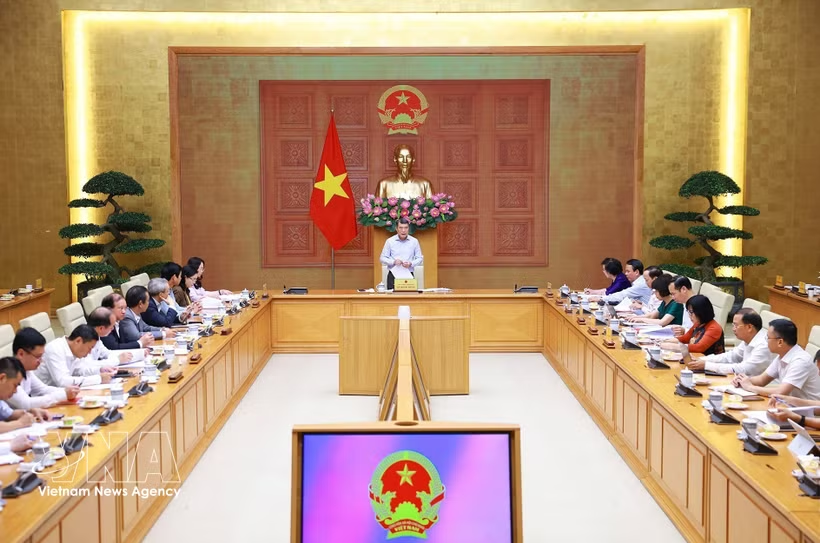
Prime Minister Le Minh Hung works with Ministry of Culture, Sports and Tourism

Tourism has emerged as a bright spot as Vietnam welcomed a record number of 21.5 million international visitors in 2025 and generating an estimated 1 quadrillion VND (37.9 billion USD) in revenue.

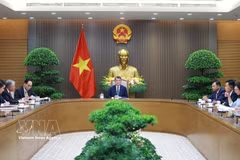
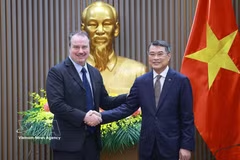
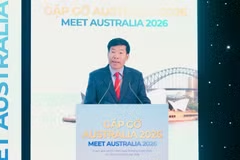
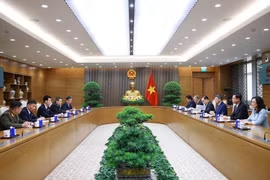
Prime Minister Le Minh Hung speaks at the working session with the Ministry of Culture, Sports and Tourism. (Photo: VNA)

Hanoi (VNA) – Prime Minister Le Minh Hung on April 25 chaired a working session with the Ministry of Culture, Sports and Tourism to review the implementation of assigned tasks, with a focus on advancing the Politburo’s Resolution No. 80 and the National Assembly’s resolution on cultural development, as well as addressing proposals and recommendations and defining effective approaches and orientations for handling key issues in the coming period.

Reports presented at the session highlighted notable progress. Institutional frameworks have been gradually improved, helping to remove bottlenecks and mobilise resources more effectively. Cultural heritage preservation and promotion have been strengthened, high-performance sports have maintained positive results, and the proportion of the population engaging in regular physical activities has reached 38.2%.

Tourism has emerged as a bright spot as Vietnam welcomed a record number of 21.5 million international visitors in 2025 and generating an estimated 1 quadrillion VND (37.9 billion USD) in revenue.

The ministry has further advanced administrative reforms by decentralising 36 procedures to provincial and grassroots levels, cutting unnecessary business conditions, and significantly reducing compliance costs and processing time.

Concluding the meeting, PM Hung emphasised that the culture, sports and tourism sector encompasses a broad scope of work with far-reaching social impact, and has received consistent attention from the Party and the State. He noted that cultural values and ethical standards are matters of deep concern to society, shaping both national identity and development quality.

While commending the ministry’s efforts, particularly its proactive role in advising and implementing Resolution No. 80, the PM pointed out several shortcomings, including delays in completing policy frameworks, gaps in legal regulations for emerging areas such as cultural industries, and limited application of science, technology, and digital transformation.

The government leader also noted that Vietnam’s high-performance sports still lag behind regional and global standards, while tourism and cultural industries have yet to fully match their potential. Challenges related to human resources and the risk of losing traditional artisans were also underscored.

Therefore, PM Hung stressed the need for a fundamental shift in mindset and working methods, moving away from entrenched practices, and transforming decisively from a management mindset to one that serves, enables, and leads development. He urged acting proactively and decisively in proposing groundbreaking policies for consideration by competent authorities, ensuring the timely implementation of the Party’s major directives.

Institutional reform remains a top priority, he said, stressing the need to swiftly translate the Party's guidelines into concrete policies and ensure timely issuance of implementing regulations. He also called for the vigorous rollout of the National Target Programme on Culture, aligned with clearly defined objectives and beneficiaries.
vnanet-leminhhung4.jpg
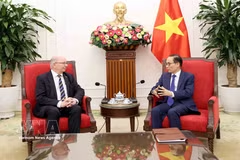
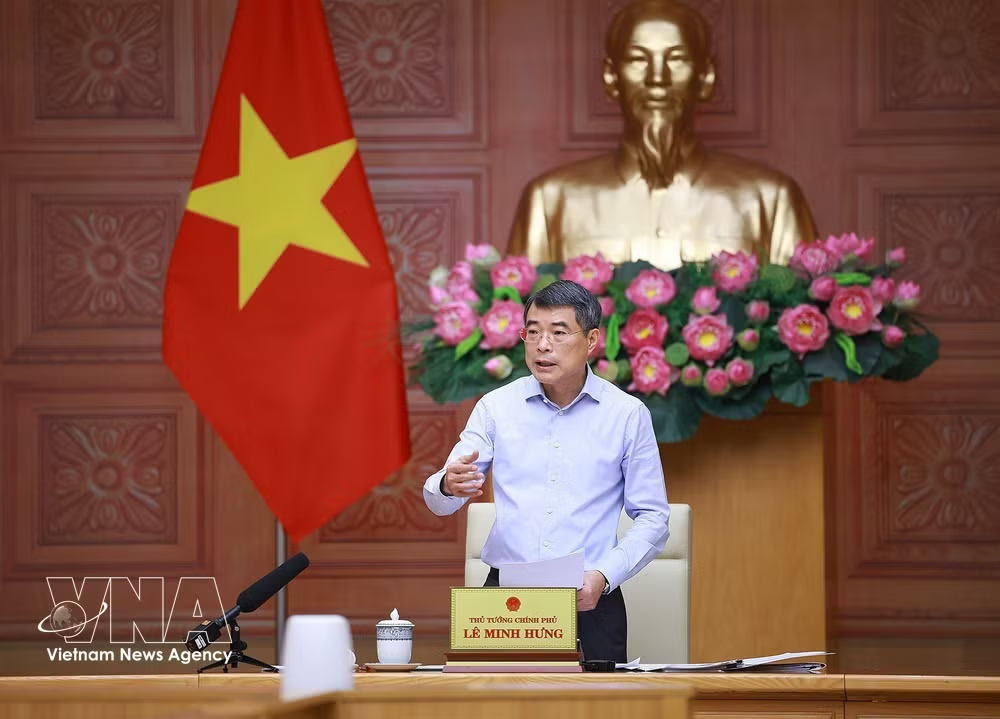
Prime Minister Le Minh Hung speaks at the working session with the Ministry of Culture, Sports and Tourism. (Photo: VNA)

In terms of sectoral development, the PM urged a strategic restructuring to enhance competitiveness, particularly in tourism, with the goal of welcoming 25 million international visitors and serving 150 million domestic tourists by 2026. He emphasised that the sector plays a vital role in achieving double-digit economic growth, noting that increased international tourism can generate substantial revenue across aviation, hospitality, and services with relatively low environmental impact.

At the same time, he cautioned against revenue leakage to foreign entities, stressing the need for policies that ensure greater domestic value capture.

The government leader also directed stronger state management and the enhanced role of media and communications in shaping public opinion and safeguarding the Party’s ideological foundation. Accelerating digital transformation across the sector, including the completion of national databases and administrative reforms in the digital environment by the second quarter of 2026, was identified as a key priority.

Looking ahead, the Government will prioritise the development of legal frameworks for cultural industries, including the building and submission for approval of a dedicated law, as well as policies on copyright, professional incentives, and administrative sanctions in media and publishing.

PM Hung called on the ministry to act with greater determination, proactivity, and effectiveness, ensuring that culture becomes a true “spiritual foundation,” an “endogenous resource,” and a source of “soft power” for national development. Tourism must evolve into a spearhead economic sector and sports should contribute meaningfully to improving public health and physical well-being, he added./.

VNA

See more

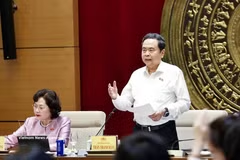
At the working session between NA Chairman Tran Thanh Man and standing members of the NA's Committee for Cultural and Social Affairs. (Photo: VNA)

National Assembly Chairman urges renovation in leadership, working style

The NA's Committee for Cultural and Social Affairs has moved fast to reshuffle its organisation after the 14th National Party Congress and the election of deputies to the 16th NA, updating its work agenda to match new directives set out in the resolutions of the 14th National Party Congress and the first Congress of the NA Party Organisation for the 2025–2030 term.

Delegates visit a photo exhibition about the career of President Ho Chi Minh. (Photo: VNA)

President Ho Chi Minh’s legacy of peace, friendship honoured in Japan

Consul General Trinh Thi Mai Phuong said the celebration was an occasion for Vietnamese people at home and abroad to express profound gratitude and respect for President Ho Chi Minh – the great leader of the Vietnamese nation, a national liberation hero and a great man of culture.

Delegates pose for a group photo at the welcoming ceremony for the ship. (Photo: VNA)

Thailand's naval ship pays friendship visit to Ho Chi Minh City

The visit is expected to strengthen mutual trust and cooperation between the defence ministries of Vietnam and Thailand, as well as between the two countries’ navies, while contributing to activities marking 50 years of diplomatic ties between the two nations.

Vietnamese Ambassador to the RoK Vu Ho speaks at the event. (Photo: VNA)

President Ho Chi Minh honoured in RoK on 136th birth anniversary

With Vietnam–Korea ties expanding across multiple fields, he noted that honouring President Ho Chi Minh in the RoK carries significance beyond the overseas Vietnamese. It offers a chance to raise mutual understanding, empathy, and bonds between the Vietnamese and Korean people built on shared values of peace, cooperation, and development.

President Ho Chi Minh works at the Presidential Palace in Hanoi. (File photo: VNA)

Ho Chi Minh Thought guides development path: Top leader

In an article written on the occasion of President Ho Chi Minh’s 136th birth anniversary (May 19, 1890 – 2026), the top Vietnamese leader affirmed that “Ho Chi Minh Thought serves as a guiding light along our development path.”

Vietnamese Ambassador to Venezuela Vu Trung My speaks at the event (Photo: VNA)

President Ho Chi Minh’s enduring legacy highlighted at Venezuela commemoration

Vice President of the United Socialist Party of Venezuela (PSUV) Jesús Faria expressed deep admiration for President Ho Chi Minh and Vietnam’s indomitable struggle for national independence. He described President Ho Chi Minh as an immortal symbol of 20th-century national liberation movements, whose legacy continues to inspire leftist parties, progressive movements, and peoples across Latin America, including Venezuela.

Standing Vice Chairman of the municipal People’s Committee Nguyen Loc Ha (R) and EU Ambassador to Vietnam Julien Guerrier. (Photo: VNA)

Ho Chi Minh City, EU boast ample room for sustainable development cooperation

Since the establishment of their diplomatic ties in 1990, Vietnam and the EU have deepened the bilateral ties into one of the bloc’s most dynamic and in-depth partnerships with an ASEAN member, Ha noted, adding that the relationship entered a new chapter in January when the President of European Council’s visit upgraded it to a Comprehensive Strategic Partnership.

Deputy Minister of Foreign Affairs Nguyen Minh Hang speaks at a discussion session on reforming multilateral systems and global governance, held on May 15, 2026, as part of the expanded BRICS Foreign Ministers’ Meeting in India. (Photo: VNA)

Vietnam ready to strengthen BRICS connection with Asia-Pacific

Hang called on countries to act responsibly in accordance with international law and the UN Charter; respect the independence, sovereignty and territorial integrity of states; refrain from using or threatening to use force; and settle disputes peacefully through dialogue. She also underscored the importance of ensuring security, safety and freedom of navigation through straits in line with international law, including the 1982 United Nations Convention on the Law of the Sea (UNCLOS).

Vietnamese Minister of Foreign Affairs Le Hoai Trung (centre), DPRK Vice Minister Pak of Foreign Affairs Sang Gil (left), and Vietnamese Ambassador to the DPRK Le Ba Vinh cut the ribbon to open the exhibition. (Photo: VNA)

Photo exhibition highlights Vietnam–DPRK relations

Visitors at the exhibition were moved by historical photographs dating back nearly 70 years, including images of the founding leader of the DPRK Kim Il Sung personally welcoming President Ho Chi Minh and a CPV delegation at Pyongyang’s Sunan International Airport during their visit to the DPRK from July 8–12, 1957. In return, the DPRK leader paid an official visit to Vietnam from November 27 to December 3, 1958.

Illustrative image (Photo: VNA)

Deputy PM calls for substantive assessment of two-tier local administration operations

Chairing a meeting on the development of a scheme to review the first-year operations of the political system’s organisational apparatus and the two-tier local administration model, Tra emphasised that the review must comprehensively and objectively evaluate the nationwide implementation of administrative unit restructuring and the operation of the new local administration model.