Ready-built factories gain from new manufacturing FDI wave

Ready-built factories attracted 73% of new manufacturing FDI in northern Vietnam over the past two quarters, as foreign investment continued to surge at the region's industrial hubs during the first eight months of 2026. The trend points to growing demand for premises that can be put into operation quickly.

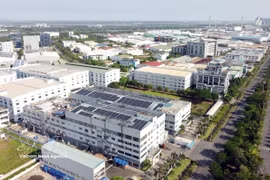
Factories and production facilities in the Chu Lai Open Economic Zone, Da Nang city, are equipped with modern production lines. (Photo: VNA)

Hanoi (VNA) – With registered FDI rising more than 55% in the first eight months and disbursed capital reaching a five-year high, and demand for production-supporting infrastructure continuing to grow, ready-built factories could emerge as a clear beneficiary of the new manufacturing FDI wave, while industrial land will remain the foundation for long-term investment plans, according to experts.

Manufacturing investment continues to rise

Ready-built factories attracted 73% of new manufacturing FDI in northern Vietnam over the past two quarters, as foreign investment continued to surge at the region's industrial hubs during the first eight months of 2026. The trend points to growing demand for premises that can be put into operation quickly.

According to Savills Vietnam, factories accounted for 54% of new manufacturing FDI projects in northern Vietnam but attracted 73% of total capital, or about 6.3 billion USD, in the first two quarters of 2026. Industrial land projects, meanwhile, accounted for 46% of projects but only 27% of investment.

The trend is also evident nationwide. Of 468 new manufacturing FDI projects, 266 were factory projects, making up 56.84% of the total and attracting about 7.09 billion USD, equivalent to 66.24% of total capital. Industrial land projects attracted about 3.62 billion USD.

Although these figures cover the first two quarters, investment flows in July and August continued to underline the strong appeal of manufacturing and northern industrial centres.

By the end of August, Vietnam had attracted 40.63 billion USD in registered foreign investment, up 55.4% year on year. Newly licensed FDI projects numbered 2,771, with total registered capital of 21.72 billion USD, up 96.8% despite a 9.4% rise in the number of projects.

Processing and manufacturing remained the largest recipient. Newly registered capital in the sector reached 12.15 billion USD, or 55.9% of total new capital. Including additional capital, the sector lured about 20.18 billion USD in the first eight months, or 59.5% of the combined capital in the two categories.

Disbursed FDI also increased, reaching about 17.25 billion USD, up 12% year on year and the highest level for the same period in five years. Processing and manufacturing accounted for 82.6%, or 14.24 billion USD.

The scale and pace of investment flows show that demand for expanded production capacity remains strong, particularly in high-tech and high-value-added sectors.
vnanet_potal-anh-cho-chum-bai-mo-khong-gian-don-dong-von-fdi-the-he-moi-8993148.jpg
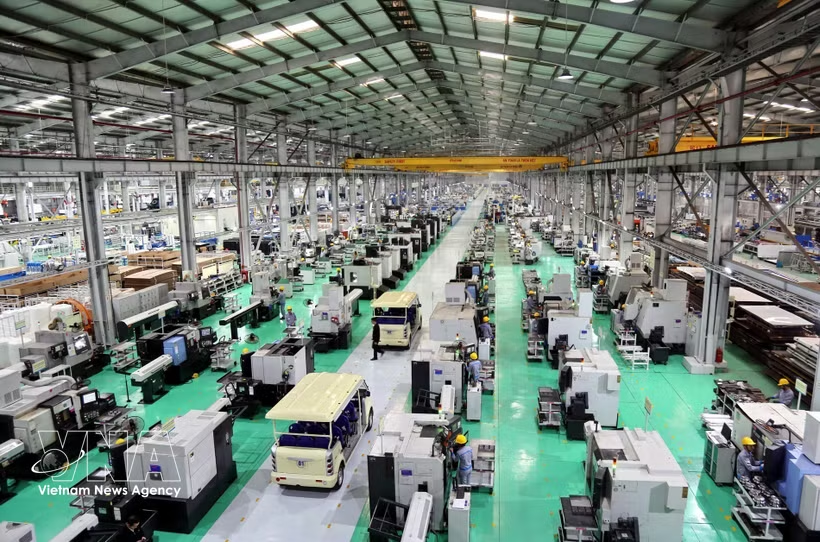
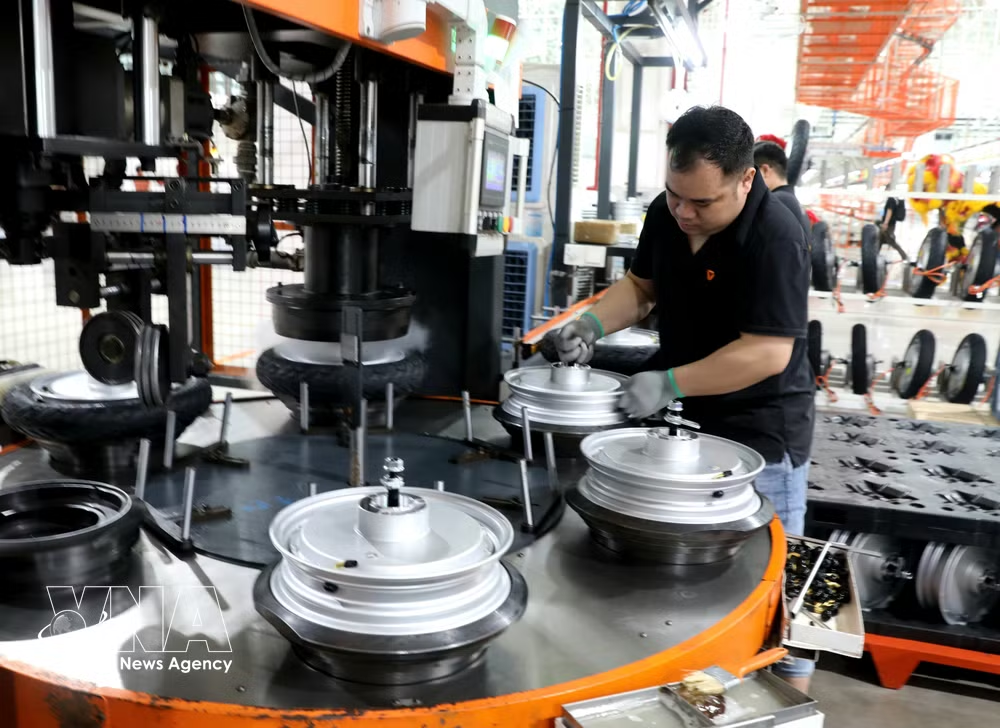
Production line at the Yadea Vietnam smart manufacturing plant, a project worth over 100 million USD located in Tan Hung Industrial Park, Bac Ninh province. (Photo: VNA)

John Campbell, Director and Head of Industrial Services at Savills Vietnam, said that as global supply chains undergo continuous restructuring, speed of deployment is becoming an increasingly important competitive factor. Bringing a factory into operation several months earlier can offer advantages in costs, orders and participation in supply chains.

This explains why ready-built factories are increasingly being considered not merely as a temporary solution for market entry, but from the outset of investment planning.

A new race in industrial real estate

The shift towards high-quality FDI is also changing requirements for industrial real estate. Gene King, Chief Investment Officer at BW Industrial Development, said FDI in Vietnam was moving more clearly towards high-value-added sectors such as electronics, semiconductors, artificial intelligence infrastructure and high-tech manufacturing.

This qualitative shift is directly affecting demand for ready-built factories, said King.

Demand for ready-built factories therefore reflects not only the need to shorten deployment time but also changes in the sectoral composition of FDI.

Savills experts noted that the higher share of investment attracted by factories than by industrial land shows that some investors are willing to pay for a platform that can shorten the process from licensing and site preparation to production.

The rise of ready-built factories, however, does not diminish the role of industrial land. Large-scale greenfield projects, long-term expansion plans and factories requiring customised designs will still need land to develop according to their specific requirements.

The bigger change is that the market now has an additional competitive criterion. It is no longer enough to provide land on which businesses can build factories. Industrial real estate must also enable them to bring production into operation more quickly, particularly as rising manufacturing investment in electronics and high-tech industries creates more diverse demand.

Alongside industrial land, businesses can opt for ready-built factories, build-to-suit facilities or integrated models combining factories with warehousing and logistics. For new investors, these options can reduce the time and resources required during the initial development stage.

The market is also seeing more developers offering such products. Alongside BW Industrial, Frasers Property, KTG Industrial, Core5, SLP and Mapletree, Logicross, the logistics brand of Japan's Mitsubishi Estate, has entered the market with projects in Nam Thuan and Hai Phong.

The emergence of these models shows that industrial real estate is gradually shifting from the question of whether land is available to how effectively it can support actual production./.

VNA

See more

Ben Thanh Market in Ho Chi Minh City attracts a large numbers of domestic and international visitor.( Photo: VNA)

Vietnam targets 50 million international visitors by 2030

The Ministry of Culture, Sports and Tourism has outlined three scenarios for 2027–2030. Under the high-growth scenario, international arrivals would rise 15–18 percent annually to reach 45–50 million, while domestic tourism would reach around 160 million trips. Total tourism revenue is projected at 80–90 billion USD.

Vietnamese durian industry pivots from volume to value

Vietnamese durian industry pivots from volume to value

Durian has morphed from a high-value crop into a strategic Vietnamese export. But as output climbs and importing markets tighten rules on quality, food safety and traceability, the industry must pivot from volume growth to sustainable value chains, better quality and diversified markets.

A display area for Mid-Autumn Festival cakes at a supermarket (Photo: VNA)

Mid-Autumn Festival cake market heats up at affordable end

Industry insiders say competition is no longer just about the cake itself. Product quality, packaging, brand reputation, delivery services and personalisation are increasingly shaping consumer choices in a market crowded with both domestic and foreign players.

Minister of Foreign Affairs Le Hoai Trung (Photo published by VNA)

Vietnam, India set 25 billion USD trade goal

Vietnam and India agreed to make better use of complementary strengths, ease market access difficulties and facilitate business activities toward achieving the 25 billion USD bilateral trade target.

Delegates at the meeting between Vietnamese businesses operating in Cambodia and the Council for the Development of Cambodia (CDC) on September 14. (Photo: VNA)

Vietnamese businesses seek to expand investment in Cambodia

Vietnam currently has 223 investment projects in Cambodia with total registered capital of nearly 3.4 billion USD. Vietnamese companies operate in agriculture, particularly large-scale farming, finance and banking, telecommunications, aviation, processing, trade and services.

Children visit President Ho Chi Minh's hometown and learn about his childhood. (Photo: VNA)

Vietnam's tourism sector faces labour shortage

A 2026 survey by Hoteljob.vn found that nearly 90% of tourism businesses planned to recruit. In Ho Chi Minh City alone, 89.7% of businesses were hiring, while 71.8% said recruitment was difficult or very difficult. The biggest shortages were among frontline workers, particularly in housekeeping, engineering, food service, front-office operations, and kitchens.

Octopus processing for export at Huy Nam Company in An Giang province. (Photo: VNA)

New opportunities for Vietnam’s seafood exports

The Vietnam-EFTA Free Trade Agreement brings together two groups of highly complementary economies. EFTA members Switzerland, Norway, Iceland and Liechtenstein have strengths in technology, innovation, finance, clean energy and sustainable development, while Vietnam is one of Asia’s most dynamic economies and is emerging as a major regional manufacturing, trade and investment hub.

The saponin content of Lai Chau ginseng can reach as high as 23.85% in its natural state, a remarkably high level compared to many other ginseng species. (Photo: baolaichau.vn)

Lai Chau ginseng development gains momentum

Blessed with rare and distinctive ecological values, the northern mountainous province of Lai Chau is stepping up efforts to conserve and develop its native ginseng, with the medicinal plant expected to play a growing role in the forest-based economy and local livelihoods.

The Vietnamese delegation poses for a group photo at the third meeting of the Vietnam-Canada Joint Economic Committee (Photo: VNA)

Vietnam, Canada broaden economic cooperation beyond trade

Vietnam is currently Canada’s largest trading partner in ASEAN. Building on the Comprehensive and Progressive Agreement for Trans-Pacific Partnership (CPTPP), the two countries are expanding bilateral economic ties into higher value-added areas such as clean energy, critical minerals, advanced technology, manufacturing and value-chain linkages.

The Index of Industrial Production (IIP) rises 14.4% in August and 11.9% in the first eight months compared to a year earlier. (Photo: VNA)

More momentum needed for economic growth in year-end race

To build momentum for the year-end race, one of the top priorities is to accelerate public investment disbursement, ensuring 100% of the allocated plan is disbursed without allowing funds to be concentrated in the final months of the year.