Removing bottlenecks key to unlocking economic value of cultural heritage

A considerable gap remains between policy ambitions and practical implementation, beginning with the way cultural heritage itself is approached.

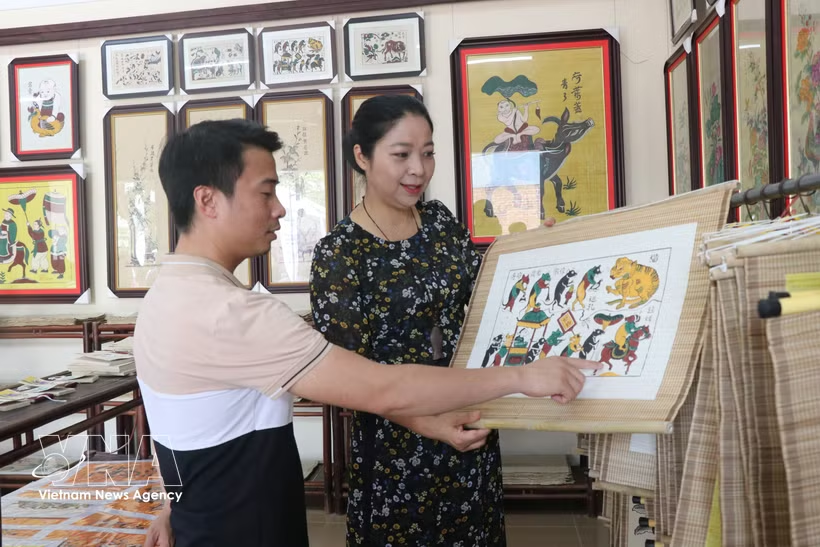
A visitor explores the art of making Dong Ho folk paintings in Bac Ninh province. (Photo: VNA)

Hanoi (VNA) – Cultural resources can only enter the marketplace as assets when they are clearly identified and protected by appropriate legal mechanisms. Removing the barriers that have long constrained heritage’s ability to generate economic value could help unlock Vietnam’s vast reservoir of traditional cultural wealth.

Significant value, yet largely untapped

​The Politburo’s Resolution No. 80-NQ/TW on the development of Vietnamese culture identifies culture as an endogenous driver of economic growth. Under the resolution, cultural industries are expected to contribute 7% of GDP by 2030 and 9% by 2045, becoming an increasingly important component of the national economy.

​However, a considerable gap remains between policy ambitions and practical implementation, beginning with the way cultural heritage itself is approached.

​Many cultural experts pointed to a long-standing paradox: while Vietnam possesses a rich and diverse heritage, the material value generated from it remains disproportionately low. Heritage that is merely preserved cannot generate new vitality. Only when it is reinterpreted through the language of the present, aligned with contemporary social needs and transformed into tangible products can it become an active contributor to economic life.

​Yet turning cultural ideas into marketable products remains a significant challenge. Although Vietnam possesses an abundance of cultural motifs, symbols, knowledge systems and traditional crafts, there is often no complete process for transforming these assets into commercially viable products.

​According to lawyer Le Quang Vinh, who has more than two decades of experience in intellectual property rights, the core obstacle lies in the lack of formal identification and classification of cultural products and heritage assets.

“Symbols, patterns, traditional knowledge and handicraft skills all have the potential to create value. But without clear identification, they cannot be valued, traded or protected under intellectual property frameworks,” he explained.

It’s a tough cycle to break: without recognition, there’s no market; without a market, heritage can’t bring in income; without income, artisans find it hard to keep their crafts alive; and without investment, there’s little room for innovation or preservation.

Enabling heritage to thrive in contemporary society

​Dr Le Thi Minh Ly, a member of the National Cultural Heritage Council, believed that the fundamental bottleneck stems from long-established ways of thinking.

​For many years, preservation through “freezing” heritage in time was widely regarded as the safest option. Heritage was placed in exhibition spaces, detached from its natural living environment, and gradually became something to be observed rather than experienced. As a result, the distance between heritage and communities, particularly younger generations, has widened. Once heritage is no longer actively practised or linked to livelihoods, it begins to lose its vitality from within.

​According to Ly, preservation and utilisation are not opposing approaches. On the contrary, responsible utilisation can be one of the most effective forms of sustainable preservation.

“When heritage generates economic value, communities have greater motivation to maintain and pass it on. When practitioners earn a stable income, traditional knowledge has a chance to survive. If heritage cannot sustain people’s livelihoods, people will inevitably abandon it,” she said.

​“Heritage needs to move beyond museum walls and return to everyday life, taking on new forms while retaining its core values,” Ly added.

​The story of Dong Ho folk paintings in Bac Ninh province offers a clear example of this approach.

​At a cultural exchange centre established by artisan Nguyen Dang Che, the traditional Dong Ho painting techniques continue to be practised and taught in their entirety. Artisans stay hands-on with their craft, inviting visitors to join in the creative process and develop a deeper appreciation for the cultural meaning behind the artwork.

​At the same time, Dong Ho imagery has been adapted for contemporary products such as calendars, notebooks, souvenirs, and lifestyle items. This demonstrates how heritage can be translated into the language of the market without compromising its authenticity.

​Ultimately, the challenge of heritage economics is not a matter of quantity but of removing critical obstacles, particularly those related to intellectual property. From identification and legal protection to commercial exploitation, each stage requires a clear and professional approach. Without any one of these links, the value chain remains fragmented. With all three in place, however, cultural heritage can become not only a symbol of identity but also a sustainable source of economic growth./.
VNA

See more

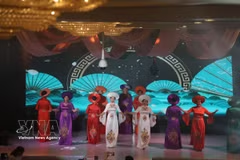
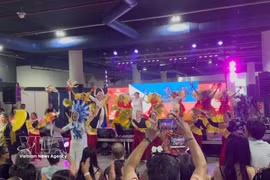
An Ao Dai show held in Prague, the Czech Republic, in May 2026 (Photo: VNA)

Vietnam culture, cuisine showcased in Czech Republic

The festival featured more than 20 booths offering traditional Vietnamese dishes, including "pho" and spring rolls, alongside activities promoting Ao Dai (Vietnamese traditonal long dress). One of the highlights was the presentation of complimentary Ao Dai to Czech residents and international visitors.

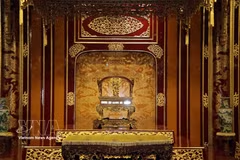
The Nguyen Dynasty (1802-1945) imperial throne, a recognised national treasure of Vietnam, officially returns to public display at Thai Hoa Palace in Hue Imperial Citadel on June 4 (Photo: VNA)

Nguyen Dynasty throne returns to Hue Imperial Citadel after restoration

The throne has been reinstated at its original central position inside Thai Hoa Palace, the ceremonial heart of the former imperial court. Its return has attracted significant interest from visitors and heritage enthusiasts eager to see one of Vietnam’s most important royal artefacts back on display.

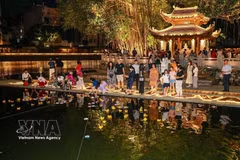
People join the “Ho Van Lantern Festival Night” programme at the special national relic site of the Van Mieu–Quoc Tu Giam (Temple of Literature) in Hanoi. (Photo: VNA)

Night-time economy drives growth of Hanoi’s cultural industries

Under the Politburo’s Resolution No. 80-NQ/TW on the development of Vietnamese culture, Hanoi has been given fresh opportunities to leverage its cultural, historical, tourism and creative assets. The city’s recently approved project on developing the night-time economy for 2026–2030, with a vision to 2045, is expected to create momentum for cultural industry growth while enhancing Hanoi’s standing as a creative and modern city with a distinctive identity.

Efforts made to preserve, promote values of Non Nuoc Cao Bang Global Geopark

Efforts made to preserve, promote values of Non Nuoc Cao Bang Global Geopark

First recognised by UNESCO on April 12, 2018, the Non Nuoc Cao Bang Global Geopark in the northern province of Cao Bang is a land shaped by more than 500 million years of geological history. Covering over 3,683 sq.km and encompassing all or part of 36 communes and wards, the geopark is home to numerous scenic landscapes, as well as historical and cultural sites of exceptional value.

Scenic views of Da Nang featured in the film "Love in Vietnam" (Photo: VNA)

Da Nang Asian Film Festival 2026 set to launch with expanded international focus

Through this coordinated effort, Da Nang aims to establish DANAFF not only as an annual film event but also as a distinctive cultural landmark, helping position the city as a reputable destination for regional film and cultural events and enhancing its international profile, Vice Chairwoman of the municipal People’s Committee Nguyen Thi Anh Thi, said.

Co Bo Temple in Thanh Hoa province (Photo: nhandan.vn)

Thanh Hoa taps spiritual heritage to boost cultural tourism

Experts have called for stronger implementation of heritage management regulations under the Cultural Heritage Law, clearer responsibilities for site management boards and stricter action against activities that distort cultural traditions.

Ambassador Do Hung Viet, Vietnam's Permanent Representative to the United Nations, and his spouse introduce Vietnamese dishes to visitors at the 2026 UN International Bazaar in New York on June 3. (Photo: VNA)

Vietnam leaves strong impression at 2026 UN International Bazaar

A wide range of traditional handicrafts reflecting Vietnam’s rich cultural heritage, including ceramics, lacquerware, silk products, brocade textiles and other items, attracted considerable attention from visitors. Many products sold out early in the day.

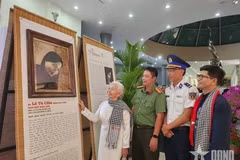
Former political prisoner Le Tu Cam is moved as she views a portrait of herself, digitally restored from archival photographs and crafted from lotus leaves, on display at the Con Dao Museum. (Photo: VNA)

Digital innovation breathes new life into Vietnam’s museums

Technology is similarly enriching exhibitions at the Vietnam Women’s Museum in Hanoi. Wartime letters, a typewriter and other artefacts linked to former Vice President Nguyen Thi Binh have been digitally integrated with collections held at the War Remnants Museum in Ho Chi Minh City. Through projection mapping, 3D displays and a virtual reality recreation of the Paris Peace Agreement, visitors can engage more deeply with the life and achievements of one of Vietnam’s most prominent diplomats.

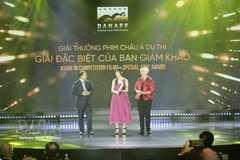
At the award ceremony of the Da Nang Asian Film Festival 2025. (Photo: VNA)

Da Nang Asian Film Festival 2026: Bridging Asia and the world

The festival is expected to bring together around 900 artists, producers and film professionals from Vietnam and abroad, including more than 200 international guests. This marks the largest edition since DANAFF was first launched in 2023, highlighting its growing appeal within the film industry.

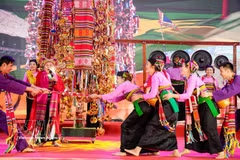
Performance showcasing excerpts from the Pon Poong festival of the Muong ethnic community in Thanh Hoa province. (Photo: VNA)

Vietnam’s culture development in digital era

Under the Politburo's Resolution No. 80-NQ/TW, issued on January 7, 2026, culture is defined as the spiritual foundation of society, an important endogenous resource, a driver of socio-economic development and a source of national soft power. In the new era, cultural values are expected to permeate all aspects of life, serving as a foundation, resource, catalyst and regulatory force for the country’s rapid and sustainable development.

Students experience virtual reality games. (Photo: VNA)

Vietnamese team crowned FFWS SEA esports champion

The triumph marked a breakthrough moment for Vietnamese Free Fire esports, with SECRET WAG becoming the first Vietnamese squad to lift an FFWS SEA trophy on home soil. The result underscored the rising stature and growing competitiveness of Vietnam’s esports scene in Southeast Asia.