Satellite rollouts mark major steps forward for Vietnam’s aerospace industry

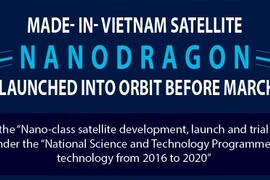
NanoDragon, a nano-layer cubesat satellite developed by the Vietnam National Space Centre (VNSC) under the Vietnam Academy of Science and Technology, is scheduled to be launched into orbit from Japan on October 1.
Satellite rollouts mark major steps forward for Vietnam’s aerospace industry ảnh 1Illustrative photo. (Source: VNA)

Hanoi (VNA) – NanoDragon, a nano-layer cubesat satellite developed by the Vietnam National Space Centre (VNSC) under the Vietnam Academy of Science and Technology, is scheduled to be launched into orbit from Japan on October 1.

The 3.8-kilogramme satellite will be sent into outer space from the Uchinoura Space Center in Japan’s Kagoshima prefecture, following the launch of the 1-kilogramme microsatellite PicoDragon and the 50-kg satellite MicroDragon, also developed by the VNSC, in 2013 and 2019, respectively.

In 2023, LOTUSat-1, an earth observation satellite manufactured by Japan under a VNSC project, is expected to be launched, making it the first radar observation satellite of Vietnam.

These mark the first major steps forward taken by the country’s fledgling aerospace industry.

PicoDragon was completely built in Vietnam by a group of local researchers who had zero experience in the field, said VNSC General Director Assoc. Prof., Dr. Pham Anh Tuan. They were experts in different areas of the science-technology industry before gathering for the project, so they got shaky at first and started to learn everything from scratch, he said.

MicroDragon, meanwhile, was created in a more professional environment in Japan with 36 Vietnamese engineers in support of Japanese professors and more advanced technologies, according to Tuan.

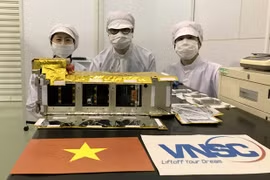
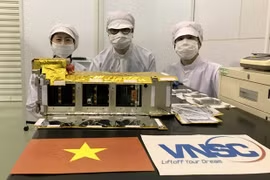
Satellite rollouts mark major steps forward for Vietnam’s aerospace industry ảnh 2NanoDragon, a nano-layer cubesat satellite developed by the Vietnam National Space Centre (VNSC) under the Vietnam Academy of Science and Technology, is scheduled to be launched into orbit from Japan on October 1. (Photo: VNSC)

NanoDragon was completely made in Vietnam and by Vietnamese engineers from the VNSC, from the stage of design through manufacturing, testing and others.

Dr. Le Xuan Huy, VNSC Deputy Director and a member of the research team, said NanoDragon is yet to reach expectation as it was developed with limited infrastructure. To partly fix the problems, the team had to ask for cooperation from foreign partners to have some parts of the project done overseas, he added.

The developers expect the satellite will function well to monitor marine vehicles with an automatic identification system and send relating data back to the ground.

Vietnam should view the aerospace as one of the five spaces it must master to be capable of safeguarding the national interests, Tuan said. Aerospace technologies require big resources, from capital to human resources and time, to ensure its balanced and sustainable development, he noted, adding that to boost the space science and industry, the country needs to stimulate demand for related technologies.

NanoDragon is the result of a project to design, manufacture, launch and test operation of a nano-sized microsatellite under the national space science and technology programme in the 2016-2020 period.

The government has recently approved a strategy for the development and application of aerospace science and technology by 2030 with an aim to expand the use of these technologies, master the design and manufacturing technologies of earth observation satellites, and support start-ups in the field.

Vietnam’s mission of conquering the space will be of the future generation but the mission to form an innovation culture and nurture passion for science among young people belongs to that of today, Tuan stressed./.
VNA

See more

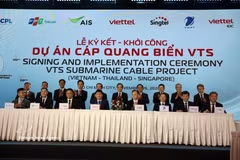
The signing and implementation ceremony for the Vietnam–Thailand–Singapore submarine cable project on November 26, 2026 (Photo: VNA)

Vietnam–Thailand–Singapore submarine cable project launched

Designed with eight fibre pairs, the system will employ next-generation wavelength-division multiplexing (WDM) technology and an open-cable architecture. It is expected to deliver a round-trip data latency of just 12 milliseconds, about 50% lower than the current average.

Deputy Prime Minister Ho Quoc Dung, together with Government leaders, representatives of the Ministry of Science and Technology and CMC Technology Group, performs the official launch ceremony of the Clex legal AI platform. (Photo courtesy of the company)

Vietnamese-made legal AI platform Clex launched

Clex was researched and developed by CMC based on a large language model specialising in Vietnamese law, which was trained and fine-tuned on a knowledge base comprising more than two million legal documents.

The VGC v1.0 security chip, designed and developed by Vietnam (Photo: VNA)

Vietnam builds initial semiconductor foundation

Experts said the first step is not another broad strategy but a hard-headed audit of what Vietnam can actually do and a clear-eyed map of its advantages, technology gaps and opportunities in the global value chain.

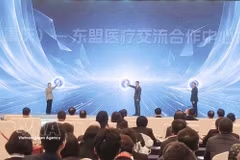
The inauguration ceremony of the ASEAN-China Health Exchange and Cooperation Centre in Chongqing. (Photo: VNA)

Vietnam proposes stronger ASEAN-China cooperation in AI

For Vietnam, AI-driven transformation is both a strategic opportunity and an inevitable requirement for development. Science, technology and innovation are becoming key drivers of growth, productivity and competitiveness, said Deputy Minister of Foreign Affairs Nguyen Manh Cuong.

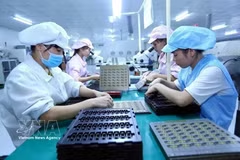
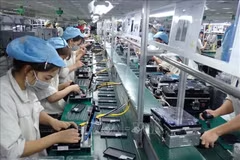
Assembling electronic components on the production line of Bao Sen Co., Ltd in Bac Ninh City. (Photo: VNA)

Vietnam builds technological capacity in digital era

As science, technology and digital transformation become increasingly integrated into production, governance and daily life, they can help create new drivers of growth and advance the development goals set out in the resolution.

The beauty of Dong Van Karst Plateau (Photo: VNA)

Vietnam tourism’s competitive future runs on digitalisation

The Vietnam National Authority of Tourism (VNAT) reported that Vietnam drew about 19.5 million foreign arrivals in the first 10 months of 2026, up 13.8% from a year earlier. That growth, along with changing consumer behavior, is forcing travel companies to rethink sales, service quality and how they mine customer data.

Visitors at the exhibtion held within the framework of the 16th Business of IP Asia Forum. (Photo: VNA)

Vietnam promotes innovation links at Hong Kong Entrepreneur Day 2026

Van expressed her hope that the NIC would serve as a bridge to encourage businesses and major corporations from the GBA to invest in Vietnam and transfer innovative technologies, particularly in artificial intelligence (AI), green transition and financial technology (FinTech).

Karnataka Chief Minister D.K. Shivakumar speaks positively about cooperation prospects and expresses hope that more Vietnamese businesses will invest in the Indian state. (Photo: VNA)

Vietnam, India's Karnataka boost science, technology cooperation

The ambassador highlighted the complementary strengths of Vietnam and the Indian state, home to the country's Silicon Valley, and significant potential for cooperation in artificial intelligence (AI), semiconductors, digital technology, and research and development.

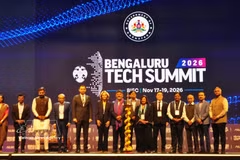
Delegates pose for a group photo at the Bengaluru Tech Summit 2026 in Karnataka, India (Photo: VNA)

Vietnam attends annual int’l tech summit in India

Vietnam's growing focus on science and technology, digital transformation and innovation as new drivers of development made India a natural partner in achieving its development and digital transformation goals. Cooperation potential between the two countries remains substantial, spanning both hardware and software.

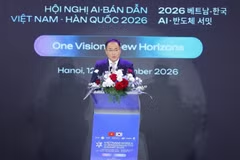
Vietnamese Deputy Minister of Science and Technology Tran Trung Tinh speaks at the event. (Photo: Published by VNA)

Vietnam, RoK seek to expand cooperation in AI and semiconductor sectors

Vietnamese Deputy Minister of Science and Technology Tran Trung Tinh stressed that the Politburo's Resolution No. 57-NQ/TW identifies science and technology, innovation and digital transformation as leading breakthroughs and key drivers of rapid and sustainable development. Semiconductors and artificial intelligence (AI) are among the strategic technologies prioritised for development.

Representatives of Cambodia’s Ministry of Education, Youth and Sport (MoEYS), the Agence Universitaire de la Francophonie (AUF) and Viettel Cambodia (Metfone) sign a tripartite agreement to strengthen cooperation and accelerate digital transformation in Cambodia’s higher education sector. (Photo: khmertimeskh.com)

Vietnamese company joins Cambodia’s digital transformation efforts

The agreement establishes a cooperation framework to modernise higher education through digital governance, digital learning, artificial intelligence (AI) applications, and capacity building through training and knowledge sharing. It also aims to expand internship, employment and scholarship opportunities for students.