Top leader attends groundbreaking ceremony for Kinh Thien Palace restoration project

The conservation, restoration and rehabilitation of Kinh Thien Palace must be carried out on a scientific basis, with maximum respect for original elements, archaeological and historical evidence, and interdisciplinary research findings, while preserving the archaeological remains already unearthed.

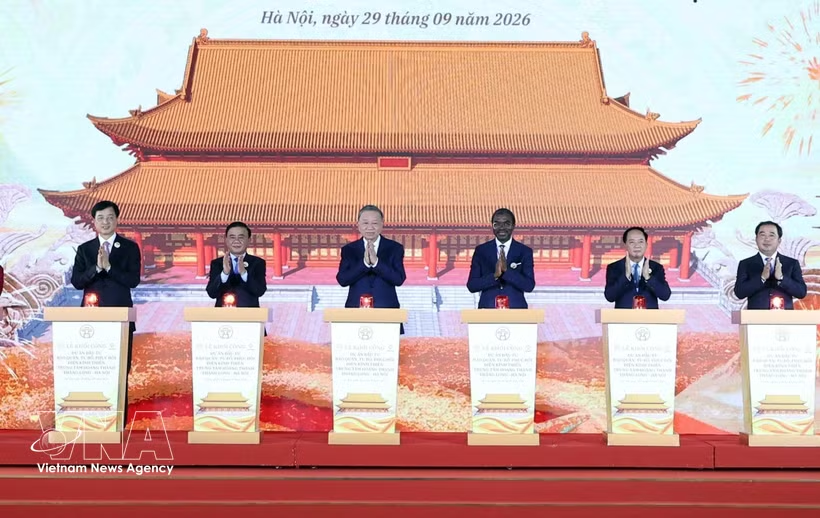
General Secretary of the Communist Party of Vietnam Central Committee and President To Lam (third, left) and officials launch the project on conservation, restoration and rehabilitation of Kinh Thien Palace on September 29. (Photo: VNA)

Hanoi (VNA) – General Secretary of the Communist Party of Vietnam Central Committee and President To Lam attended a groundbreaking ceremony for a project on conservation, restoration and rehabilitation of Kinh Thien Palace at the World Heritage Site of Thang Long Imperial Citadel in Hanoi on September 29.

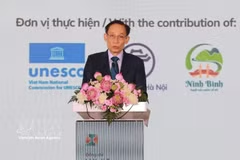
Addressing the ceremony, Chairman of the Hanoi People’s Committee Vu Dai Thang said the Thang Long Imperial Citadel was inscribed on the UNESCO World Heritage List in 2010. It embodies the outstanding universal value of a site that served as the centre of national power continuously for more than 13 centuries, as evidenced by its overlapping cultural strata and surviving architectural traces.

Within this space, Kinh Thien was the principal palace of the Forbidden City of Thang Long under the Le Dynasty (1428 -1789). According to the Dai Viet Su Ky Toan Thu (The Complete Annals of Dai Viet), construction began in 1428 under King Le Thai To and was completed under King Le Thanh Tong (1442–1497), on the foundations of principal palaces dating back to the Ly and Tran dynasties.

It was the centre of political power and royal ceremonies, where the court held audiences, conducted major ceremonies and received envoys. It was also the highest symbol of the national power of Dai Viet from the 15th to the 18th centuries.

The conservation, restoration and rehabilitation of Kinh Thien Palace must be carried out on a scientific basis, with maximum respect for original elements, archaeological and historical evidence, and interdisciplinary research findings, while preserving the archaeological remains already unearthed.

The Hanoi People’s Committee Chairman stressed that the capital city views heritage conservation as an integral part of its development strategy.

In his welcoming remarks, Lazare Eloundou Assomo, Director of the UNESCO World Heritage Centre, acknowledged the distinctive feature of the Thang Long Imperial Citadel, namely its unique continuity as a centre of political and cultural power for nearly 13 centuries. He said the site holds profound significance for Vietnam’s history and identity while also serving as an exceptional testament to the shared history of humanity.

The value of the site lies not only in its archaeological remains and historical structures, but also in the layers of history, memories and traditions they preserve, as well as the strong ties between the heritage site and Hanoi’s people.
vnanet-kinhthien1.jpg
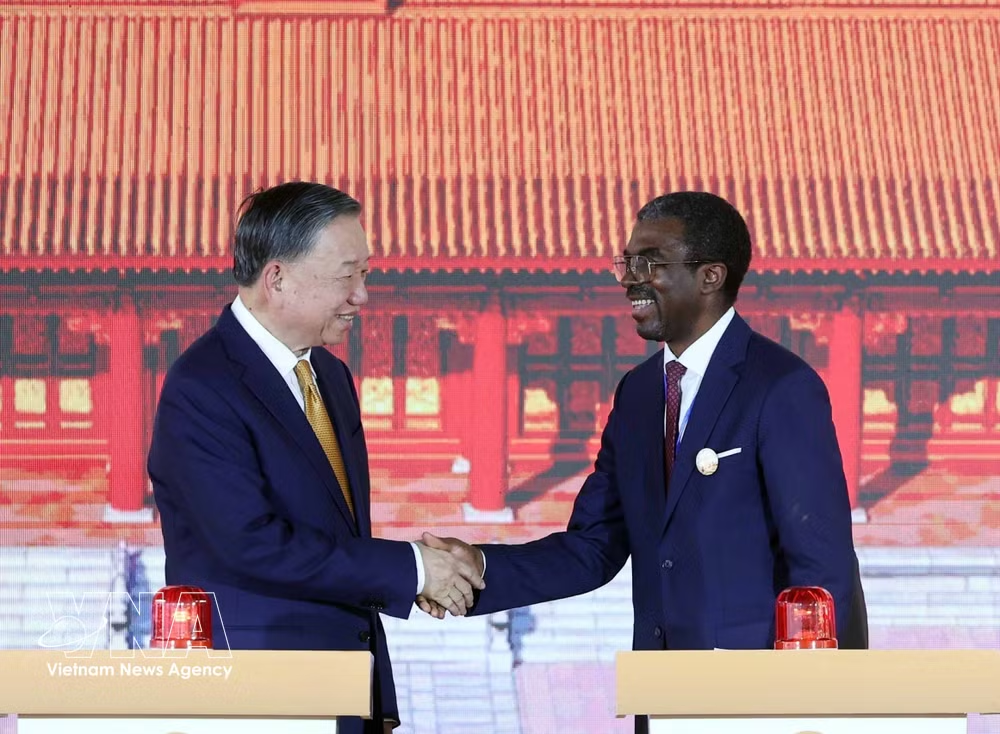
General Secretary of the Communist Party of Vietnam Central Committee and President To Lam and Lazare Eloundou Assomo, Director of the UNESCO World Heritage Centre, at the ceremony
(Photo: VNA)

Kinh Thien Palace, which is deeply connected with this history, is an important component of the World Heritage Site. The restoration project marks the beginning of a new phase of stronger cooperation among Vietnam, UNESCO, the International Council on Monuments and Sites (ICOMOS) and the World Heritage Committee, he said.

General Secretary and President Lam and other delegates visited an exhibition on the authenticity of the Kinh Thien Palace restoration and the Kinh Thien Palace space.

Inscribed by UNESCO as a World Heritage Site in 2010, the Thang Long Imperial Citadel embodies outstanding historical, cultural, archaeological and architectural values, reflecting more than a thousand years of the development of Thang Long-Hanoi.

The conservation, restoration and rehabilitation of Kinh Thien Palace goes beyond recreating an architectural structure. It aims to gradually restore the central space of the Thang Long Imperial Citadel and highlight the historical and cultural values of the nation.

Restoring Kinh Thien Palace and its associated spaces is an important task marking the beginning of the implementation of the vision for the central axis of the Thang Long Imperial Citadel through 2035, based on the 100-year vision of Hanoi’s master plan.

The project has been prepared on the basis of 15 years of interdisciplinary research into history, archaeology, architecture and intangible heritage, as well as comparisons with relevant cases in the region. Domestic and international scientists have participated in the process, together with in-depth consultations with UNESCO and ICOMOS./.
VNA

See more

Red Dao girls in Van Son commune, Bac Ninh province, are dressed in traditional attire. (Photo: VNA)

Digital transformation key to preserving, promoting ethnic cultural values

Training local young people in filming, audio recording, digital storytelling, data preservation and responsible use of AI can help build a new generation of cultural custodians. This, in turn, can help transform cultural heritage into a resource for economic development while contributing to the country’s broader development.

Tourism breathes new life into craft villages

Tourism breathes new life into craft villages

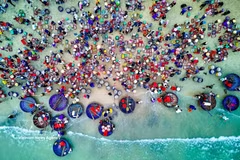
More than 5,400 craft villages and villages with craft activities provide a rich and distinctive resource for Vietnam’s tourism sector, especially as interests are shifting from sightseeing and shopping to exploring local lifestyles.However, simply attracting visitors or adding destinations to tours is only a first step. Craft village tourism is sustainable only when local artisans and residents benefit from it, and it breathes new life into the places where the crafts originated.

The second World Culture Festival in Hanoi will be expanded in both scale and scope of activities. In the photo: The first World Culture Festival in Hanoi. (Photo: VNA)

World Culture Festival brings vibrant global showcase to Hanoi

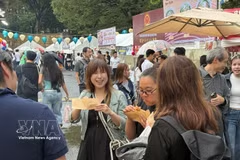
The second Cultures of the World Festival in Hanoi 2026 is expected to create a vibrant meeting point for Hanoi and cultures from around the world, connecting traditional heritage with new forms of cultural expression and bringing cultural stories closer to the public.

Political-artistic programme “Fatherland in Our Hearts”, jointly organised by Nhan Dan Newspaper and the Ho Chi Minh City People’s Committee. (Photo: nhandan.vn)

Vietnam eyes building national brands for cultural industries

This is the first time a Party document has set specific quantitative targets for cultural brands and cultural industries. With thousands of tangible and intangible heritage assets and the rich cultural life of 54 ethnic groups, Vietnam has a strong foundation for achieving these goals. However, turning cultural resources into recognised brands requires determination and systematic approaches.

Mo Muong is a national intangible cultural heritage closely associated with the spiritual life of the Muong ethnic minority community (Photo: VNA)

Digital transformation helps preserve Mo Muong cultural values

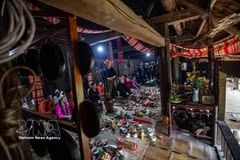
Digital transformation is emerging as an important solution to preserve and promote traditional cultural values at risk of fading, including Mo Muong, a national intangible cultural heritage closely associated with the spiritual life of the Muong ethnic minority community.

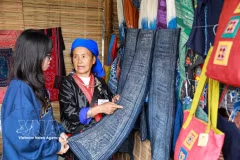
A visitor learns about the traditional culture of the Mong ethnic community. (Photo: VNA)

Vietnamese identity finds new expression in creative design

From traditional knowledge and craftsmanship, contemporary design draws inspiration from Vietnamese cultural identity and passes it on through the language of a new era. Linking knowledge, design, production, and markets can help turn cultural resources into sustainable economic value and create more creative design brands with a distinct Vietnamese identity.

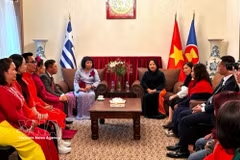
A delegation from the Vietnam Federation of UNESCO Associations (VFUA) led by Deputy Secretary General Nguyen Le Hang, has a meeting with the Vietnamese Embassy in Greece. (Photo courtesy of the embassy)

Vietnam, Greece hold cultural dialogue

Cultural exchanges such as “Ode to Peace” contributed to promoting the role of culture, enhancing understanding among nations, and advancing peace and sustainable development.