Top leader suggests combining Vietnam’s strengths with Stanford’s global networks

General Secretary and President To Lam expressed his belief that combining Vietnam’s strengths, dynamic economy, development ambitions and innovation opportunities with Stanford’s global knowledge, talent and networks will help establish an effective cooperation model between academia and practice, universities and businesses, and technology and people, generating new value and practical benefits for both sides and the region.

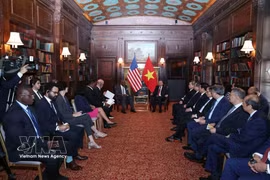
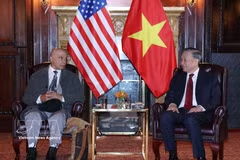
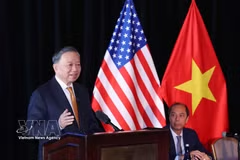
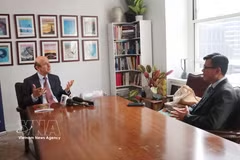
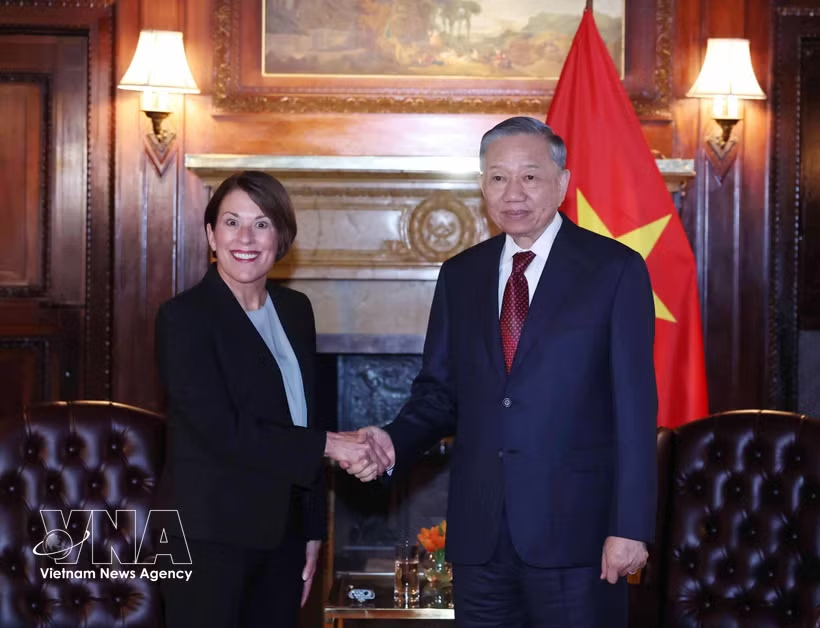
General Secretary of the Communist Party of Vietnam Central Committee and President To Lam (right) meets with Professor Sarah Anne Soule, Dean of Stanford Graduate School of Business at Stanford University, in New York on September 21. (Photo: VNA)

New York (VNA) – General Secretary of the Communist Party of Vietnam Central Committee and President To Lam met with Professor Sarah Anne Soule, Dean of Stanford Graduate School of Business at Stanford University, in New York on September 21 afternoon (local time).

The meeting took place during the top Vietnamese leader’s working trip to attend the high-level General Debate of the 81st session of the United Nations General Assembly and conduct bilateral activities in the US.

General Secretary and President Lam spoke highly of Stanford University in general and Stanford Graduate School of Business in particularly as leading global educational institutions and hubs connecting knowledge, technology, businesses and talent worldwide.

He expressed interest in Stanford’s priorities in education, leadership capacity development and AI, stressing that as AI advances rapidly, core human capabilities such as creative thinking, judgment and decision-making are becoming increasingly important to the competitiveness and development of countries.

The leader said Vietnam is entering a new development phase with the goals of achieving fast and sustainable growth and becoming a high-income developed country by 2045.

The country has identified science, technology, innovation, digital transformation and high-quality human resources as key drivers of growth, he said, adding that it needs not only additional resources but, more importantly, the capacity to generate, absorb and transform knowledge, technology and innovation into productivity and competitiveness.

General Secretary and President Lam expressed his belief that combining Vietnam’s strengths, dynamic economy, development ambitions and innovation opportunities with Stanford’s global knowledge, talent and networks will help establish an effective cooperation model between academia and practice, universities and businesses, and technology and people, generating new value and practical benefits for both sides and the region.

Proposing the two sides focus on three priority areas of cooperation, he elaborated that the first is leadership capacity development for management officials, business leaders and other relevant groups, with a focus on modern governance and international connectivity.

The second is strengthening innovation capacity and AI expertise. Stanford could share knowledge and experience in AI and the digital economy while connecting Vietnam’s innovation ecosystem with its global network of experts, founders and investors.

The third is promoting research and innovation partnerships to enable Vietnam to become a co-creator of knowledge and new value, he added.

On this occasion, General Secretary and President Lam also informed Soule that Vietnam will host APEC in 2027 and expressed his hope that Stanford will participate as a knowledge partner contributing to activities related to science, technology, innovation, digital transformation and human resources development.

He welcomed the signing of a memorandum of understanding (MoU) between Vietnam’s Ministry of Foreign Affairs and Stanford Graduate School of Business, as well as the school’s planned visit to Vietnam in early 2027 to implement priority cooperation programmes. He considered this as a starting point for larger collaborative initiatives with clear objectives and outcomes that meet the needs and interests of both sides.

For her part, Soule spoke highly of Vietnam’s dynamic economic growth and its increasingly important role in the global economy.

She agreed with the Vietnamese leader’s suggested cooperation priorities and affirmed Stanford’s commitment to developing partnerships based on mutual respect and a shared commitment to educational excellence.

She said such partnerships will help develop leadership and human resource capabilities, promote mutual understanding and train leaders capable of addressing complex global challenges.

Besides, she added, the signing and implementation of the MoU on cooperation between Vietnam's Ministry of Foreign Affairs and Stanford Graduate School of Business will help create substantive, meaningful, and impactful cooperation opportunities that serve the interests of both sides, while also contributing to further strengthening the partnership between the US and Vietnam.

Soule invited General Secretary and President Lam to visit Stanford Graduate School of Business at a convenient time, and he accepted with pleasure.

In the presence of the Vietnamese leader, Minister of Foreign Affairs Le Hoai Trung and Soule exchanged the MoU between the Ministry of Foreign Affairs and Stanford Graduate School of Business./.

VNA
See more

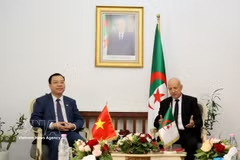
Secretary-General of the National Liberation Front (FLN) Abdelkrim Benmbarek (R) receives Vietnamese Ambassador to Algeria Vu Duy Long on September 21. (Photo: VNA)

Vietnamese ambassador pays courtesy call on FLN Secretary-General

Secretary-General of the National Liberation Front (FLN) Abdelkrim Benmbarek affirmed the importance the FLN attaches to the continued consolidation of friendship, solidarity and cooperation between the two parties on the basis of their cooperation agreement signed last year, thereby helping to promote relations between the two countries and peoples.

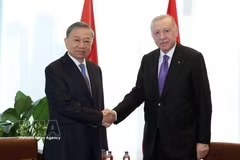
General Secretary of the Communist Party of Vietnam Central Committee and President To Lam (L) has a meeting with Turkish President Recep Tayyip Erdogan in New York on September 21 (local time). (Photo: VNA)

Top leader meets with Turkish President on UNGA 81 sidelines

Vietnam and Türkiye should also work towards the goal of 4 billion USD in bilateral trade by having Türkiye recognise Vietnam's market economy status, open their respective markets to each other and reduce trade barriers, General Secretary of the Communist Party of Vietnam Central Committee and President To Lam said.

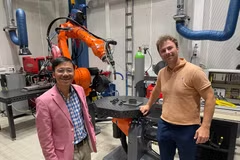
Assoc. Prof. Vu Viet Hung (left) visits a 3D-printed space made by robots. (Photo: VNA published)

Science, technology open new avenues for Vietnam-Canada ties

If the political momentum generated by high-level exchanges can be translated into durable cooperation mechanisms, science, technology and innovation could move beyond academic exchanges and individual projects to become a substantive pillar of Vietnam-Canada relations, generating concrete products, businesses and economic value for both countries.

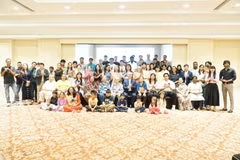
General Secretary of the Communist Party of Vietnam Central Committee and President To Lam speaks at the meeting with Vietnamese experts and intellectuals in the US, in New York on September 21 morning (local time). (Photo: VNA)

Top leader meets Vietnamese experts and intellectuals in US

The Party and State have determined that Vietnam must persistently and resolutely address these shortcomings, while creating favourable conditions and encouraging scientists to conduct research and pursue innovation in order to develop practical and effective products, General Secretary of the Communist Party of Vietnam Central Committee and President To Lam said.

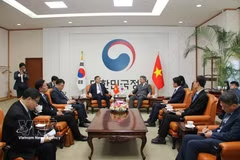
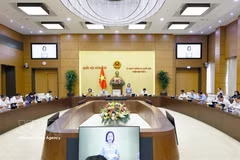
The working session between representatives of the Ho Chi Minh National Academy of Politics and the RoK Ministry of the Interior and Safety. (Photo: VNA)

Vietnam, RoK promote strategic cadre training cooperation in new development phase

A delegation of the Ho Chi Minh National Academy of Politics (HCMA) is paying a working visit to the Republic of Korea (RoK) from September 20-22 to strengthen cooperation in public governance, digital government and training of Vietnamese leaders and managers, particularly strategic-level cadres, to meet national development requirements in a new phase.

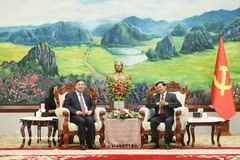
Standing Deputy Prime Minister Pham Gia Tuc (left) meets with Party General Secretary and President of Laos Thongloun Sisoulith in Vientiane on September 21, 2026. (Photo: VNA)

Standing Deputy PM works in Laos to strengthen relations

The two sides agreed to keep working together to deepen the substance of “strategic cohesion”, focusing on effectively implementing the agreements between the two Parties and countries; strengthening defence and security cooperation; creating breakthroughs in economic, trade and investment links; and promoting collaboration in culture, sports, tourism, education, locality-to-locality ties and people-to-people exchanges.

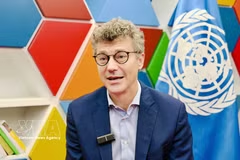
Jonathan Wallace Baker, UNESCO Representative to Vietnam, grants an interview to the Vietnam News Agency (Photo: VNA)

UNESCO ready to work with Vietnam to implement International Decade of Culture for Sustainable Development initiative: Representative

Jonathan Wallace Baker, UNESCO Representative to Vietnam, noted that the official proclamation of the 2027–2036 period as the "International Decade of Culture for Sustainable Development" comes at a particularly important moment. As the international community works to accelerate progress towards the 2030 Agenda while beginning to consider what comes after 2030, the Decade provides a ten-year framework to strengthen the place of culture in development.

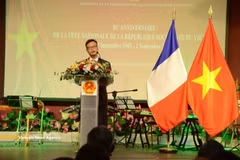
Vietnamese Ambassador to France Trinh Duc Hai addresses the ceremony in Paris on September 18. (Photo: VNA)

Vietnam, France look towards shared future

Vietnamese Ambassador to France Trinh Duc Hai noted that the two countries share a long and eventful history, along with deep exchanges in people-to-people ties, culture, intellectual life and science. Bilateral relations today have moved beyond the framework of their shared history and are firmly looking towards the future.

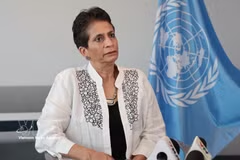
Kanni Wignaraja, UN Assistant Secretary-General and Regional Director for Asia and the Pacific at the UN Development Programme (UNDP), in an interview granted to the Vietnam News Agency (Photo: VNA)

Vietnam can offer valuable lessons to support more effective multilateralism: UN official

Assessing the significance of General Secretary of the Communist Party of Vietnam Central Committee and President To Lam’s attendance at the UN General Assembly High-Level Week, a UN official noted that Vietnam’s presence consistently reflects a development and foreign policy vision that places peace, stability, security, and the well-being of the people at the centre.