National Assembly Standing Committee considers 2027 legislative programme

NA President Tran Thanh Man said in 2027 the Government should shift from pursuing a high volume of legislation to ensuring high-quality laws that provide stability and create favourable conditions for development.

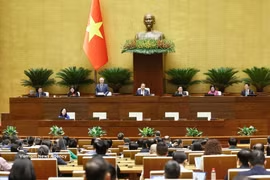
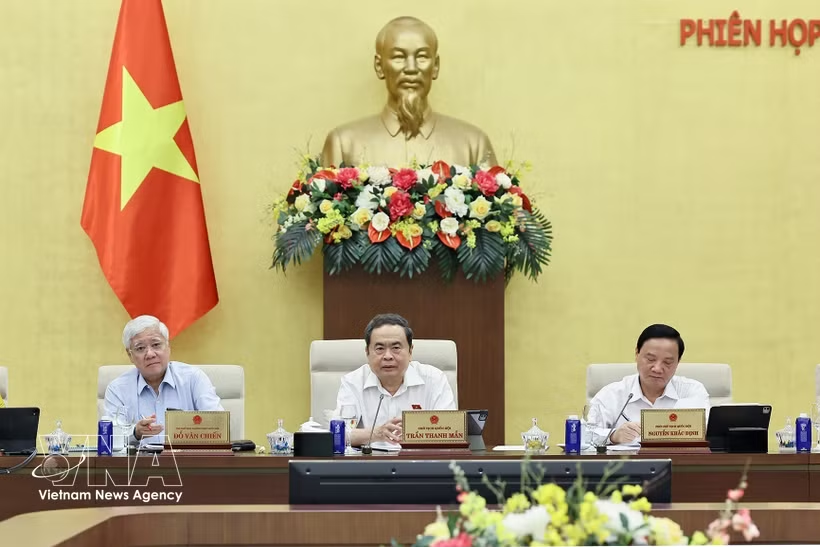
NA President Tran Thanh Man (centre) speaks at the NA Standing Committee's sixth session on September 21. (Photo: VNA)

Hanoi (VNA) – The National Assembly (NA) Standing Committee on September 21 discussed the draft 2027 legislative programme, with NA President Tran Thanh Man calling for earlier preparation, fewer adjustments and higher quality.

Speaking at the standing committee’s sixth session, the NA President said in 2027 the Government should shift from pursuing a high volume of legislation to ensuring high-quality laws that provide stability and create favourable conditions for development.

He noted that a large number of laws have been adopted in recent years, helping remove institutional bottlenecks. The key task now, however, is to ensure effective implementation and translate laws into practice.

NA President Man pointed out that the legislative programme has undergone frequent adjustments, while some legislative dossiers have been submitted late or without sufficiently thorough preparation. Impact assessments in some cases have also lacked depth, resulting in bills being postponed, withdrawn or submitted for expedited procedures.

He stressed that before a bill is included in the programme, its key issues, policies, scope, required resources and feasibility must be basically clear. He called for greater discipline in maintaining the stability and consistency of the legal system. While laws must respond promptly to practical requirements, this should not mean frequent amendments.

The top legislator requested that the 2027 legislative programme be designed from the perspective of the legal system as a whole rather than the individual needs of particular agencies.

For emerging fields such as data, artificial intelligence, cybersecurity, digital technology and unmanned aerial vehicles, he called for a comprehensive review of the relevant legal framework and clear delineation of regulatory boundaries before deciding whether separate legislation is necessary.

He also urged the adoption of a new legislative approach under which laws should cover matters falling under the NA’s authority and establish stable, fundamental principles, and frequently changing issues should be delegated to competent authorities to ensure flexibility.

However, he stressed that such a division between legislation and regulation must not simply shift difficult issues to lower levels. Law drafting techniques should also be strengthened to prevent group and local interests from influencing law-making.
vnanet-tranthanhman2.jpg
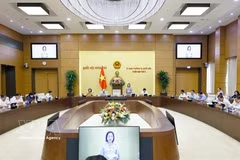
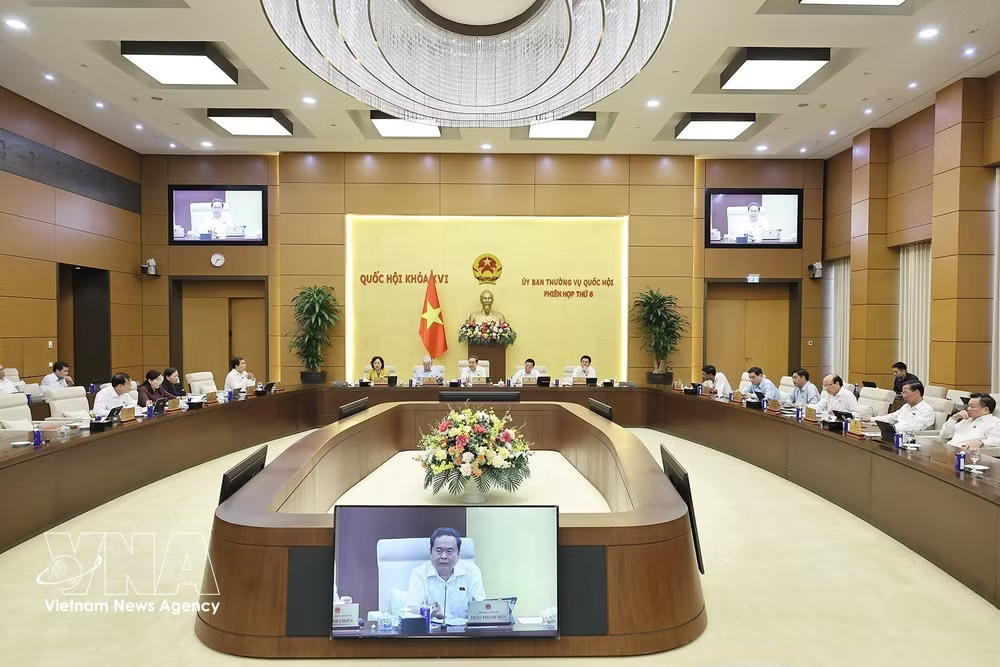
An overview of the NA Standing Committee's sixth session on September 21 (Photo: VNA)

NA President Man also called for stricter discipline from the outset, with the Government and relevant agencies preparing legislative dossiers well in advance and supervision agencies becoming involved from the policy-making stage. Supplementing the legislative programme during the year should remain an exception rather than become a regular practice, he added.

At the session, Deputy Prime Minister Le Tien Chau said the Government is reviewing documents of the 14th National Party Congress, resolutions, directives and conclusions of the Party Central Committee and its Politburo and Secretariat, as well as the results of a comprehensive review of the legal system to fully identify additional legislative tasks needed.

The Government will propose only genuinely necessary bills with clear political, legal and practical foundations and sufficient preparation, while minimising requests to add, withdraw or postpone bills, he stated.

Concluding the discussion, NA Vice President Nguyen Khac Dinh said the standing committee agreed in principle to consider adopting a resolution on the 2027 legislative programme, with 23 of the 28 projects proposed by relevant agencies included.

Also at the session, the State Audit Office of Vietnam reported that it carried out 132 audit tasks through 180 audit teams in 2026. For 2027, it plans to conduct 139 audit tasks, focusing on public finance and assets, major national projects, public investment, enterprises and financial institutions, as well as areas vulnerable to wastefulness and negative practices./.
VNA

See more

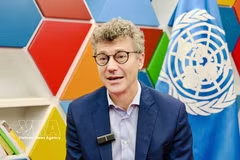
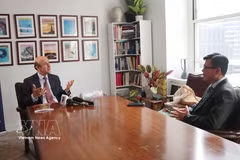
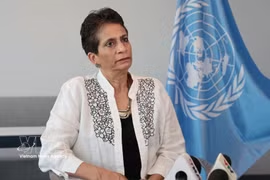
Jonathan Wallace Baker, UNESCO Representative to Vietnam, grants an interview to the Vietnam News Agency (Photo: VNA)

UNESCO ready to work with Vietnam to implement International Decade of Culture for Sustainable Development initiative: Representative

Jonathan Wallace Baker, UNESCO Representative to Vietnam, noted that the official proclamation of the 2027–2036 period as the "International Decade of Culture for Sustainable Development" comes at a particularly important moment. As the international community works to accelerate progress towards the 2030 Agenda while beginning to consider what comes after 2030, the Decade provides a ten-year framework to strengthen the place of culture in development.

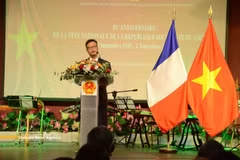
Vietnamese Ambassador to France Trinh Duc Hai addresses the ceremony in Paris on September 18. (Photo: VNA)

Vietnam, France look towards shared future

Vietnamese Ambassador to France Trinh Duc Hai noted that the two countries share a long and eventful history, along with deep exchanges in people-to-people ties, culture, intellectual life and science. Bilateral relations today have moved beyond the framework of their shared history and are firmly looking towards the future.

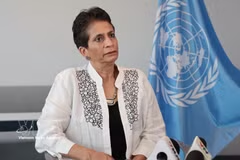
Kanni Wignaraja, UN Assistant Secretary-General and Regional Director for Asia and the Pacific at the UN Development Programme (UNDP), in an interview granted to the Vietnam News Agency (Photo: VNA)

Vietnam can offer valuable lessons to support more effective multilateralism: UN official

Assessing the significance of General Secretary of the Communist Party of Vietnam Central Committee and President To Lam’s attendance at the UN General Assembly High-Level Week, a UN official noted that Vietnam’s presence consistently reflects a development and foreign policy vision that places peace, stability, security, and the well-being of the people at the centre.

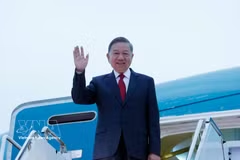
General Secretary of the Communist Party of Vietnam Central Committee and President To Lam departs Hanoi on September 20 morning to attend the UNGA 81 high-level general debate, engage in bilateral activities in the US, and pay a state visit to Canada. (Photo: VNA)

Top leader departs for UNGA 81 high-level debate, state visit to Canada

The trip is expected to make an important contribution to further strengthening and deepening Vietnam’s relations with the UN, the US and its partners; promoting more substantive and closely connected Vietnam–Canada ties; and affirming Vietnam’s proactive, active and responsible role in global issues, as well as its active contribution to regional and global peace, stability, cooperation and development.

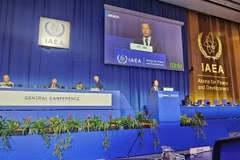
Nguyen Hoang Linh, Director of the Vietnam Agency for Radiation and Nuclear Safety, delivers Vietnam’s national statement at the plenary sitting of the 70th Regular Session of the IAEA General Conference in Austria. (Photo published by VNA)

Vietnam affirms safe, peaceful development of nuclear energy

Delivering Vietnam’s national statement, Nguyen Hoang Linh, Director of the Vietnam Agency for Radiation and Nuclear Safety, said the Southeast Asian nation is implementing its strategy for the development and application of atomic energy for peaceful purposes through 2035, with a vision to 2050, while preparing the necessary conditions for its Ninh Thuan nuclear power projects, nuclear sci-tech centre, and new research reactor.

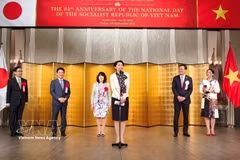
Chairwoman of the Japan-Vietnam Parliamentary Friendship Alliance Obuchi Yuko speaks at the ceremony marking 81st National Day of Vietnam in Tokyo, Japan, on September 18, 2026. (Photo: VNA)

Vietnam, Japan move forward together in new era of development

Minister of Finance Katayama Satsuki affirmed that Vietnam-Japan relations have entered a new stage of development. She said cooperation in areas such as finance, semiconductors, artificial intelligence (AI), critical minerals and energy would not only promote mutual growth but also contribute to regional peace and prosperity.