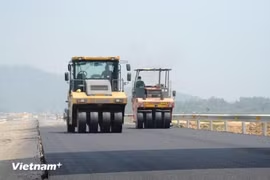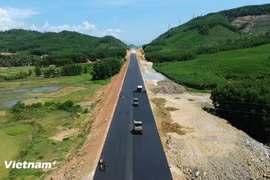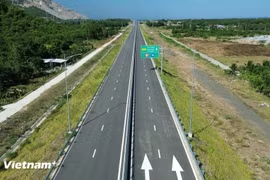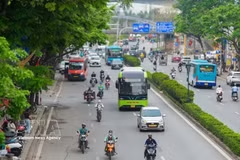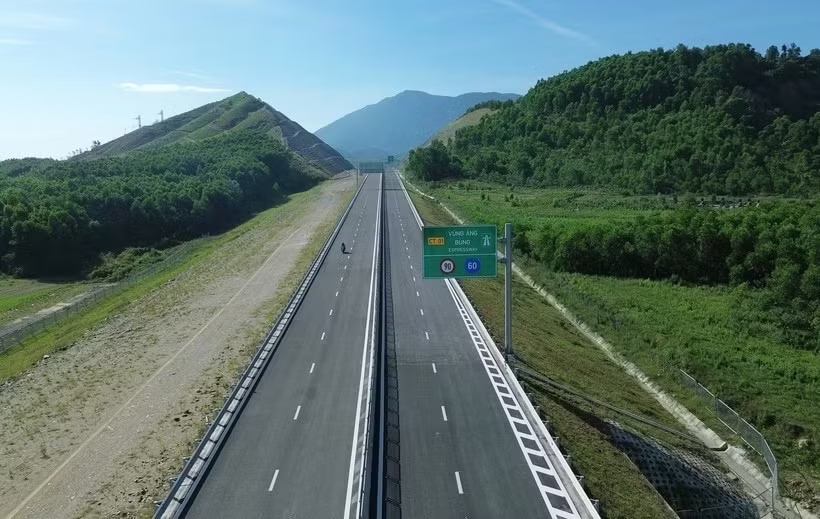
Hanoi (VNA) - The Ministry of Construction reported that the national expressway network now comprises 3,345km of main routes and 458km of interchanges and access roads. Road transport remains the dominant mode of domestic transport, accounting for 70-75% of freight and around 91% of passenger traffic.
The ministry directly manages about 4,875km of key national highways of regional and international importance, equivalent to around 20% of the network, while more than 17,520km, or over 70%, have been decentralised to local authorities for management.
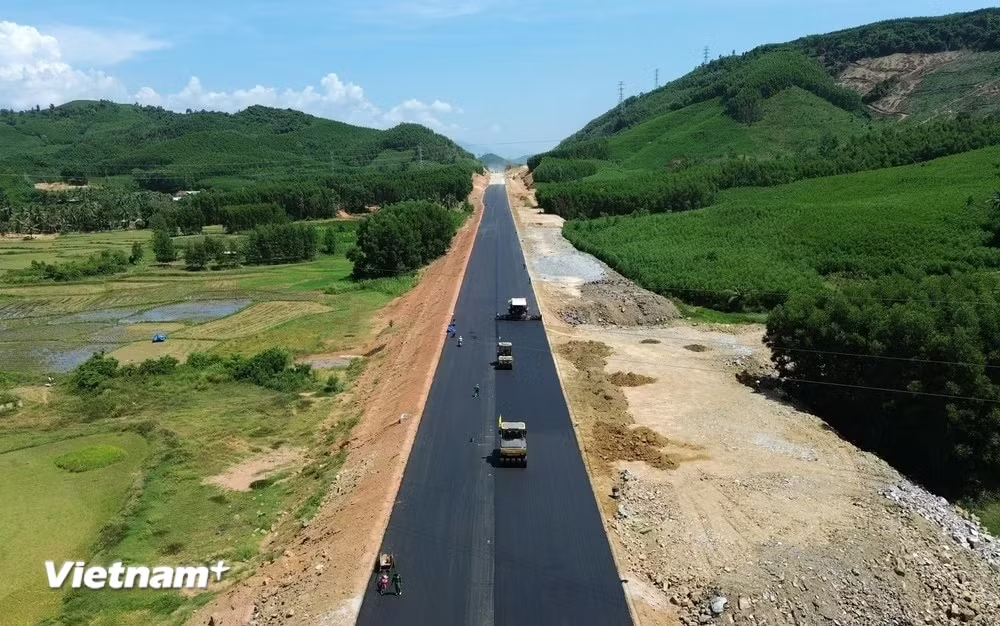
Across the country, 38 expressway projects covering about 2,111km are under construction. Of these, the Ministry of Construction is implementing eight projects with a combined length of 284km, local authorities are overseeing 29 projects totalling 1,797km, while the Vietnam Expressway Corporation (VEC) is developing a 30km project.
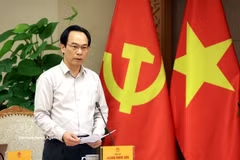
Deputy Minister of Construction Nguyen Xuan Sang said the motorways sector had developed in line with planning, with transport infrastructure gradually expanded and modernised through the completion of key routes. He added that the auction of investment rights for 21 service areas along the North-South Expressway had generated more than 1.5 trillion VND (over 57 million USD) for the State budget.
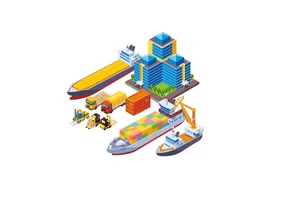
For the maritime sector, infrastructure has continued to improve, with cargo throughput rising from 706.1 million tonnes in 2021 to 955.5 million tonnes in 2025.
The country now has 309 port terminals, around 107km of wharves, 14 offshore oil and gas ports, together with an increasingly synchronised system of shipping channels, navigational aids and breakwaters, meeting all domestic and import-export transport demand.
Although inland waterways, with a navigable network of about 25,108.6km, have not received adequate investment, they form major transport corridors linking key economic regions.
On that basis, the ministry is refining transport plans to strengthen integration between maritime and inland waterway transport, prioritising investment in gateway ports and key shipping channels.
It is also accelerating major port projects, including Gemalink Phase 2, Cai Mep Ha, Lien Chieu, Lach Huyen berths 7, 8, 9 and 10, and Hon Khoai, while promoting greater decentralisation.
In aviation, the ministry is speeding up key projects, including Phase 1 of Long Thanh International Airport, the expansion of Ca Mau Airport, runway upgrades at Vinh and Lien Khuong airports, the upgrading of Phu Quoc International Airport for the APEC Economic Leaders' Meeting in 2027, and construction of a second runway at Phu Cat Airport.
The ministry is also reviewing and refining airport planning to develop a modern and synchronised airport network, accelerate major projects, strengthen decentralisation, expand international air routes, promote air logistics, and advance digital and green transformation in line with Resolution No. 57-NQ/TW on science, technology, innovation and national digital transformation.
For the railway sector, the ministry is directing relevant agencies to expedite procedures for Component Project 2 of the Lao Cai-Hanoi-Hai Phong railway, as well as the Hanoi-Lang Son and Hai Phong-Ha Long-Mong Cai railways. It is also working with local authorities to speed up land clearance, compensation and resettlement.
The Ministry of Construction is finalising a report on the selection of technology suppliers and transfer partners for the North-South high-speed railway project for submission to the Government Party Committee and competent authorities.
Looking ahead, the ministry said it would continue monitoring developments in the Middle East, assess their impact, and propose measures to prevent disruptions to supply chains, production and business activities, while stabilising transport and construction material prices and ensuring the progress of investment projects.
The ministry will also accelerate investment preparation, review and update technical standards for major transport projects, and propose solutions to remove obstacles in the construction sector in support of the country's economic growth targets./.