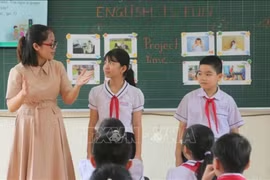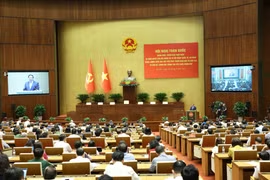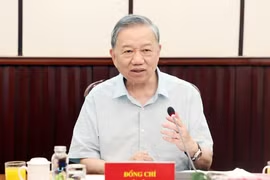
Hanoi (VNA) – The Ministry of Education and Training (MoET) has finalised a draft National Assembly resolution on six groups of key policies aimed at making breakthrough in education and training. The draft has been publicised on the ministry’s online portal for public consultation.
According to the MoET, the draft resolution seeks to institutionalise the Party and State’s major guidelines and policies on education and training, including the Party Central Committee’s Resolution 29-NQ/TW, dated November 4, 2013, on fundamental and comprehensive reform of education – training, and the Politburo’s Resolution 71-NQ/TW, dated August 22, 2025, on making breakthrough in the field.
Human resources and education institution governance
The draft proposes empowering local authorities in managing education institutions. Directors of provincial-level education departments are given power over the appointment of institution leaders, and the management and use of teachers, administrators, and staff at preschool and general education levels. The Minister of Education and Training would issue professional standards and criteria for directors of provincial-level departments.
It also introduces preferential allowances and flexible recruitment policies to attract high-quality professionals. The aim is to build a sufficient, well-structured, and regionally and internationally standardised teaching and management workforce that meets the requirements of reform and integration.
Curriculum, content, and development mechanisms
Under the proposal, the Government would determine overarching directions for education reform, including curriculum renewal and mechanisms for training cooperation with enterprises. A national certification recognition system would be developed to ensure lifelong learning and connectivity across education levels.
The Minister of Education and Training would annually report to the Government, give directions over preschool education reform, and be given the power to permit the piloting of new educational models, vocational skill councils, and flexible higher education programmes linked to labour market demand. The minister would also be responsible for approving a unified set of national textbooks which would be subject to regular review and updates.
The Government would further detail special mechanisms for such fields as culture, arts, elite sports, and journalism – publication, with talent-based selection, professional standards, investment priorities, and merit-based incentives to be specified.
Digital transformation, sci-tech development and innovation
To accelerate digital transformation, science – technology development and innovation, the draft allows pilot partnerships between the State, educational institutions, and enterprises to build an integrated smart education platform for management, teaching, and assessment.
A national education and human resources information system would be developed and connected to labour market and science – technology databases to better forecast workforce supply and demand, and improve management efficiency.
The draft also proposes using public funds and mobilising domestic and international experts for developing strategic technologies, implementing the digital university model, and sharing resources across institutions. A mechanism for tripartite cooperation would be built to support investment in shared laboratories while training, research, and technology transfer in key fields be enhanced.
International integration
The draft proposes a five-year visa and work permit exemption for foreign experts and scientists with doctoral degrees who teach, research, or manage at Vietnamese higher education or vocational training institutions.
Some key universities would be authorised to certify foreign experts and scientists exempt from work permit requirements and be responsible for the legality of their diplomas, degrees, and working conditions. Educational institutions would be allowed to hold international conferences and workshops in line with regulations, without prior approval, and only need to notify the MoET and provincial authorities.
The resolution also encourages partnerships between Vietnamese universities and top 500 global institutions to open branch campuses in Vietnam under the public – private partnership (PPP) model. International students studying in Vietnam would be permitted to work up to 20 hours per week.
National scholarship fund
A National Scholarship Fund would be established under the MoET, financed by the State budget, donations, sponsorships, and other lawful sources. The fund would provide talent scholarships, support high-quality human resources development, encourage research and learning, and promote vocational skill improvement aligned with the needs of the labour market and international integration. Its operations would be transparent and subject to independent audit.
Finance, investment in education and training
The draft resolution stipulates that the State budget allocate at least 20% of total expenditure to education, including a minimum of 5% for development investment and 3% for higher education. Priority would be given to early childhood and general education in disadvantaged areas, alongside continued investment in tertiary, vocational, and continuing education.
A special financial mechanism would be built to support universal lower secondary education by 2030 and upper secondary by 2035. The proposal also targets free textbooks before 2030, tuition exemptions for national defence and security education, and outstanding preferential land, tax, and infrastructure policies for educational institutions.
According to the MoET, the proposed policies are designed to address current challenges, remove institutional barriers, and create strategic breakthroughs for a modern, inclusive, and globally integrated education system./.