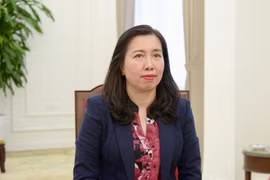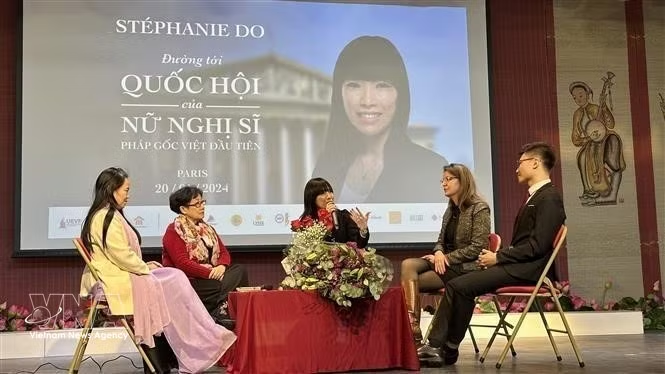
Paris (VNA) – Vietnam–France relations are at a turning point and have an opportunity to enter a new phase of development, in which the two countries need to shift from a mindset of cooperation to one of “co-creation”, based on a shared strategic vision, concrete projects and complementary strengths, said Stéphanie Do, Chairwoman of the Together for France party.
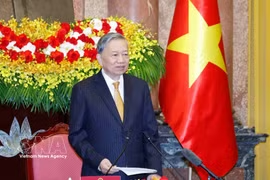
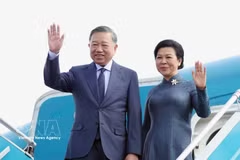
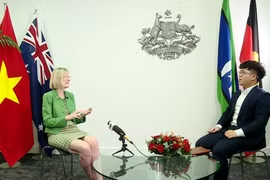
Stéphanie Do, also former member of the French National Assembly and former Chairwoman of the France–Vietnam Parliamentary Friendship Group, gave an interview to Vietnam News Agency correspondents in Paris ahead of General Secretary of the Communist Party of Vietnam Central Commitee and President To Lam’s official visit to France.
She held that the visit carries particular significance, reflecting the strong and sustained momentum in bilateral relations. It comes amid intensified high-level exchanges between the two countries, following French President Emmanuel Macron’s State visit to Vietnam last year, which she had the honour of joining.
She said that such a high frequency of exchanges in France–Vietnam relations is unprecedented, considering the different political terms in both countries. This not only demonstrates the depth of the two countries’ strategic partnership, but also reflects a genuine friendship built on trust, mutual respect and sincere sentiments between their people. This momentum is paving the way for a new and more ambitious phase of the Vietnam–France Comprehensive Strategic Partnership.
The two countries share not only a long history of close ties and strong people-to-people and cultural connections, but also increasingly common interests in such areas as economy, trade and investment, energy transition, healthcare, education, scientific research, digital technology, defence and security, she stated.
“In the new context, Vietnam and France need to move from a relationship based primarily on historical ties to one grounded in a shared strategic vision and concrete projects,” she noted.
According to the Vietnamese-origin former lawmaker, France could become a priority partner for Vietnam in its efforts to upgrade technological capabilities, develop human resources and pursue sustainable development. Conversely, Vietnam is an important gateway for France to access Southeast Asia and a key partner within the Association of Southeast Asian Nations (ASEAN). These shared interests and complementary strengths provide a foundation for the bilateral relationship to enter a more substantive and ambitious phase of cooperation.
France boasts recognised expertise and experience in technology, science, industry, energy, the environment and infrastructure, while Vietnam has a dynamic market, a young population, strong adaptability and a strategic location at the heart of Southeast Asia.
Among the areas with significant potential, Stéphanie Do first highlighted infrastructure and transport, particularly railways, urban transportation, seaport infrastructure and logistics. Vietnam’s development requires modern, sustainable and highly interconnected infrastructure systems. In her view, French experience could generate added value not only in technology but also in planning, training and skills transfer.
Energy transition and green growth were also identified as major areas for cooperation. Vietnam, like many countries in the region, is facing challenges posed by climate change and the energy transition, while French companies have extensive experience in renewable energy, energy efficiency, smart grids, water management, the circular economy and low-carbon technologies. These are areas with considerable potential for the two countries to develop long-term partnerships.
Another area she particularly values is innovation, research, artificial intelligence (AI), digital technology and high technology. As Vietnam seeks to become a leading technology country in Asia, France, with its network of universities and major higher-education institutions, research centres and startup ecosystem, could become a priority partner accompanying Vietnam in realising this ambition. She said the two countries need to significantly strengthen partnerships among researchers, universities, businesses and young entrepreneurs.
Space and maritime affairs are also strategic fields that could open up new avenues for cooperation. Vietnam has a long coastline and is attaching increasing importance to its maritime strategy, while France possesses internationally recognised scientific, technological and industrial capabilities in both maritime affairs and space. These complementary strengths could facilitate cooperation in Earth observation, climate monitoring, resource management, risk prevention and the protection of maritime spaces.
Alongside technological and economic sectors, Stéphanie Do placed particular emphasis on training and human resources, stressing that Vietnam–France cooperation in higher education, vocational training, research and student exchanges should be placed at the heart of the partnership. Investing in Vietnam’s younger generation is also an investment in the future of relations between the two countries, she noted.
Building on their complementary strengths, Stéphanie Do said France needs to view Vietnam not merely as a market with considerable potential, but also as a strategic partner and an important hub in the region. Conversely, France can serve as a gateway for Vietnam to access the European market, while also being a partner supporting Vietnam in enhancing its technological and industrial capabilities. The two countries should pursue substantive cooperation projects that jointly create value through investment, innovation, training and expansion into new markets, she stated.
Regarding initiatives that should be promoted during the top Vietnamese leader’s visit, Stéphanie Do said the two countries should develop a joint programme of strategic projects, clearly identifying priority areas, responsible focal points, implementation roadmaps and targets to be achieved.
“The key is not to announce a large number of projects, but to ensure that the projects already agreed upon are implemented and deliver concrete results. This will facilitate the participation of French businesses in major infrastructure development and modernisation projects in Vietnam,” she said.
In addition, the two countries should strengthen connections among businesses, startups, investors and government agencies, and promote joint investment and manufacturing and industrial cooperation, rather than limiting ties to trade exchanges, she added.
According to Stéphanie Do, Vietnam is seeking to enhance its position in global value chains, while France has technological strengths and experience that can support this process. Therefore, the two countries should promote cooperation towards joint production, joint innovation and, where conditions permit, jointly expanding into regional markets.
Innovation and future technologies are another priority. Stéphanie Do expressed her hope that France and Vietnam would develop more joint programmes in AI, digital technology, space technology, biotechnology, healthcare, clean energy and maritime technologies. She said both countries have talented researchers, engineers, entrepreneurs and human resources; what is needed now is to strengthen connections among these resources.
She also emphasised the need to boost training collaboration and locality-to-locality connections, strengthen exchanges between young generations, and promote the role of the Vietnamese community in France and French people with close ties with Vietnam.
Stéphanie Do said that Vietnam and France are facing a “historic opportunity” as Vietnam undergoes rapid transformation, while France is also seeking to strengthen partnerships with dynamic economies in Asia. The two countries therefore share a common interest in moving forward together and seizing the current opportunity to bring bilateral relations into a new phase of development.
In her view, General Secretary and President To Lam’s visit should serve as an opportunity to give the Comprehensive Strategic Partnership clear objectives and resources and, above all, deliver concrete results. Only on that basis can Vietnam and France build a more balanced and ambitious relationship that, above all, brings greater benefits to the people of both countries./.
VNA