EU’s global gateway strategy boosts sustainable investment, connectivity in Vietnam

The European Union (EU) is stepping up efforts to expand sustainable investment and connectivity in Vietnam under its Global Gateway strategy.

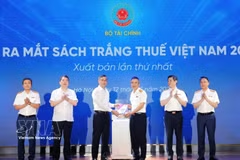
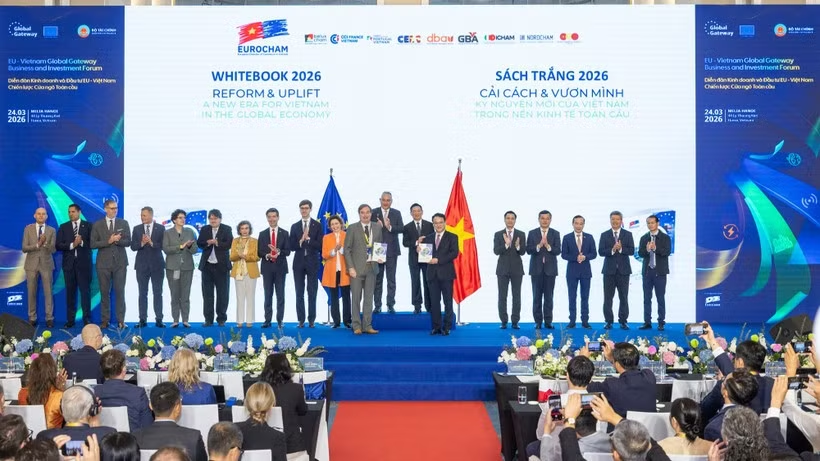
The White Book handover from EuroCham Vietnam to the Vietnamese Government. (Photo: VietnamPlus)

Hanoi (VNA) – The European Union (EU) is stepping up efforts to expand sustainable investment and connectivity in Vietnam under its Global Gateway strategy, reaffirming a strong, long-term commitment to supporting the country’s green transition and economic development.

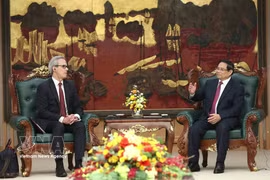
During his visit to Vietnam from March 23–25, EU Commissioner for International Partnerships Jozef Síkela highlighted the bloc’s determination to translate strategic cooperation into concrete projects, marking a significant step forward in the implementation of the EU–Vietnam Comprehensive Strategic Partnership.

Speaking at the EU–Vietnam Global Gateway Business and Investment Forum on March 24, Síkela described Vietnam as a dynamic economy with strong growth, a young population and vast potential.

With the Global Gateway strategy, the EU is bringing European businesses and investors to Vietnam to turn ambition into tangible projects, create jobs and support the country’s green transition, he said.

The Global Gateway is the EU’s flagship initiative to mobilise up to 400 billion EUR (468.71 billion USD) in public and private investments worldwide between 2021 and 2027. In Vietnam, this approach is being realised through “Team Europe” initiatives and major financing packages.

Síkela announced that the EU is rolling out a 560-million-EUR investment package to support Vietnam’s energy transition and economic development. A key project is the Bac Ai pumped-storage hydropower plant, with a capacity of 1,200 MW and an estimated total investment of around 900 million EUR. The project is expected to play a critical role in stabilising the national power system, enhancing energy storage capacity and improving the reliability of renewable energy sources.
cao-uy-eu-jozef-sikela.jpg
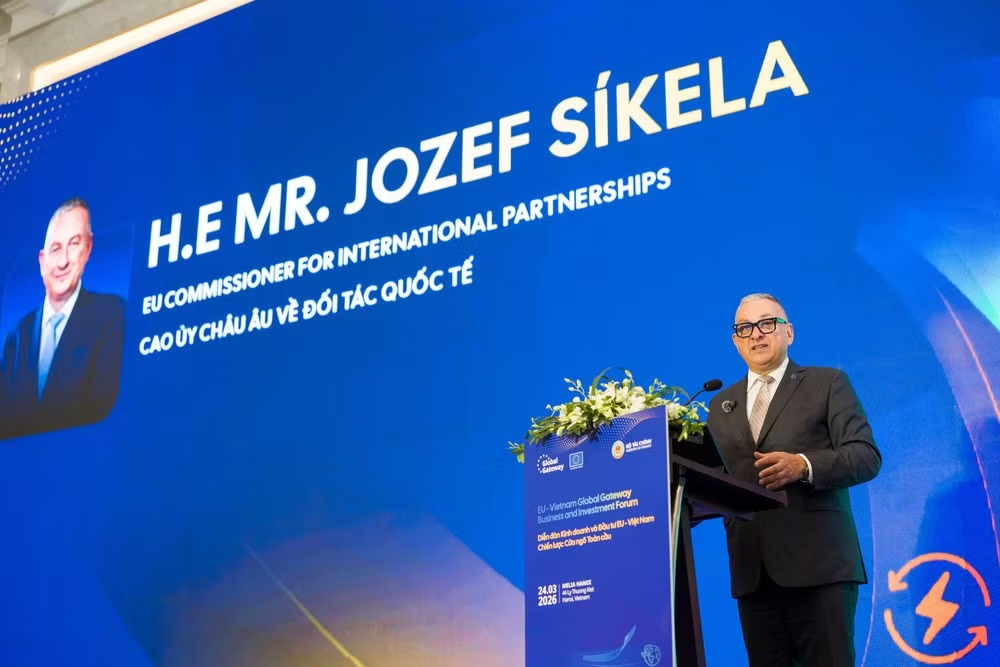
EU Commissioner for International Partnerships Jozef Síkela announces a 560-million-EUR investment package in support of Vietnam’s energy transition and economic development. (Photo: VietnamPlus)

In parallel, the EU has launched a 40-million-EUR Sustainable Transport Facility aimed at leveraging over 1 billion EUR in investment for railway and urban transport projects.

Nicola Beer, Vice-President of the European Investment Bank (EIB), affirmed that the bank, as the EU’s financial arm, stands ready to support Vietnam in implementing major infrastructure projects, including the planned North–South high-speed railway. She noted the success of Hanoi’s Metro Line 3 as a clear example of effective EU–Vietnam cooperation.

Expanding access to sustainable finance was another key focus of the visit. A newly announced 200-million-EUR financing agreement between the EIB and Techcombank will help Vietnamese businesses access preferential funding for renewable energy, energy efficiency and clean transport projects. This is expected to foster stronger synergy between public ambitions and private capital flows.

Beer said the EIB has been active in Vietnam since 1997, investing around 800 million EUR in sustainable infrastructure, transport and climate action. She stressed that future cooperation will prioritise energy systems, green finance and sustainable mobility, aiming to deliver high-quality projects with long-term impact.
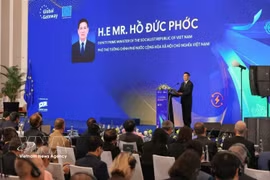
pho-thu-tuong-chinh-phu-ho-duc-phoc.jpg
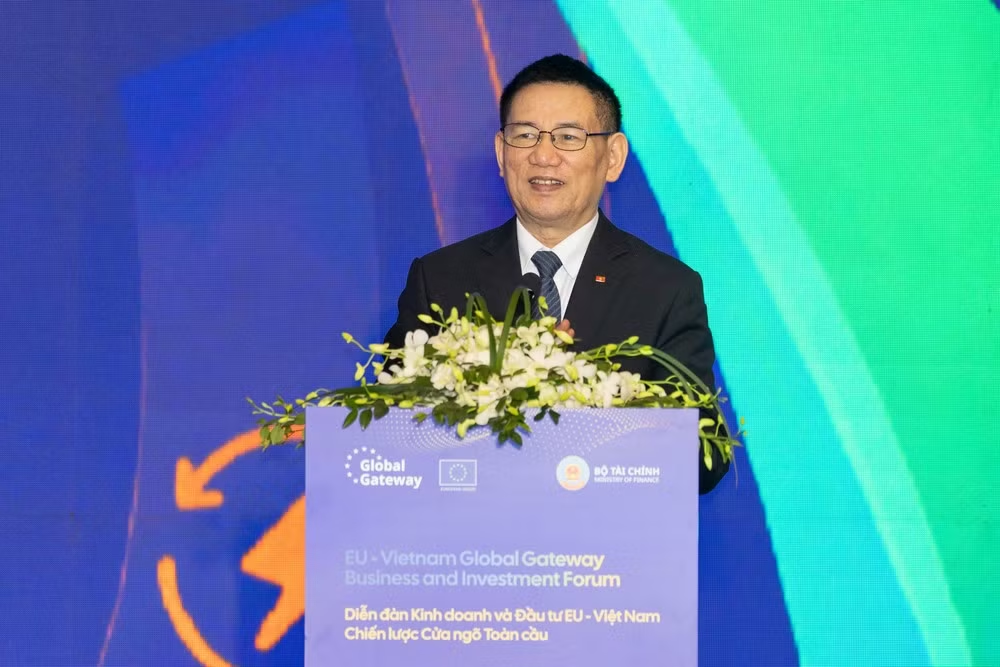
Deputy Prime Minister Ho Duc Phoc emphasises Vietnam’s desire for continued EU support in accessing green finance and attracting selective, high-quality investment. (Photo: VietnamPlus)

Representing the Vietnamese Government, Deputy Prime Minister Ho Duc Phoc expressed appreciation for sustained commitment from the EU. He underscored Vietnam’s desire to access green finance and attract high-quality, selective investments in areas such as the digital economy, circular economy, semiconductors and high technology, while advancing a just energy transition.

He reaffirmed that Vietnam considers the EU a leading partner and remains committed to achieving net-zero emissions by 2050. To maximise cooperation effectiveness, he called for enhanced technical support from the EU to help Vietnamese enterprises better integrate environmental, social and governance (ESG) standards into global value chains.

The Deputy PM also urged EU member states to expedite the ratification of the EU–Vietnam Investment Protection Agreement (EVIPA), describing it as a crucial missing piece to establish a stable and secure legal framework for businesses on both sides.

Looking ahead, he proposed closer cooperation in developing new growth models, including free trade zones and international financial centres in Vietnam.

“These will serve as magnets for global capital, generating new added value for both Vietnam and its European partners,” he said./.
VNA

See more

Viettel launches the Unitel Logistics brand in Laos. (Photo: VNA)

Vietnamese firms expand global footprint

The Government recently approved the “Go Global” programme for 2026-2030, which identifies the private sector as a key driving force in Vietnam’s international expansion process. It aims to help Vietnamese private enterprises strengthen their overseas presence in a comprehensive, effective and sustainable manner through international investment, business activities and deeper integration into regional and global supply and value chains.

Vietnam and Cambodia are seeking to strengthen supply chain connectivity and promote sustainable border trade at a trade promotion conference in Vietnam's Mekong Delta province of Dong Thap on May 15. (Photo: https://thoibaonganhang.vn/)

Vietnam, Cambodia eye stronger border trade, supply chain connectivity

Vietnam–Cambodia trade ties have grown rapidly in recent years, becoming one of the major pillars of economic cooperation in the Mekong sub-region. The two countries share a 1,137-km border and an increasingly developed network of international and secondary border gates, facilitating cross-border trade, logistics and investment.

Illustrative image. (Photo: VNA)

Three proposals to connect overseas Vietnamese resources with private economy at home

There are currently many Vietnamese IT specialists working in technology corporations, banks, start-ups and innovation ecosystems across Canada. With appropriate mechanisms in place, this workforce could become a technology bridge, helping Vietnamese enterprises access management expertise, technical solutions, international standards and partnership networks in North America.

The Nguyen Van Linh–Nguyen Huu Tho intersection fully opens both underpasses to traffic, helping ease congestion in the area. (Photo: VNA)

Ho Chi Minh City pushes for full public investment disbursement

Ho Chi Minh City was allocated a record 147.599 trillion VND (5.6 billion USD) in public investment capital for 2026, up 22.6% from last year and accounting for nearly 14.6% of the nation’s total public investment budget. However, disbursement by the end of April remained below the national average.

Visitors explore Quang Tri province’s OCOP products (Photo: VNA)

Quang Tri links OCOP products with tourism to expand farm produce markets

The central province currently has 160 OCOP products developed by cooperatives, cooperative groups and businesses, including two five-star and 31 four-star products. These locally distinctive products are gradually becoming "ambassadors" showcasing Quang Tri’s culture and identity to domestic and international visitors.

Work starts on Hanoi’s Red River Landscape Boulevard Axis project on December 19, 2025. (Photo: VNA)

Hanoi approves nearly 28-bln-USD Red River landscape boulevard project

Covering more than 11,400 hectares and requiring an estimated 736.96 trillion VND (nearly 28 billion USD), the project is expected to reshape urban development along both banks of the Red River over the coming decades while improving transport connectivity and public spaces in the capital.

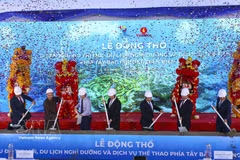
Deputy Prime Minister Nguyen Van Thang and delegates perform the ground-breaking ceremony for the Northwest Dien Bien Phu New Urban Area, Resort and Sports Complex project. (Photo: VNA)

Vingroup launches largest-ever urban development project in Dien Bien

Under the master plan, the project will span more than 228.5ha and accommodate around 12,000 residents. It is designed under a “city within a city” model integrating residential areas, commercial and service facilities, resorts, schools, healthcare services, public spaces and sports infrastructure.

Deputy Prime Minister Nguyen Van Thang and delegates press the button to launch construction of the Dien Bien Phu cultural-historical tourism and cable car complex project in Dien Bien province on May 10, 2026. (Photo: VNA)

Dien Bien Phu cultural-historical tourism, cable car complex project launched

The project aims to effectively tap the area’s natural landscapes, geographical advantages and distinctive historical value, while creating a high-quality tourism product with strong competitiveness. It is also intended to preserve, honour and promote the value of the Dien Bien Phu Victory special national historical relic site.

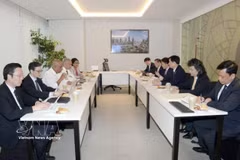
Politburo member Nguyen Duy Ngoc (third, right), who is Standing Deputy Head of the Central Steering Committee for Science-Technology Development, Innovation and Digital Transformation, holds a working session with the Colombo Port City Management Board. (Photo: VNA)

Vietnam studies Colombo smart port city model

Ngoc praised Sri Lanka’s orientations in developing seaport infrastructure, digital infrastructure, digital economy and international service centres, describing them as valuable references for Vietnam in developing strategic infrastructure, innovation centres, smart urban areas and digital economy ecosystems.