Expert suggests harnessing Vietnamese intellectual resources in US for national development

Dr Huynh The Du described Vietnamese students and researchers in the US as “knowledge ambassadors” and a direct link between the two countries’ education and innovation ecosystems.
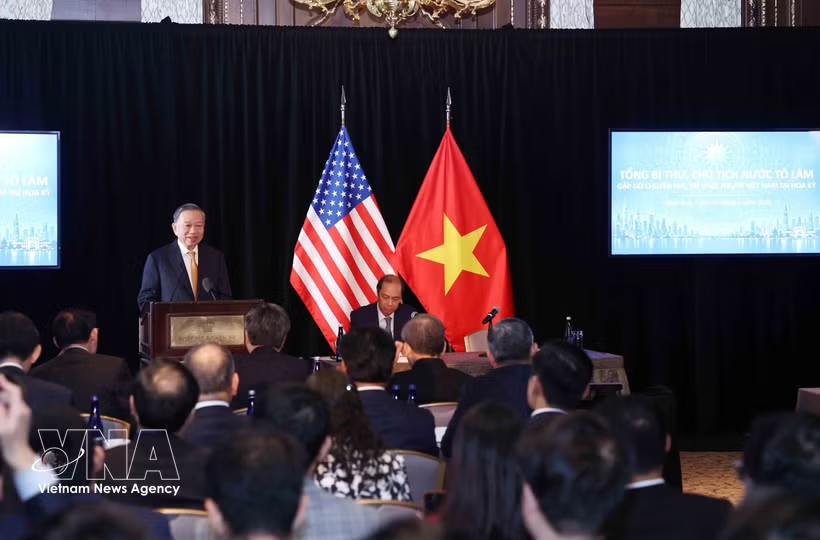
General Secretary and President To Lam meets with Vietnamese intellectuals in the US on September 21, 2026. (Photo: VNA)

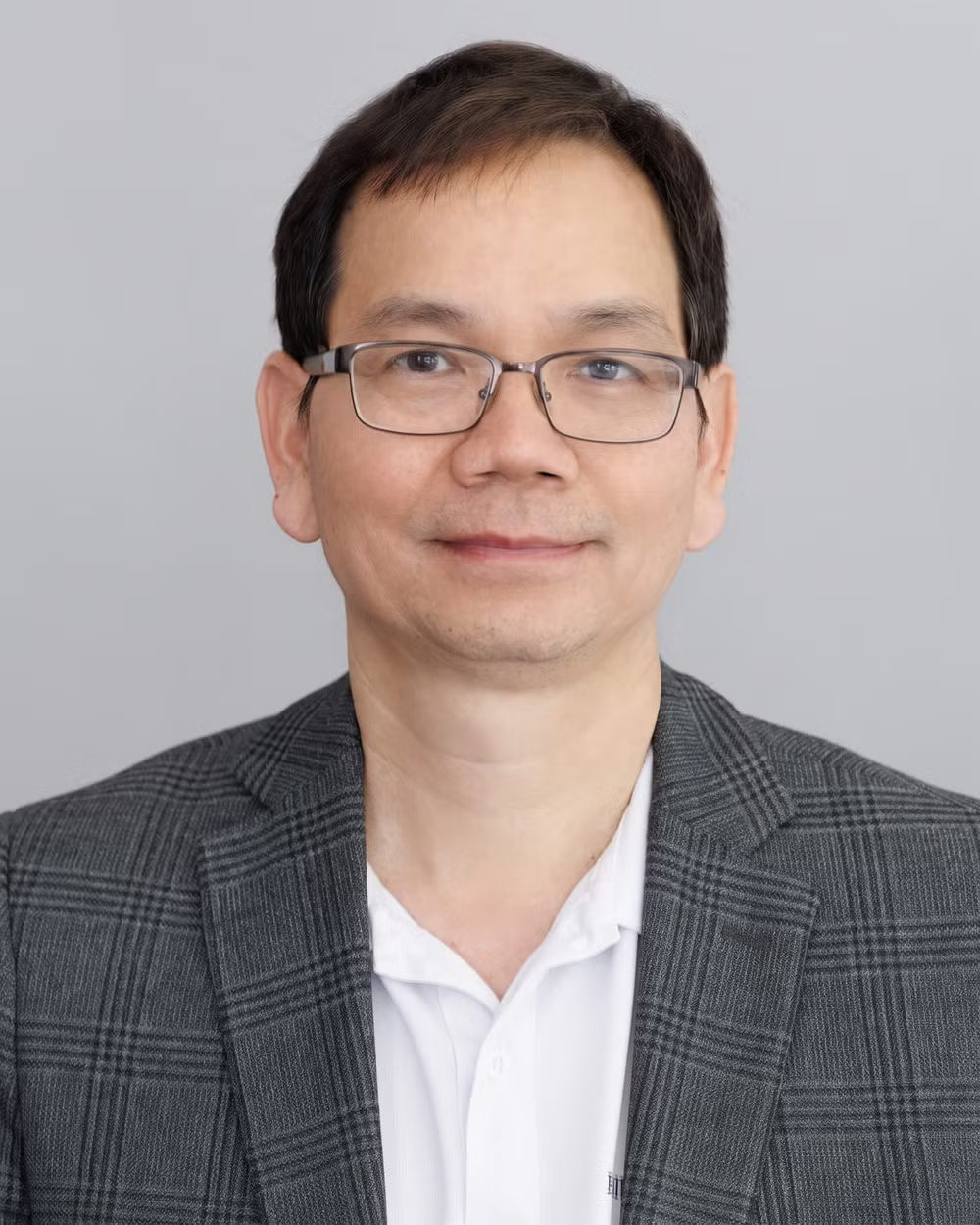
Washington, D.C (VNA) – Within the framework of the Vietnam–US Comprehensive Strategic Partnership, the Vietnamese community in the US serves as a “dual bridge” with three key roles, according to Dr. Huynh The Du, Chair of the Board of Directors and Chief Executive Officer of the Association of Vietnamese Professionals and Students in the US.

First, it serves as a bridge for technology and innovation. Vietnamese entrepreneurs and engineers in Silicon Valley and other major technology hubs can connect venture capital, support technology commercialisation, and facilitate knowledge transfer to Vietnam.

Second, the community serves as a bridge for people-to-people diplomacy and policy credibility. The growing social standing and professional reputation of Vietnamese expatriates can help strengthen strategic trust between the two governments and provide objective policy perspectives.

Third, Vietnamese experts in healthcare, education and law can contribute to raising institutional capacity in Vietnam and promoting its integration with global professional standards, according to Du.

He described Vietnamese students and researchers in the US as “knowledge ambassadors” and a direct link between the two countries’ education and innovation ecosystems.

ve.jpg
Dr. Huynh The Du, Chair of the Board of Directors and Chief Executive Officer of the Association of Vietnamese Professionals and Students in the US (Photo published by VNA)

Vietnam should prioritise four strategic technology areas when building cooperation networks, he recommended, elaborating that the first is semiconductor and microchip technology, involving collaborative training for a high-quality engineering workforce—spanning stages from design and testing to participation in the supply chain.

Next are artificial intelligence (AI) and data science, with applications in public administration, finance, and healthcare, alongside the development of data governance frameworks. The third area comprises green transition technologies and renewable energy, supporting Net Zero commitments, sustainable infrastructure development, and climate change adaptation. The fourth covers biotechnology and advanced medicine, focusing on medical technology transfer and public healthcare.

To turn the intellectual potential of the Vietnamese community in the US into tangible resources, Du said cooperation should be based on specific tasks and mutual benefits. This could include commissioning experts for specific projects, policy advice, and joint research from afar, while creating more flexible mechanisms for short-term visiting appointments and sabbaticals.

He also proposed developing joint labs connecting Vietnamese laboratories with research teams led by Vietnamese professors and experts in the US, helping young researchers in Vietnam gain exposure to international standards.

Du expressed his hope that the just-ended trip to the US by General Secretary of the Communist Party of Vietnam Central Committee and President To Lam will generate concrete outcomes, particularly in education and science – technology cooperation, including scholarships, joint research projects, funding commitments and high-tech human resources training in semiconductors and AI.

The expert also expected the trip to help concretise supply-chain commitments, advance the recognition of Vietnam as a market economy and facilitate high-tech investment from the US.

Emphasising the importance of strengthening trust and inspiring a spirit of contribution, he said direct meetings with high-level leaders could reinforce the great national solidarity and create a trusted environment for Vietnamese intellectuals abroad to make long-term contributions to the homeland./.
VNA

See more

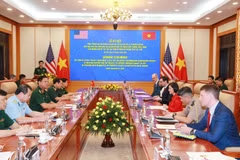
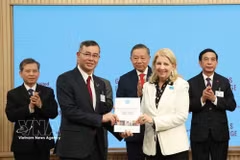
General Secretary of the Communist Party of Vietnam Central Committee and President To Lam (centre), together with senior officials of Vietnam, witnesses the exchange of cooperation documents between Vietnam and United Nations agencies in New York on September 22, 2026. (Photo: VNA)

Vietnam to receive over 221 million USD in UN development resources

The three Country Programme Documents provide an important framework for cooperation between Vietnam and the three UN development agencies for 2027–2031, helping mobilise international resources for the country’s development priorities and Sustainable Development Goals.

Leaders of the Ho Chi Minh City Red Cross Society on host a delegation from the Social Work Department of the Communist Party of China Central Committee led by Deputy Head Zhao Shi Tang on September 22 (Photo: VNA)

Vietnam, China strengthen humanitarian and social welfare cooperation

The Ho Chi Minh City Red Cross Society and the Red Cross Society of China are expected to grow increasingly close, helping strengthen the foundation of friendship and bring the Vietnam-China comprehensive strategic cooperative partnership into a new phase of more substantive cooperation.

General Director of Vietnam News Agency Vu Viet Trang (second, right) delivers a presentation at the international forum "Dialogue about Fake 4.0" (Photo: VNA)

VNA proposes establishing mechanism for sharing, verifying information

VNA General Director Vu Viet Trang said that the VNA is developing a three-pronged approach to fact-checking: verifying information at the source; utilising technology to scan for and flag potentially false information; and establishing rapid fact-checking channels, thereby affirming its role as a key national news agency.

Deputy Prime Minister Le Tien Chau speaks at the meering (Photo: VNA)

Vocational education restructuring must be swift, prudent and firm: Deputy PM

Deputy Prime Minister Le Tien Chau emphasised that restructuring does not mean reducing training capacity. Training enrolment could increase if it meets actual demand. Vocational education institutions transferred to local management should serve not only their respective localities but also the human resources needs of their regions and the country.

Prime Minister Le Minh Hung speaks at the September 21 meeting on textbook supply, the review of general education curricula and textbooks, and preparations for a thematic supervision delegation on the implementation of Politburo Resolution No. 71-NQ/TW. (Photo: VNA)

Prime Minister calls for decisive action to end textbook shortages

The Prime Minister requested a serious review to clarify the responsibility of organisations, units, and individuals involved in the inadequate supply of textbooks at the beginning of the school year, with violations to be handled in accordance with regulations.

Delegates attend the meeting of the Steering Committee for Combating IUU Fishing of Ho Chi Minh City on September 21 (Photo: VNA)

HCM City tightens seafood traceability to combat IUU fishing

Addressing a meeting of the municipal Steering Committee for Combating IUU Fishing on September 21, Pham Thi Na, Deputy Director of the municipal Department of Agriculture and Environment, reported that all local fishing vessels had been updated in the national fisheries database (VNFishbase) as of September 15, while nearly 95% of vessels of 15 metres or longer had been equipped with vessel monitoring systems (VMS).

Deputy Prime Minister Ho Quoc Dung chairs the meeting with several ministries and sectors on the revised Land Law on September 21 (Photo: VNA)

Deputy PM requests careful review of revised Land Law

The draft law follows a new legislative mindset under the Political Bureau’s Resolution No. 66-NQ/TW on reforming lawmaking and enforcement to meet development requirements in the new era. Accordingly, the law would provide framework and principle-based regulations, while frequently changing matters would be assigned to the Government, ministries, sectors, and localities for regulation.