Ho Chi Minh City to issue municipal, project bonds through VIFC to fund infrastructure

Beyond raising funds for infrastructure, the mechanism would help develop an international bond market, one of the four strategic product pillars of VIFC-HCMC. It would also connect domestic financing needs with international investors and financial institutions while promoting specialised services such as issuance consultancy, capital arrangement, credit ratings and risk management.

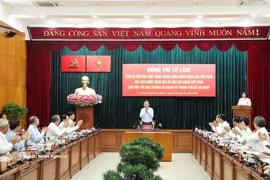
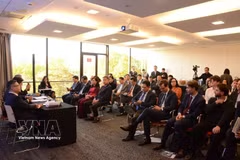
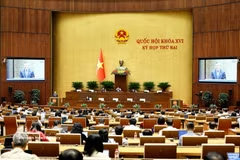
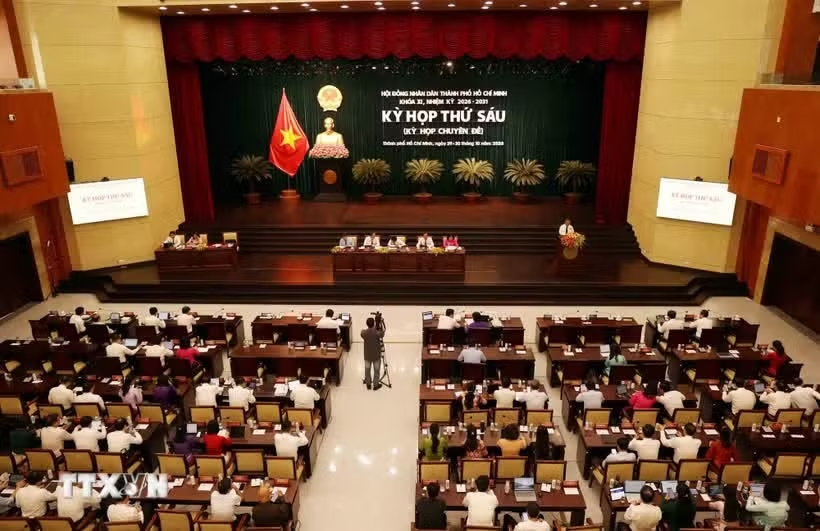
A view of the sixth thematic session of the Ho Chi Minh City People’s Council (Photo: VNA)

Ho Chi Minh City (VNA) – The Ho Chi Minh City People’s Council has approved a resolution on issuing municipal and project bonds through the Vietnam International Financial Centre (VIFC), opening up a new channel for medium- and long-term financing for key c and laying the groundwork for an international bond market in the city.

The council adopted the resolution during its sixth thematic session, under growing pressure to attract investment capital as infrastructure demands far surpass the city’s budget.

Between 2026 and 2030, the city’s total public investment needs are projected to reach 3.1 quadrillion VND (120 billion USD), but budget resources are expected to cover only about 31%. A total of 98 major transport and technical infrastructure projects have preliminary investments exceeding 1.5 quadrillion VND. Around 90 projects are proposed for investment under the public-private partnership (PPP) model for 2026-2031, with estimated capital surpassing 1.27 quadrillion VND.

The city aims to maintain average annual GRDP growth in double digits, with total social investment equivalent to 35-40% of GRDP over the five years. Its population is projected to reach around 18 million by 2030 and more than 27 million by 2050, further increasing demand for transport networks and essential infrastructure.

With limited room for budget expansion, diversifying funding sources, particularly by accessing medium- and long-term international capital, has become increasingly important.

The policy basis for the new mechanism was established in Politburo Resolution No. 09-NQ/TW dated May 19, 2026, on developing Ho Chi Minh City in the new era. The resolution allows the city to mobilise funds for key projects through municipal and project bond issuance, as well as loans from domestic and international financial institutions.

The Law on Urban Development No. 18/2026/QH16, which took effect on October 1, 2026, provides the legal framework for the city to issue such bonds through the VIFC.

The newly approved resolution sets out key provisions on issuers, the use of proceeds, issuance principles and payment responsibilities.

Beyond raising funds for infrastructure, the mechanism would help develop an international bond market, one of the four strategic product pillars of VIFC-HCMC. It would also connect domestic financing needs with international investors and financial institutions while promoting specialised services such as issuance consultancy, capital arrangement, credit ratings and risk management.

Nguyen Huu Huan, Vice Chairman of the VIFC-HCMC Executive Authority, said international capital mobilisation requires coordinated efforts in planning, financial discipline, project preparation and legal frameworks, rather than being merely an isolated transaction.

The resolution provides the legal basis for the municipal People’s Committee to prepare its first bond issuance. Although challenging, this initial offering will be crucial to establishing the city’s credibility in international capital markets and paving the way for subsequent municipal and corporate bond issues through the centre, he said.

According to VIFC-HCMC, the city plans to select several pilot projects for the initial issuance phase. The centre and relevant municipal agencies are working together to identify viable projects suited to this financing mechanism, targeting international investors and VIFC members./.

VNA

See more

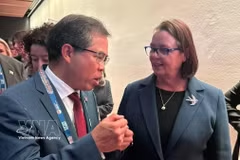
Vietnamese Ambassador to Australia Pham Hung Tam (left) talks to Australian Minister for Resources Madeleine King. (Photo: VNA)

Vietnam, Australia push collaboration in energy, critical minerals

Vietnamese Ambassador to Australia Pham Hung Tam used the International Mining and Resources Conference and Exhibition 2026 (IMARC 2026) in Sydney, held on October 27-29, to meet Australian officials, researchers and companies and push cooperation in energy, critical minerals and mining tech.

Illustrative photo: VNA

New drivers sought for tourism real estate market

Vietnam’s tourism real estate market needs to shift its focus from speculative investment and expectations of price increases towards operational efficiency, revenue generation and sustainable asset value, experts said at a conference in the central province of Gia Lai on October 30.

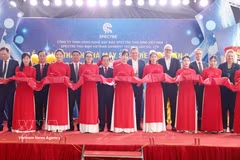
At the ribbon-cutting ceremony to inaugurate Spectre 2 Hung Yen garment factory (Photo: VNA)

Denmark’s Spectre opens fourth Vietnam plant

The factory is built around high technology, energy efficiency and environmental responsibility, and carries LEED Gold certification, a top standard for energy-saving, eco-friendly building design. Solar power and modern design are expected to cut about 1,600 tonnes of CO2 emissions a year versus conventional plants of similar size.

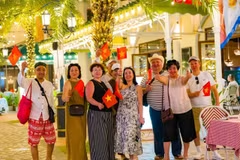
Phu Quoc welcomes an estimated 8.57 million-plus visitors in the first nine months of 2026, up 30.5% year on year, including more than 1.92 million international arrivals, an increase of 60.2%. (Photos: Sun Group)

Tourism powers nearly 40% economic growth in Phu Quoc

In the first nine months of 2026, Phu Quoc welcomed an estimated 8.57 million-plus visitors, up 30.5% year-on-year, with international arrivals exceeding 1.92 million, an increase of 60.2%. Tourism revenue reached approximately 45.976 trillion VND, up 47.7% and exceeding the full-year target by 1%.

Swedish Ambassador to Vietnam Johan Ndisi (Photo: VNA)

Vietnam poised to seize opportunities in technology, green investment: Foreign ambassadors

The presence of technology companies, new investments and emerging cooperation frameworks is laying the foundation for deeper bilateral ties. To capitalise on these opportunities, Vietnam needs to better connect available resources, strengthen domestic technological capabilities and prepare to meet the requirements of high-standard markets, according to Nordic countries' ambassadors to Vietnam.

At the Paris conference between Vietnamese and French companies (Photo: VNA)

Vietnam, France expand cooperation in industry, clean energy, hi-tech

In industry, Phu Tho wants hi-tech, supporting industries, electronics components, precision mechanics, automation, new materials and semiconductors, tied to R&D, technology transfer and domestic suppliers. In infrastructure and green growth, it seeks industrial park, logistics, modern management, energy efficiency and wastewater reuse projects, aiming at eco-industrial parks.

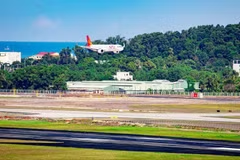
The first commercial flight lands on the new runway at the Phu Quoc International Airport (Photo: nhandan.vn)

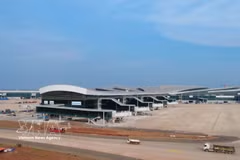
Phu Quoc airport opens second runway after eight-month sprint

The new second runway of Phu Quoc International Airport, measuring 3,300 metres in length and 45 metres in width, meets the International Civil Aviation Organisation (ICAO) Code E standards, enabling it to accommodate wide-body aircraft such as the Boeing 787, Airbus A350 and Boeing 777, thereby enhancing Phu Quoc’s international air connectivity.

At an orchard in Bac Ninh city (Photo: VNA)

Bac Ninh hunts buyers for 118,000 tonne fruit crop

Bac Ninh Authorities are leaning on growing area codes for traceability and market access. As of October 16, 2026, the city had 91 codes covering 1,764.9 ha, including 80 for export, 11 for domestic sales.

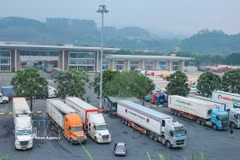
Import and export goods at Lach Huyen Port in Hai Phong city. Photo: VNA

Vietnam’s trade surpasses 1 trillion USD in 10 months

Vietnam recorded a trade surplus of an estimated 6.8 billion USD in October, marking the second consecutive month of surplus and narrowing the cumulative trade deficit for the first 10 months to around 12.7 billion USD.