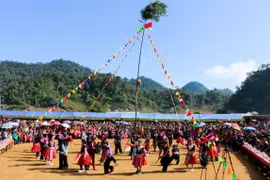
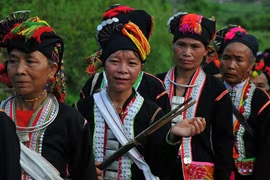
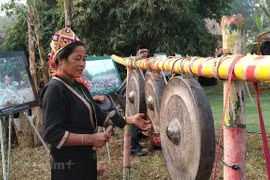
A shaman conducting new rice celebration at the family of Vuong Van Pho in Lung Vi hamlet, Na Khuong commune of Quang Binh district (Source: baohagiang)
Hanoi (VNA) – Le Mung Com Moi (New Rice Celebration), a festival held in late eighth month and early ninth month of the Lunar year among ethnic minority groups in the northern province of Ha Giang, has been a unique cultural practice of local ethnic minority people to celebrate bumper crops.
Mung com moi is an agricultural practice that reflects the spiritual life of local residents and their respect to rice, an important crop in their production.
Normally, the ritual takes place several weeks before the rice harvesting season. A respectful shaman chooses a good day for all families in their village to celebrate the festival together. They offer their fruitful outcomes of labour to gods and ancestors, praying for favourable weather, bumper crops, good health and prosperity.
The festival is well organised to show respect for their ancestors who accumulated and transferred them rice growing techniques. On behalf of the family, the shaman reads the prayer to thank the Rice Genie and invite the ancestors’ souls to come home to share the happiness of a good crop with their children.
The shaman tells a story of the earth formation, rice growing techniques, and people’s effort and time to tend rice fields. He thanks genies for giving them rice and advises people to work hard and unite in production and life.
Hoang Su Phi, having a total area of 3,700 hectares of terraced rice fields, is one of the two border districts in the west of Ha Giang, which is home to 13 ethnic minority groups, including Dao, Tay, Nung, Co Lao and La Chi. Local ethnic minority groups have maintained their traditional practices, especially agricultural rituals.
Celebration by Dao, Nung, La Chi people
Dao ethnic families in Ho Thau Commune, Hoang Su Phi District, often hold a new rice festival when entering the harvest, around the 5th to 10th day of the ninth Lunar month every year.
With the custom of worshiping polytheists, the Dao people of Ho Thau Commune believe that the rice plant also has a soul. So according to traditional rites, the most important thing is to bring the new rice soul home.
In the early morning, women of the family go to the rice field to cut biggest rice ears in the fields and tie them up in small bunches for sun drying. Then the best rice ears tied in small bunches are hung on the wall of their houses and the remaining will be used to make green glutinous rice flakes and cook steamed glutinous rice for offerings to deities and ancestors.
Dao people believe that first rice of a harvesting season should be given to the elderly of the family, the ancestors, and gods who have helped them enjoy a bumper crop.
During the event, Dao people will pay tribute to their ancestors, while the shaman will help the family get rid of evils and bad luck.
Similarly, the new rice offering ceremony is one of the rituals bearing strong agricultural beliefs of the Nung ethnic group in Po Lo Commune.
This ritual depends on the season of ripe rice, which is held by families in the eighth or ninth month of the lunar calendar every year.
To perform this ritual, in the early morning, the woman of the family goes to the rice field to prune the largest and newly ripened rice in the field, usually sticky rice. If the sticky rice has not yet ripened, they have to use plain rice. The rice is tied into bundles to carry home. From these rice grains, the largest seeds will continue to be selected and tied into two bundles and hung on the wall at both ends of the altar.
The rest is used to make green rice or cook into sticky rice to offer to ancestors, heaven and earth. If for some reason, the family does not have enough new rice, they can mix some old rice to cook or use a few new rice grains to put in a pot of sticky rice to get the essence of new rice and offer it to the ancestors.
In the long-standing tradition of the La Chi people in Ban Phung commune, Hoang Su Phi District, the new rice offering ceremony is a very important ritual.
Before the event, the host's wife, who is considered the "Mother of rice", will have to get up very early to prepare baskets and tweezers to pluck the first grains of rice and cook them to give thanks to the ancestors.
The picking of the first grains of rice also has a very sacred meaning, because this is also the ceremony of "receiving" the soul of the rice, with the desire to pray for the family's new crop to be lucky and favourable.
Only after offering new rice can families bring the newly harvested rice into their home and eat. Before the new rice offering ceremony takes place, families are not allowed to burn rice straw because the rice spirit is still on the straw, if burned, next year, the crop will be lost./.