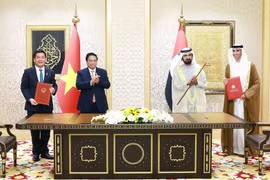
Hanoi (VNA) – In order to implement the Comprehensive Economic Partnership Agreement (CEPA) between Vietnam and the United Arab Emirates (UAE), the Ministry of Industry and Trade has issued Circular No. 24/2026/TT-BCT dated May 5, 2026, stipulating rules of origin for goods under the pact.
The circular comprises four chapters, 36 articles and four appendices. The appendices include product-specific rules, the UAE-VN certificate of origin (C/O) form, a declaration form for approved exporters, and a declaration form for any exporter.
The circular sets out the scope of regulation, applicable entities and principles for determining the origin of goods under the Vietnam-UAE CEPA. The provisions apply to agencies and organisations authorised to issue certificates of origin, traders, and organisations and individuals involved in import-export activities.
Notably, the circular stipulates that goods shall be considered originating if they satisfy one of several criteria, including being wholly obtained, undergoing sufficient processing or manufacturing, or being produced entirely from originating materials. For non-wholly obtained goods, origin is determined based on criteria such as a change in tariff heading (CTH) or a qualifying value content (QVC) of no less than 35% of the ex-works price.
The circular also provides for origin certification mechanisms under the CEPA. Accordingly, goods originating in the UAE imported into Vietnam, or vice versa, will be eligible for preferential tariffs if accompanied by one of the following documents: a UAE-VN form C/O; a self-certification document issued by an approved exporter; or a self-certification document for consignments valued at no more than 500 USD.
The document took effect on May 5, 2026. Customs authorities will also accept proof of origin documents issued in accordance with the circular for consideration of preferential tariff treatment for import declarations registered from February 3, 2026 onwards./.
See more
Vietnam’s hi-tech exports surpass 50% as startup ranking hits record
The domestic innovation ecosystem continued to expand, with 963 sci-tech enterprises, 20 sci-tech exchanges and 37 innovation centres operating across 26 out of the 34 cities and provinces nationwide.
Deputy Minister urges tougher accountability for delayed national target programmes
Speaking at the Government’s regular press conference for May on June 3, the Deputy Minister acknowledged that implementation and disbursement of national target programmes, as well as public investment projects in general, remain slower than expected despite repeated reviews by the Ministry of Finance, relevant ministries and localities.
Ho Chi Minh City becomes Asia’s tech FDI magnet with 6.6 bln USD inflow
The latest wave is heavily concentrated in data centres, AI, semiconductors and R&D - the core pillars of the digital economy, said Nguyen Ky Phung, head of the Saigon Hi-Tech Park management board.
Reference exchange rate stays flat on June 4
The opening-hour buying and selling rates at major commercial banks also remained stable compared to the June 3 session.
FDI inflows into Phu Tho surge 3.5-fold in first five months
As of May 20, Phu Tho province had granted investment licences to 15 new FDI projects with total registered capital of 307.2 million USD. Investors from Japan, the Republic of Korea, Taiwan (China) and China continued to select Phu Tho as an investment destination, with China taking the lead in the number of newly licensed projects.
Aquatic products face challenge of maintaining market share in US
According to the Vietnam Association of Seafood Exporters and Producers (VASEP), the US National Oceanic and Atmospheric Administration (NOAA) has recently recognised Vietnam’s crab fishery as equivalent to US standards. Under an updated decision issued in last month, Vietnamese crab and crab products will continue to be eligible for import into the US market.
Government to introduce strong incentives for rental housing development
Rental housing is identified as a strategic long-term segment serving a broad range of people, particularly workers, students, civil servants, public employees and members of the armed forces.
TikTok interested in investing in logistics, digital finance in Vietnam
Deputy Minister of Finance Cao Anh Tuan commended TikTok’s rapid growth and its contributions to Vietnam’s digital economy. With tens of millions of users, TikTok has become not only a platform for content creation and social interactions but also an effective tool for product promotion, market expansion, and e-commerce.
Vietnam to become one of Asia’s leading high-value manufacturing hubs: seminar
Vietnam is now on the threshold of becoming a leading manufacturing hub for both global and ASEAN markets, with the potential to position itself as one of Asia’s foremost high-value manufacturing centres. However, the country is also facing increasing competition from regional economies such as Malaysia, Indonesia and India.
Halal market offers Vietnam pathway to sustainable growth, global competitiveness
Many of Vietnam’s key export products, including rice, coffee, cashew nuts, pepper, seafood, processed fruits and vegetables, and packaged foods, are well-positioned to meet rising demand in Muslim markets.
Public investment disbursement reaches 21.6% of 2026 target
Central-budget disbursement totalled 70.64 trillion VND, fulfilling 19.4% of the annual target, while local-budget disbursement approximated 148.72 trillion VND, or 22.9%.
Hung Yen seeks to expand investment cooperation with Japanese partners
Hung Yen authorities will continue working closely with investors to promptly resolve obstacles and create the most favourable conditions for Japanese business expansion and long-term cooperation in the province.
Trade turnover exceeds 445 billion USD in five months
In May, Vietnam's trade turnover amounted to 99.07 billion USD, rising 3.2% from the previous month and 25.8% from a year earlier. Exports increased 19.5% year-on-year in the January-May period, while imports surged 30.8%.
Government leader calls for stronger growth measures to achieve double-digit expansion
Prime Minister Le Minh Hung stressed the need for coordinated and decisive actions to promote growth, accelerate institutional reform, speed up public investment disbursement, and advance science and technology, innovation and digital transformation.
Vietnam seen as ASEAN’s resilient growth bright spot
According to the World Bank (WB), buoyed by impressive GDP growth of 8% in 2025, Vietnam entered 2026 as one of Southeast Asia's strongest-performing economies. In its latest economic update released in May, the WB highlighted Vietnam’s robust fundamentals and favourable growth outlook.
State budget revenue up 15.4% in first five months
Of the five-month figure, domestic revenue remained the main contributor, totalling an estimated 1.168 quadrillion VND, or 53.1% of the annual target, up 15.8% from the same period last year.
Vietnamese firm showcases technological capabilities at world’s leading firefighting, rescue exhibition
Hiep Hoa Special Purpose Vehicle JSC is showcasing a range of its specialised vehicles and fire-fighting and rescue equipment at INTERSCHUTZ 2026 – the world's leading trade fair for the fire and rescue services, civil protection and safety which is being held in Hannover, Germany from June 1 to 6.
Xiaomi Vietnam fined for violating consumer rights
Xiaomi Vietnam Co., Ltd was fined 290 million VND (about 11,000 USD) for three violations of consumer protection regulations, according to the National Competition Commission (NCC) under the Ministry of Industry and Trade.
Vietnam's economy accelerates despite global uncertainties: French report
Vietnam is well positioned to remain among Asia’s fastest-growing economies. Future success will depend on the country’s ability to leverage opportunities from international integration while developing new domestic growth drivers to support its ambition of becoming a high-income economy by 2045.
Hanoi’s May CPI rises 0.28%
The Statistics Office attributed the stable market situation to the city’s efforts to implement Government directives on price governance and inflation control while ensuring adequate supply of goods and services, especially essential ones.