Vietnam actively joins in seeking new momentum for Mekong subregional cooperation

Vietnam will work with member states and the ASEAN Secretariat to boost greater participation and support from development partners and the private sector, said Deputy Minister of Foreign Affairs Nguyen Minh Hang.

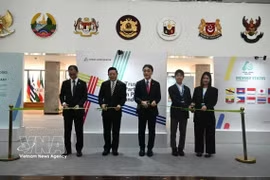
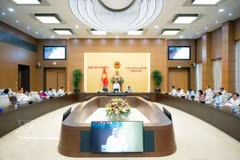
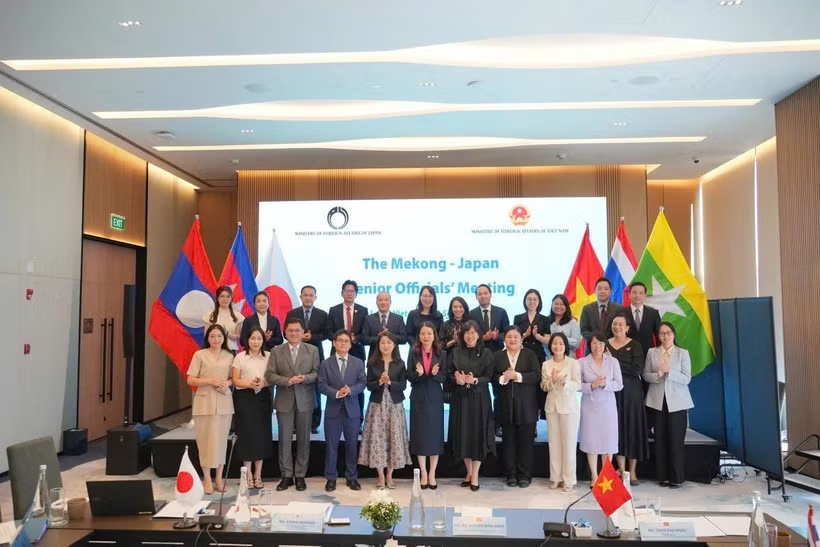
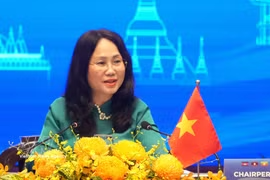
Participants in the senior officials’ meetings of the Cambodia-Laos-Myanmar-Vietnam (CLMV) and Mekong-Japan cooperation frameworks in Quang Ninh city on September 30 (Photo: The Vietnamese Ministry of Foreign Affairs)

Hanoi (VNA) – Deputy Minister of Foreign Affairs Nguyen Minh Hang attended senior officials’ meetings of the Cambodia-Laos-Myanmar-Vietnam (CLMV) and Mekong-Japan cooperation frameworks in the northeastern city of Quang Ninh on September 30.

The meetings brought together senior officials and representatives from the foreign ministries and other agencies of Cambodia, Laos, Myanmar, Thailand, Vietnam and Japan. They reviewed opportunities and challenges, discussed cooperation priorities for the coming period and prepared for the 12th CLMV Summit and the 13th Mekong-Japan Summit.

At the CLMV Senior Officials’ Meeting (SOM), Hang said developments over the past five years had reaffirmed the long-term value of CLMV cooperation in narrowing the development gap, strengthening economic connectivity and ensuring that ASEAN integration benefits all member states.

Ahead of the 12th CLMV Summit, she proposed that senior officials focus on three areas. The first is to complete summit documents with a new approach, a shared vision and priorities suited to new development requirements. The second is to recommend priorities and initiatives for the next phase, particularly in economic connectivity, tourism, human resource development and sustainable water-resource management. The third is to renew cooperation commitments to consolidate solidarity and improve implementation of initiatives through shared responsibility, clear roadmaps and regular reviews.

Vietnam will work with member states and the ASEAN Secretariat to boost greater participation and support from development partners and the private sector, she said.

At the Mekong-Japan SOM, Hang highlighted the partnership’s contributions to connectivity, sustainable development, responses to non-traditional security challenges and the building of a trusted partnership between Japan and Mekong countries.

She welcomed Japan’s promotion of the partnership under the principle of co-creation and said the upcoming summit would provide an opportunity for leaders to reaffirm the strategic importance of the Mekong-Japan partnership to stability, cooperation and prosperity in the subregion and the wider region.

Noting that cooperation outcomes had yet to match the expectations and potential of the partnership, she called on senior officials to identify several annual priority areas for consideration by leaders. Immediate priorities should include smart supply chains, renewable energy, the application of artificial intelligence and emerging technologies, and the fight against transnational crime.

She also called for greater mobilisation of resources for Mekong-Japan cooperation, including promoting existing Japanese frameworks and initiatives such as POWER ASIA.

Participants held frank and open discussions on opportunities and challenges facing the two frameworks and supported Vietnam’s proposed priority areas and initiatives for submission to the two upcoming summits. The 13th Mekong-Japan Summit is expected to be the first meeting of Mekong and Japanese leaders in six years and is expected to produce practical outcomes and new momentum for the partnership’s next stage.

Other areas of common interest included digital transformation and green transition, transport-corridor connectivity, disaster early warning, food security and greater private-sector participation.

The participants agreed on the need to further improve the substance and effectiveness of both cooperation frameworks./.
VNA

See more

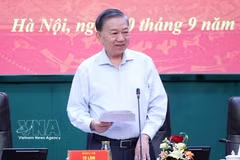
General Secretary of the Communist Party of Vietnam Central Committee and President To Lam speaks at a meeting to review the performance of the Central Public Security Party Committee and the Ministry of Public Security in the third quarter and the first nine months of 2026. (Photo: VNA)

Top leader calls for proactive approach to national security

The Central Public Security Party Committee must play a core advisory role and accelerate the implementation of resolutions, conclusions and plans already adopted, he said, stressing that the key task now was to speed up implementation and produce concrete results, said top leader To Lam.

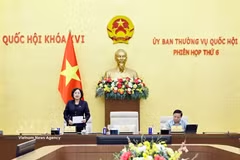
NA Vice President Nguyen Thi Hong speaks at the meeting (Photo: VNA)

NA Standing Committee proposes priority for domestic bidding

Presenting the draft revised Bidding Law, Minister of Finance Ngo Van Tuan said the draft, comprising eight chapters and 60 articles, aims to simplify procedures, shorten project implementation time, strengthen decentralisation and delegation of authority, improve the effectiveness of State management, and handle violations and resolve petitions in bidding activities.

Illustrative Image (Photo: VNA)

People-to-people diplomacy deepens Vietnam-Germany friendship

Nguyen Anh Tuan, Chairman of the association, highlighted the important role of people-to-people diplomacy in strengthening friendship and mutual understanding between the two countries' people, particularly through Vietnamese alumni and former workers who studied and worked in Germany.

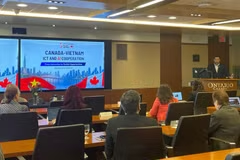
Delegates at the seminar "Canada- Vietnam: ICT and AI Cooperation" (Illustrative photo by VNA)

Vietnam-Canada strategic partnership creates new space for broader cooperation

Former Canadian member of parliament Bryon Wilfert said the state visit by General Secretary of the Communist Party of Vietnam Central Committee and President To Lam offers Canada an opportunity to elevate its relationship with one of the Indo-Pacific’s most important emerging economic and strategic partners.

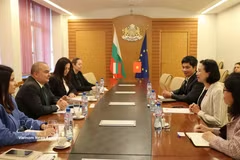
An overview of the meeting (Photo: VNA)

Vietnam, Bulgaria promote substantive agricultural cooperation

The Bulgarian side highlighted the potential for cooperation with Vietnam in agricultural trade, scientific research, training and technology transfer. Bulgaria expressed readiness to share experience in sustainable agriculture, forest management and development, combating illegal, unreported and unregulated (IUU) fishing, as well as crop cultivation, livestock farming and breeding climate-resilient plant varieties.

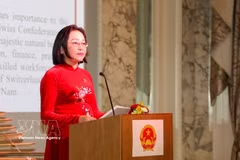
National Assembly Vice President Nguyen Thi Thanh expresses appreciation for Switzerland’s support during important periods in Vietnam’s history at a ceremony marking the 81st anniversary of Vietnam’s National Day (Photo: VNA)

Vietnam, Switzerland seek to deepen traditional friendship, expand cooperation

Looking ahead, Vietnam wishes to work with Switzerland to further deepen bilateral relations, with traditional friendship and political trust as the foundation, economic cooperation as a pillar, and science-technology and innovation as drivers, National Assembly Vice President Nguyen Thi Thanh said, adding that the two sides should also expand cooperation in areas where Switzerland has strengths and Vietnam has needs.

Gazprom logo at a petrol station in Moscow, Russia. (Photo: Xinhua/VNA)

Vietnam-Russia petrochemical ties hold fresh potential

He noted that trade between the Eurasian Economic Union (EAEU) and Vietnam reached 8.3 billion USD in 2025. Despite the Vietnam-EAEU Free Trade Agreement having been in force for 10 years, considerable room remains to expand economic cooperation, particularly in petrochemicals.

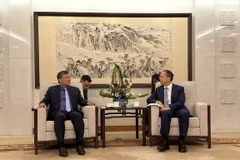
Standing Deputy Minister of Foreign Affairs Nguyen Minh Vu (L) meets with Executive Vice Minister of Foreign Affairs Ma Zhaoxu. (Photo: baoquocte.vn)

Vietnam, China propel substantive partnership

They welcomed recent gains in Vietnam-China ties, especially stronger political trust; improved cooperation mechanisms through Party, Government, parliamentary and Vietnam Fatherland Front channels; faster strategic connectivity between the two economies; expanded economic, trade and investment collaboration; and more people-to-people and locality-to-locality exchanges.

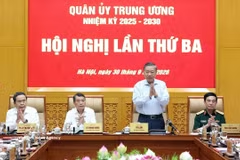
At a meeting between the standing boards of the Government and NA’s Party committees (Photo: VNA)

NA, Government’s Party committees meet on legislature’s second session agenda

National Assembly President Tran Thanh Man coordination must go beyond finishing the agenda to improve the quality of NA decisions and Government enforcement; deal with policies rather than just paperwork, especially in the fight against corruption and other negative phenomena; and pin down final responsibility for each product, not just progress.