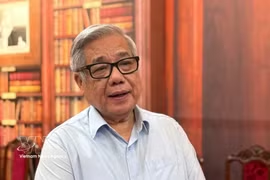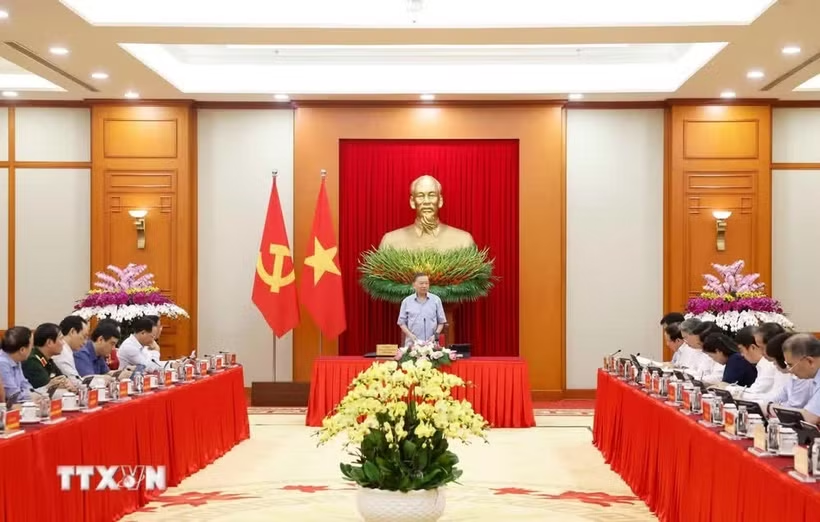
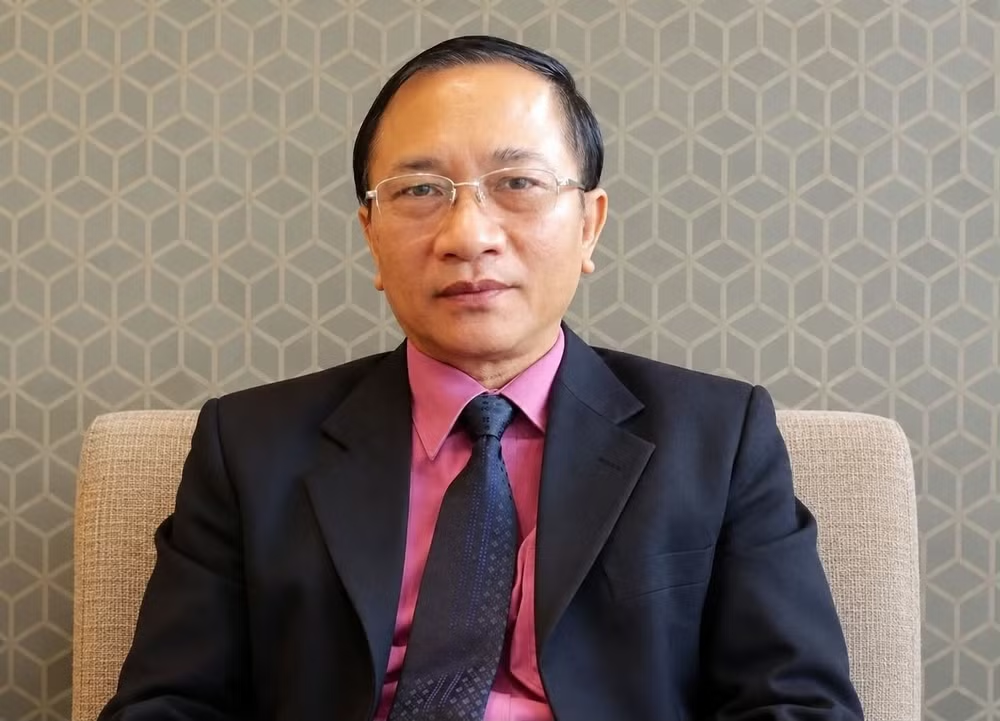
Dr. Hoang Ngoc Vinh, former Director of the Department of Professional Education under the Ministry of Education and Training, spoke to VietnamPlus about the guidance given by Party General Secretary and State President To Lam to the ministry on implementing Resolution No. 71 and preparations for the 2026-2027 academic year.
Education drives national development
- What is your assessment of Party General Secretary and State President To Lam’s guidance for the education sector at the June 16 working session?
Dr. Hoang Ngoc Vinh: I believe this was one of the most important statements on education in recent times. What is noteworthy is not the introduction of another new target, but rather the approach to education development.
When the General Secretary and President called for a shift from the mindset of “education management” to “education development governance,” this should not be understood as reducing the State’s role in managing education. The State must still manage education through laws, standards, planning, quality accreditation and resource allocation. What needs to change is the management approach.
Previously, we tended to focus heavily on inputs such as schools and classrooms, staffing, funding, curricula and administrative targets. These factors are essential, but they are not enough. Education development governance raises more important questions: How effectively are these resources being used? What are students learning? What can graduates do after leaving school, and how much is education contributing to national development?
In other words, the focus must shift from managing inputs to governing outcomes, and from emphasising processes to prioritising the quality of outputs. Evaluation of assessment reports must be based on substantive, measurable results. In my view, this is the core spirit of Resolution 71 and the right direction for Vietnamese education in the coming period.
- What points in the General Secretary and President’s directions have attracted your greatest attention?
Dr. Hoang Ngoc Vinh: I am particularly interested in two points.
First, education must be viewed as a driver of national development, rather than simply a public service. To develop science and technology, artificial intelligence, semiconductors, strategic industries and the innovation economy, we must start with education. Without a sufficiently high-quality workforce, major strategies can easily run short of people capable of turning them into reality.
Therefore, the General Secretary and President’s emphasis on advancing higher education while developing vocational education shows that human resource development must be comprehensive, covering both advanced qualifications and occupational skills. Universities produce researchers, engineers, experts and highly qualified managers, while vocational education provides technicians and skilled workers capable of operating technology in production.
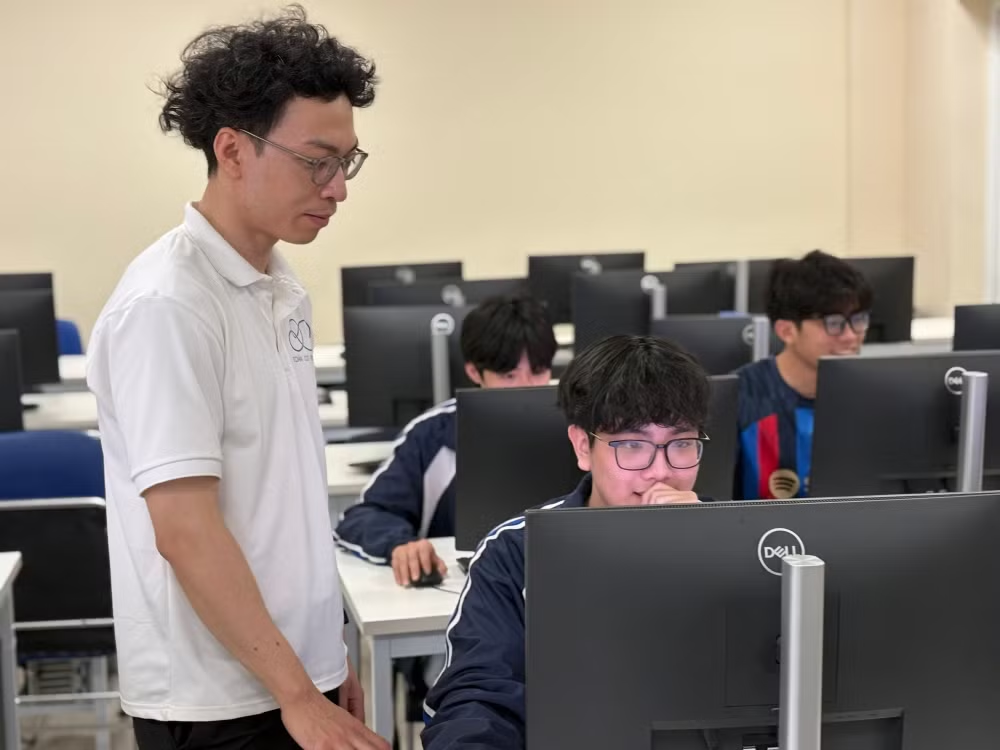
But human resources development is not just about skills and technology. I also paid close attention to the requirement to place greater emphasis on ethics, lifestyle and character education in the coming academic year. An education system that focuses solely on employability while neglecting ethical foundations will find it difficult to produce well-rounded people. The country needs capable people, but above all, they must be decent, responsible and able to live within the framework of the law.
Second, education governance must be based on data and evidence. Education data, such as results of the high school graduation examination, have often been used to publish scores, conduct admissions, rank institutions or make comparisons. But it has not been sufficiently exploited to improve policies. Examination results can show which localities are weak in particular subjects, which groups of students need support, where teachers require training and what investments are needed to improve teaching and learning quality.
The formulation of education reform policies also requires practical data, domestic research and international experience. Without evidence, education policy can easily become a matter of trial and error, or risky decision-making. Data-driven governance is not about producing more reports, but about making decisions more accurately, while reducing the cost of mistakes.
Education institutions must be given greater autonomy
- In your view, what are the biggest bottlenecks facing the sector today?
Dr. Hoang Ngoc Vinh: In my view, the biggest bottleneck is not the curriculum or textbooks, but the lack of consistency in policy implementation between the central and local levels.
We do not lack sound policies. Almost every issue facing education has already been identified in various resolutions and development strategies. However, there remains a considerable gap between policy and the classroom.
Teacher shortages persist in many localities. Schools in some areas remain overcrowded. Vocational education is not seen as an attractive pathway for learners. Universities still have a gap with the labour market. These problems do not stem from a lack of regulations, but from weak implementation.

I think that to remove these bottlenecks, we need to shift from managing tasks to governing outcomes. Educational institutions are changing while local school management models continue to operate in the old way – relying heavily on seeking approval, procedures, reports and paperwork inspections – it is difficult to achieve real change.
Schools must be given greater autonomy over professional matters, teaching organisation, and resource use, while being held accountable for quality. Local authorities and heads of educational institutions should also be given clearer powers, accompanied by clearer responsibility for final outcomes: What are students learning? How are teachers being supported? Is the school environment safe? And is education quality genuinely improving?
- How do you assess the education sector’s implementation of Resolution 71 so far?
Dr. Hoang Ngoc Vinh: I think the education sector has taken a number of positive steps since Resolution 71 was issued. Several major contents have been incorporated into action programmes, the process of amending laws and policy formulation.
However, this is only the initial stage. The success of Resolution 71 will not be measured by the number of conferences organised, but by whether working conditions have changed, whether students in different regions have gained access to better learning environments and whether the quality of human resources has improved.
In other words, Resolution 71 will be judged by changes in schools, rather than by reports produced for each term of office.
- What should the education sector do in the coming period to better implement Resolution 71 and General Secretary and President To Lam’s guidance?
Dr. Hoang Ngoc Vinh: In my view, the most important thing is to identify the right priorities and focus on them.
First, we must definitively address the issue of teachers and school management personnel. Without a sufficient number of high-quality teachers, all reforms will face limitations. If we want to grant schools greater autonomy, State management and education leaders need to develop professional training programmes for principals.
Next, we need to build an education data system that genuinely serves governance. Data must become a tool for detecting problems early and making decisions more quickly.

Another priority is to be more determined in decentralising authority to educational institutions. Schools cannot be subject to excessive procedural constraints while simultaneously being expected to innovate and take responsibility for education quality.
Finally, education must be aligned with the country’s development strategy. When we talk about AI, semiconductors, digital transformation, the green economy or high-tech agriculture, we must be able to answer how the education system is preparing human resources for these sectors.
In a country where agriculture still accounts for a large share of the workforce, training advanced technicians for agriculture is extremely important, but this has not received the attention it deserves. If we fail to solve the human resource challenge, major development goals could easily remain merely policy aspirations.
- Thank you very much!