Hanoi (VNA) – Vietnam's green transition requires hundreds of billions of US dollars in investment, while international funding is considered readily available. The challenge is to improve the country's capacity to absorb capital, standardise projects and develop effective financing channels to connect global resources with green projects at home.
To fulfil its commitment to achieve net-zero emissions by 2050, Vietnam needs to mobilise around 700 billion USD over the course of its long-term transition. The scale of the funding requirement highlights the need to expand sources beyond the State budget, particularly private and international capital.
Capital available, but projects still struggle to attract funding
However, according to Nguyen Quang Thuan, Chairman and CEO of FiinGroup, the availability of capital is not the biggest challenge. International investors are increasingly interested in green projects and products and are prepared to allocate substantial amounts of capital. The bottleneck lies in channelling those funds towards suitable projects in Vietnam.
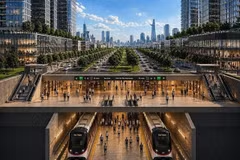
In practice, many domestic green projects have yet to fully meet the “appetite” of foreign investors, particularly in terms of transforming them into investable assets. Many remain relatively small, while their design and financial structures have not kept pace with the requirements of large-scale capital flows. This gap is particularly evident in sectors requiring long-term financing, such as metro systems, expressways, seaports and water infrastructure.
Green capital currently tends to flow mainly into smaller-scale projects, such as water supply schemes, while remaining limited in large-scale ones, he noted.
The way international capital currently enters Vietnam also reflects this gap. According to Thuan, foreign green financing is currently channelled mainly through on-lending arrangements, whereby funds are provided through domestic credit institutions for subsequent lending to end borrowers.
The challenge, therefore, is not simply to find more capital, but also to develop projects of sufficient scale and with appropriate structures to enable long-term funding to participate.
Paving the way for international capital to enter green projects
With both international capital and investment demand already in place, the challenge is to establish effective channels capable of directing funds towards suitable projects while standardising projects in line with market requirements.
Assoc. Prof. Dr Nguyen Huu Huan, Vice Chairman of the Executive Board of the Vietnam International Financial Centre in Ho Chi Minh City (VIFC-HCMC), said green finance should be viewed as a layer of growth infrastructure running across the economy, rather than simply as a standalone financial product.
Under this approach, VIFC-HCMC is expected to serve as one of the key hubs connecting international financial resources with domestic investment needs. Capital would be raised internationally, channelled through the financial centre and disbursed to green projects and infrastructure. At the same time, standardised data and reduced risks are expected to help transform climate-related projects into investable assets that can be listed and traded across borders.
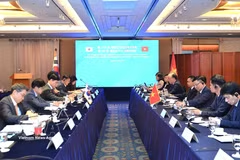
This approach is gaining further momentum. At a meeting of the VIFC's Executive Council on August 19, the executive bodies proposed six groups of priority products, including investment and asset management funds, international carbon credits, financial technology and bonds issued through the international financial centre.
If the centre is to serve as a bridge between projects and international capital, policy-wise, the priority is to establish a foundation that allows these capital flows to play a deeper role in the green transition. According to the Ministry of Finance, in implementing the national green growth strategy for 2021-2030, with a vision to 2050, mechanisms and policies are being developed across a range of areas, from State budget allocations and tax policies to the green financial market, international capital mobilisation and the development of a carbon market.
Notably, under the spirit of Politburo Resolution No. 68-NQ/TW on private economic sector development, the State budget is also being positioned as “seed capital”, focusing on critical areas such as site clearance, backbone infrastructure, financial viability support and risk-sharing mechanisms. This would enable public resources to create conditions for greater participation by the private sector and international financial institutions in projects supporting the green transition, while easing pressure on the State budget and public debt.
Alongside public resources, expanding medium- and long-term fundraising channels is another important link in improving green projects' access to finance. Between 2021 and 2025, commercial banks, property developers, energy companies and other businesses successfully issued more than 1 billion USD worth of green and sustainability-linked bonds in domestic and international markets. The Ministry of Finance is also working with ministries and sectors to develop a pilot scheme for issuing sovereign green bonds based on approved environmental criteria and a green taxonomy.
From project standardisation and the establishment of hubs connecting projects with international capital to the use of public funding as “seed capital” and the development of long-term financing instruments, the building blocks needed to channel capital into the green transition are gradually taking shape.
With funding requirements running into hundreds of billions of US dollars, turning green projects into assets that meet investment criteria will be crucial to bridging the gap between available capital and real-world investment needs./.
VNA