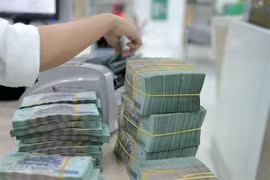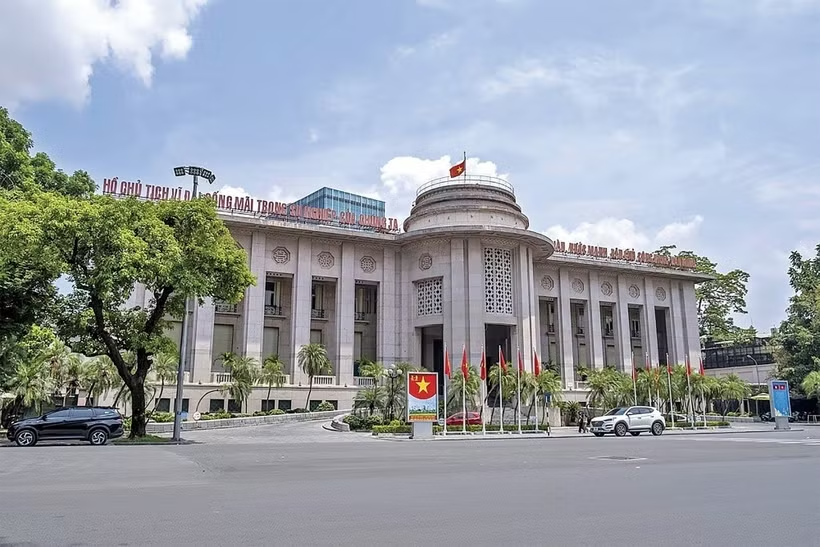
Hanoi (VNA) - For more than 74 years, Vietnam’s banking sector has accompanied the nation through war, peace, subsidy-driven planning, reform, and now the digital era. From the early days of printing the “Uncle Ho banknotes”, the first currency bearing the beloved leader’s image, amid hardship to today’s robust digital transformation, the banking system has remained a pillar in preserving the value of the currency, controlling inflation, stabilising the macroeconomy, and providing capital for development.
In flames of war
Immediately after the August Revolution in 1945, the the nascent Democratic Republic of Vietnam faced severe challenges like an empty treasury, and the Indochina Bank controlled by French capitalists seeking to suppress revolutionary finances. To take the initiative in resources, on November 15, 1945, the Government printed and issued the Financial Treasury Notes – the “Uncle Ho banknotes.”
In 1951, the second National Party Congress determined the need to establish a national bank. On May 6, 1951, President Ho Chi Minh signed Decree No. 15/SL establishing the National Bank of Vietnam, laying the foundation for an independent banking system tasked with issuing currency, mobilising capital, and regulating circulation.
The monetary route – A silent legend
During the resistance war against the US, alongside legendary supply routes such as the Ho Chi Minh Trail, there was also a lesser-known “monetary route,” which transported hundreds of millions of US dollars in international aid through bombings and blockades, timely supporting the southern battlefields.
Former Deputy Governor Le Van Chau, once an officer of the Special Foreign Currency Fund B29, recalled that units like B29, C32, and B6 overcame all difficulties to ensure timely financial support for the South. From manual transfers, we moved to wire transfers, cutting transaction times from 30 days down to just 30 minutes.
According to him, from 1965 to 1975, the banking sector transferred about 1 billion USD to the South, along with large amounts of Saigon, Cambodian, Laotian, and Thai currency – all safe, not a single cent missing.
Vo Ho Viet (Bay Thu), former officer of the Special Finance Unit N2683, remembered the keepsake of a Honda 67 motorbike once used to transport money across forests and mountains.
He said they dressed like traders, carrying money as if it were goods so the enemy would not detect us. Every trip was tense, but the spirit of serving the Fatherland gave them the strength to complete the mission.
Rebuilding system after national reunification
After 1975, the Government organised currency exchanges in the South to stabilise the economy, and by 1978, currency was unified nationwide. However, the banking system still operated under a centrally planned mechanism, primarily disbursing capital.
A major turning point came with the Doi Moi (Renewal) reforms in 1986. The banking system was restructured, with a clear division between the State Bank and commercial credit institutions. From the 1990s, international relations expanded, and the legal framework was strengthened, laying the groundwork for a modern banking sector.
The period 2000–2010 saw rapid credit growth but also revealed risks amid global crises. Since 2011, the Government has implemented restructuring, tackled bad debts, improved risk management, and gradually reinforced financial resilience.
Breakthroughs in digital era
In the past five years, Vietnam’s banking sector has made remarkable progress. By mid-2025, over 95% of individual transactions at commercial banks were conducted digitally. Nearly 87% of adults held bank accounts, and cashless payments reached a value equivalent to 25 times GDP.

Dr. Can Van Luc, Chief Economist of BIDV, observed that digital transformation helps banks reduce costs, maintain low interest rates, support economic recovery, and enhance competitiveness.
Pham Tien Dung, Deputy Governor of the State Bank of Vietnam, emphasised that digitalisation not only changes operations but also promotes financial inclusion, bringing services closer to people, especially in remote areas.”
At the same time, the sector continues restructuring credit institutions. On-balance-sheet bad debts remain below 2%; many banks have adopted international Basel II and Basel III standards; and credit grew by 15.08% in 2024, the highest since the pandemic.
By mid-2025, the total outstanding credit of the system exceeded 16.9 quadrillion VND, compared with just over 10 trillion VND in 1991, a testament to the vast flow of capital that banks have channelled into the economy.
Reaching out to the world
The reputation of Vietnamese banks has been increasingly recognised. By 2024, 15 banks were listed among the world’s Top 500 most valuable banking brands, while many institutions had their credit ratings upgraded by Moody’s, S&P, and Fitch.
Governor Nguyen Thi Hong affirmed that Vietnam’s banking sector is moving towards a more complete system, not only meeting domestic needs but also reaching out globally. Vietnam sees a resilient financial system as the basis for becoming a financial hub in the region.
For more than 74 years, the banking sector has proven itself to be a “silent flow” shaping the nation’s buoyant financial system – from printing the first banknotes, resolute under bombardments, to breakthroughs in the digital era.
This journey underscores a consistent mission: preserving the value of the currency, controlling inflation, stabilising the macroeconomy, and serving as a capital anchor for businesses and citizens. Entering the age of digital transformation and deep international integration, the banking sector continues to carry forward its proud tradition with confidence and ambition for sustainable development – towards a prosperous and happy Vietnam./.