Hanoi (VNA) - The Party Central Committee’s issuance of a Resolution on building and developing Vietnam into a strong maritime nation aims to respond to the need to expand the country’s development space and modernise maritime governance.
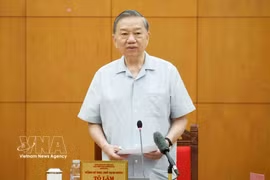
The Secretariat of the Communist Party of Vietnam (CPV) on July 29 held a nationwide conference to study and implement the Resolution of the third plenum of the 14th CPV Central Committee. General Secretary of the CPV Central Committee and President To Lam attended the conference and provided guidance on related resolutions, including the one on building and developing Vietnam into a strong maritime nation, as well as tasks relating to Party building, national development, and improving the effectiveness of Vietnam’s political system in the coming period.
General Secretary and President Lam stressed that the development of the maritime economy must go hand in hand with ecosystem protection, improvements in people’s livelihoods, the safeguarding of national sovereignty and national development. Vietnam must therefore prepare the necessary conditions so that, by 2045, it will become a nation that prospers from the sea and develops sustainably from the sea, with modern maritime governance and advanced marine technologies.
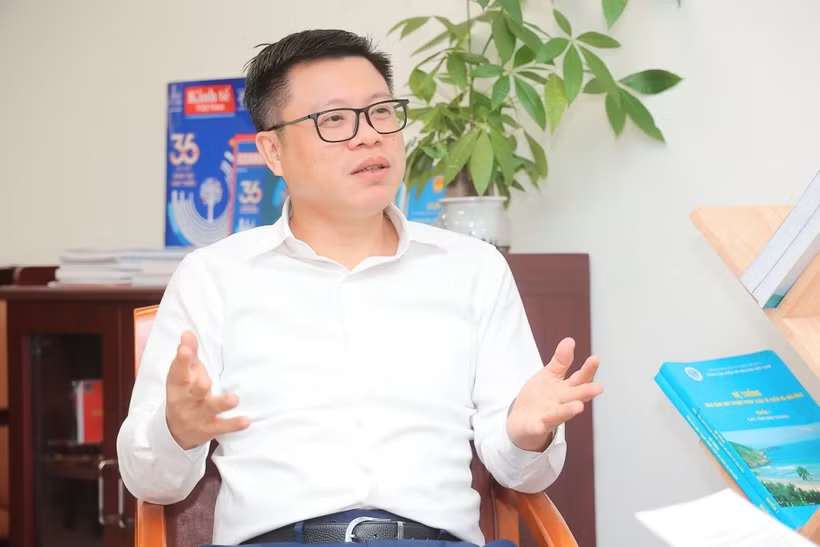
On this occasion, VietnamPlus spoke with Nguyen Quoc Toan, Director of the Vietnam Agency of Seas and Islands under the Ministry of Agriculture and Environment, about the significance of this strategic shift, as well as new directions in institutional development, with a view to enabling Vietnam to become a “strong maritime nation” as envisioned.
Building modern, integrated legal framework
Reporter: First of all, could you tell us about the significance of the resolution on building and developing Vietnam into a strong maritime nation?
Director Nguyen Quoc Toan: The resolution on developing Vietnam into a strong maritime nation is an important document that establishes a strategic vision to meet the requirements of expanding the country’s development space, modernising maritime governance, and promoting the strategic role of the sea in economic development, national defence and security, foreign affairs and international integration. This is also why the sea has received such strong attention from the Party and State.
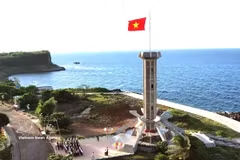
The sea has held an exceptionally important position throughout the country’s socio-economic development. It is not only a natural resource and an area of strategic importance for national defence and security, but also an integral part of the daily lives of millions of fishermen who make their living at sea. The sea is also a symbol of Vietnam in the country’s process of economic development. More recently, changes in the model of local government, together with changes to the country’s administrative boundaries, reducing the number of provinces and centrally governed cities from 63 to 34 – 21 of which have a coastline – have created new room for development in terms of economic and geographical space.
Alongside the Party Central Committee’s review of the strategy for developing the maritime economy, commonly referred to as Resolution No. 36-NQ/TW, this process has also raised issues relating to amendments to the Law on Marine and Island Resources and Environment. During the drafting of the law, we also consulted with many organisations and localities.
We believe that the resolution on building Vietnam into a strong maritime nation will provide an important foundation and crucial legal basis for continuing to improve the institutional framework and meeting the requirements of the new phase of development.
Reporter: As you mentioned, after 10 years of implementing the 2015 Law on Marine and Island Resources and Environment, the Ministry of Agriculture and Environment has conducted a review of its implementation in practice. What are the biggest “bottlenecks” currently hindering the effective mobilisation of resources from the sea, and how have these limitations affected investors, businesses and the development of Vietnam’s maritime economy?
Director Nguyen Quoc Toan: After 10 years of implementation, the 2015 Law on Marine and Island Resources and Environment has provided an important legal foundation for the integrated management of marine resources and the protection of the marine and island environment, contributing to the implementation of Vietnam’s strategy for sustainable development of the marine economy. However, in the context of new development requirements, particularly the goal of making the maritime economy a driver of national growth, a number of provisions of the Law have revealed limitations and have not kept pace with development in practice.
Recently, the Ministry of Agriculture and Environment conducted a review of the implementation of the law and identified a number of core bottlenecks. These include an incomplete legal framework for the management and use of marine space and rights to use marine areas. Also, policies to promote economic activities at sea and on islands are not yet sufficiently robust, and digital transformation in maritime governance does not yet meet practical requirements.
In addition, the legal framework governing the rights of organisations and individuals using marine areas remains incomplete. The recognition, protection and exercise of the rights of marine-area users do not yet meet the requirements for mobilising long-term investment resources at sea. Many businesses have reported that the lack of a comprehensive legal mechanism for establishing, protecting and exercising rights to use marine areas has constrained their ability to raise capital, access credit, attract investment and implement large-scale projects.
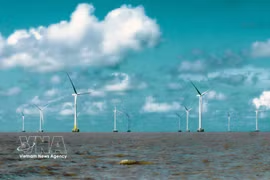
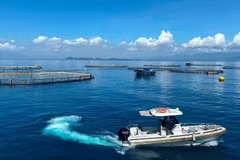
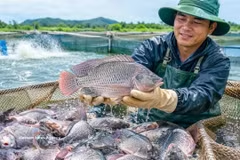
Regulations on the development of the maritime economy remain fragmented, without sufficiently strong mechanisms to encourage investment in offshore wind power, industrial-scale marine aquaculture, the marine circular economy, the marine bioindustry, maritime logistics services and multi-purpose marine development models. Meanwhile, the need to transform the growth model towards green and sustainable development, low carbon emissions, and the application of science and technology is becoming increasingly urgent.
In addition, certain provisions of the current law have not kept pace with developments in the broader legal system and overlap with specialised laws governing investment, land, fisheries, environmental protection, planning, geology and minerals, among other areas. This has created difficulties in implementation and increased compliance costs for businesses.
For investors and businesses, these bottlenecks have reduced the stability and predictability of the marine investment environment and prolonged the preparation and implementation of projects. They also generate compliance costs and limit the ability to make effective use of marine resources and mobilise long-term investment capital, particularly for large-scale and high-technology projects.
For this reason, the current amendment of the law is not merely intended to address shortcomings and remove bottlenecks in the 2015 Law on Marine and Island Resources and Environment. It also aims to establish a modern, integrated, and transparent legal framework, ensure unified management of marine space, make effective use of marine resources, create a stable investment environment, and expand development opportunities for businesses, people, and local authorities.
At the same time, it will ensure a balance between economic development and the protection of the marine environment, national defence and security, sovereignty, sovereign rights and national jurisdiction. In doing so, it will establish a long-term institutional foundation for Vietnam to become a strong maritime nation, prosper from the sea and develop sustainably in the 21st century.
Unlocking resources and promoting sustainable maritime economic development
Reporter: One of the new provisions in the draft law is the proposed issuance of certificates of rights to use marine areas. What significance would establishing rights to use marine areas have in safeguarding the lawful rights and interests of individuals and businesses, while also creating a stable investment environment at sea?
Director Nguyen Quoc Toan: One of the important new provisions in this draft law is the issuance of certificates of rights to use marine areas. This can be regarded as an important step towards completing the institutional framework for the management and use of marine space in a more open, transparent and modern manner, while providing better protection for the lawful rights and interests of organisations and individuals using marine areas.
At present, the rights of organisations and individuals to use marine areas are primarily recognised through decisions allocating marine areas. However, for large-scale projects, projects involving long-term use, or projects requiring the mobilisation of credit, this mechanism is not particularly convenient for publicly documenting, demonstrating and exercising rights relating to the allocated marine areas.
The provision for issuing certificates of rights to use marine areas is an important step to complete the institutional framework for the management and use of marine space in a more open, transparent and modern direction.
For this reason, the draft law not only proposes the issuance of certificates, but also expands the rights of marine-area users in a manner consistent with market mechanisms and relevant legislation.
The certificate will serve as a legal instrument making public the right to use a marine area that has been established by the State. This will facilitate the exercise by organisations and individuals of rights such as mortgaging, leasing, contributing capital and transferring rights to use marine areas in cases permitted by law. At the same time, it will enhance transparency and legal security in investment, production and business activities.
For individuals and businesses, this provision will contribute to better safeguarding their lawful rights and interests, improving access to credit and capital, reducing legal risks, and increasing the stability and predictability of the investment environment, particularly for large-scale, long-term investment projects such as industrial-scale marine aquaculture, offshore wind power, seaports, logistics and marine infrastructure.
For the State, the issuance of certificates does not create additional rights beyond those already provided for by law. Rather, it serves as a tool to standardise the establishment, management and monitoring of rights to use marine areas. It will also contribute to building a unified database on the use of marine space, strengthening the effectiveness of State management and reducing disputes and overlapping claims in the exploitation and use of marine resources.
It can be affirmed that establishing rights to use marine areas through certificates will both safeguard the lawful rights and interests of people and businesses and create a transparent, stable and legally secure investment environment. This, in turn, will unlock resources from the sea and promote sustainable development of the maritime economy in line with the policies of the Party and State.
Realising the ambition of building a strong maritime nation
Reporter: If the amended Law on Marine and Island Resources and Environment is passed by the National Assembly with the breakthrough mechanisms as expected, what strategic changes in maritime economic development do you believe the legislation will bring about?
Director Nguyen Quoc Toan: If passed by the National Assembly, the draft amended Law on Marine and Island Resources and Environment will bring about an important shift in thinking about maritime development. It will move from fragmented, sector-by-sector management towards integrated management of resources and use of marine space, linked with planning, science and technology and digital transformation. It will establish a foundation for the mobilisation of marine resources and the rapid and sustainable development of the maritime economy, while ensuring national defence and security, sovereignty, sovereign rights, national jurisdiction and national interests at sea.
Vietnam’s consistent position today is to regard the sea not only as a space for survival, but also as a development resource, a new space for growth and one of the strategic drivers for implementing the Resolution of the 14th National Party Congress. It is a space in which growth poles, modern maritime industries and new drivers of national development can emerge.
We expect the amended Law on Marine and Island Resources and Environment to expand development space for modern maritime industries. It will establish a transparent legal basis for mobilising social resources, attracting strategic investors and promoting innovation. Also, it will ensure that the maritime economy develops within the carrying capacity of marine ecosystems, while being linked to the protection of community livelihoods and the preservation of the sea for future generations. The law will also bring about a decisive shift from management relying heavily on administrative procedures towards governance based on planning, data, monitoring and risk management.
Reporter: As the State management agency responsible for the marine and island sector, what message would the Vietnam Agency of Seas and Islands like to convey to the business community, investors and coastal localities so that they can join hands in realising the goal of building Vietnam into a strong maritime nation and a country that prospers from the sea in the 21st century, in line with the direction given by General Secretary and President Lam?
Director Nguyen Quoc Toan: Vietnam’s sea is not only a space for survival, but also a space for development, a new space for growth and a strategic national resource. Therefore, the State will continue to improve the institutional framework and create a transparent, stable and legally secure investment environment, while working alongside businesses to unlock, mobilise and make effective use of resources from the sea.
In the coming period, the State will continue to improve the institutional framework and create a transparent, stable and legally secure investment environment, while working alongside businesses to unlock, mobilise and make effective use of resources from the sea.
We hope that the business community, investors and local authorities, particularly localities with coastlines, will join hands in developing maritime economic activities in a green, modern, innovative and sustainable direction. This will contribute to realising the ambition of building Vietnam into a strong maritime nation and a country that prospers from the sea, in the spirit of the Resolution of the 14th National Party Congress and the direction given by General Secretary and President Lam.
- Thank you very much!