Vietnam ’s seafood exports will certainly be influenced by thestrict requirements stated in the European Commission (EC)’s Regulation1005, to take effect in January 2010, said a Vietnamese official.
Under the regulation, which covers establishing a system to prevent,deter and eliminate illegal, unreported and unregulated (IUU) fishing,each batch of seafood exported to the EU must be accompanied by awritten commitment from the processing factory on the origin ofproducts, or a catch certificate, said Nguyen Viet Manh, DeputyDirector of the International Cooperation Department under the Ministryof Agriculture and Rural Development (MARD).
He added that these documents must be checked by authorised agencies inthe importing countries before commodities are transported to theirports of entry.
The regulation specifies that the EU bans the import ofillegally-caught seafood products. In cases where seafood exportersimport materials from other countries, and include them in products forexport, the same regulations on the certification and authorisation ofsuch materials apply.
The EU also requires that catch certificates and commitments byprocessing factories must furnish details on fishing vessels, fishingzones, processing facilities, and export procedures, as well as thevolume and types of seafood.
According to MARD Deputy Minister Luong Le Phuong, under internationallaw, fishermen have the right to fish in their territorial waters.Therefore, it is difficult to give details on fishing zones and datesas well as to change the methods used by fishing communities to catchfish, he said.
Because Vietnam lacks supervision and certification systems and alarge-scale fleet of vessels, with fishing operations dispersed over awide area, it will face serious difficulties in ensuringIUU-compliance, managing fishermen, and providing them access toinformation on the application of the EC’s new regulation.
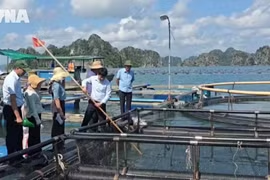
According to the Department of Production and Protection of AquaticResources, Vietnam now has around 130,000 fishing vessels, most ofwhich are small-sized, and are expected to catch 2 million tonnes ofaquatic products per year.
The MARD has established a working team which is responsible forimplementing the requirements of EC Regulation 1005. However, a workingteam member said that it will be hard for them to meet all therequirements as the IUU will become effective within four months.
The EU is now Vietnam ’s largest seafood importer with 26 out of its 27members importing products. In 2008, Vietnam ’s seafood volume shippedto the EU accounted for over 40 percent of its total seafood exportsand 25.4 percent of its total export turnover.
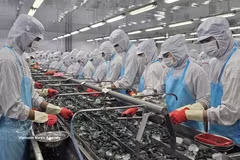
Over the past years, Vietnamese businesses have always satisfied allstandards set by the EU, a market with strict requirements on foodquality and hygiene.
This was not only recorded by increasing volumes of seafood products tothe EU over the years, but also reaffirmed by the recent EC approval ofthe inclusion of 30 more Vietnamese companies on its list of businessesentitled to export seafood to the EU, raising the total of Vietnam’sseafood businesses allowed to ship products to this market to330./.