Efficient energy use: A ‘passport’ for boosting exports

Amending the Law on Economical and Efficient Use of Energy is seen as a crucial step for Vietnam to meet its international commitment to achieve net-zero emissions by 2050.

Hanoi (VNA) - Amending the Law on Economical and Efficient Use of Energy is seen as a crucial step for Vietnam to meet its international commitment to achieve net-zero emissions by 2050.

sourcing2.jpg
Businesses take part in Vietnam International Sourcing 2024. (Photo: Vietnam+)

Vietnam’s energy demand is expected to remain high in the coming years, while fossil fuel resources such as coal and crude oil are gradually depleting. As a result, economical and efficient energy use has been identified as an essential solution to improve economic performance, protect the environment and reduce greenhouse gas emissions.

With increasingly strict requirements from global markets, failure by businesses to meet emission reduction commitments for each product will undermine competitiveness and pose serious challenges in exporting to international markets.

These issues were discussed at the seminar “Promoting Economical and Efficient Energy Use: The Need for Synchronized and Feasible Policies,” held on June 5 in Hanoi by the Industry and Trade Magazine.

According to Dang Hai Dung, Deputy Director of the Department of Innovation, Green Transition and Industrial Promotion under the Ministry of Industry and Trade, Vietnam faces emerging non-traditional challenges, including climate change. Foreign markets have set up technical barriers in the form of green standards and environmental, social and governance (ESG) requirements for imported goods.

Products entering these markets must consume minimal energy and have low emissions. In the European Union, a carbon border tax will be applied from 2026, requiring measurement of emissions embedded in products exported from Vietnam. This marks the first shift from technical barriers to tariff barriers.

In addition, disruptions in global supply chains – seen most clearly during the COVID-19 pandemic – and geopolitical tensions have directly impacted energy supply, affecting oil and gas prices.

The amended law will address both the challenges of international markets and supply chains, enabling better forecasting to support energy planning. “With accurate data, we can predict energy demand for the next one, two or even five years, allowing for more proactive production, supply and management,” Dung noted.

19ye4y.jpg
The seminar “Promoting Economical and Efficient Energy Use: The Need for Synchronized and Feasible Policies” held in Hanoi. (Photo: Vietnam+)

Statistics from the Vietnam Electricity Group (EVN) show the country has over 2.5 million businesses in production, trade, services and agriculture. These account for around 82% of national electricity consumption, with industry alone using about 53%. In 2024, the country’s commercial electricity output reached 216 billion kWh, of which industry and services consumed 173 billion kWh. Some 4,000 key manufacturing firms alone accounted for 34% of national electricity use.

Economical and efficient energy use has been a consistent policy of the Party and State for many years. Even before the 2010 law was passed by the 12th National Assembly, the Government had introduced national programmes on energy efficiency.

Implementation has yielded positive results. In 2024, electricity savings reached about 2.64% of national consumption, exceeding the 2% target set by the Prime Minister’s Directive 20. Many key manufacturing sectors, such as cement and steel, have adopted solutions to cut electricity use, including recovering waste heat from production processes for reuse in kilns and power generation.
bhdnnp.jpg
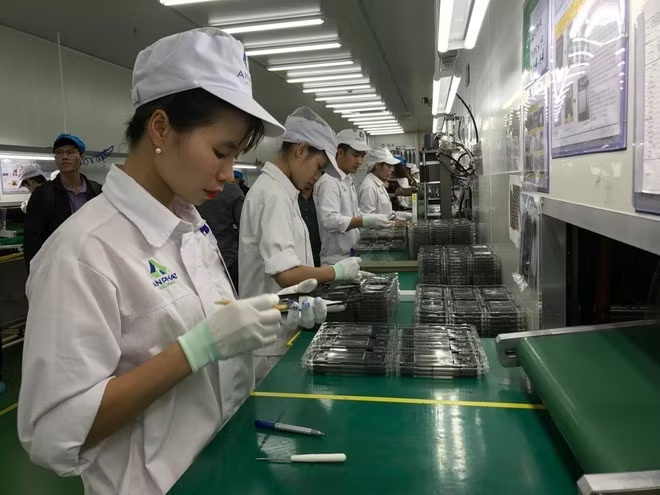
Enterprises invest in high technology to increase export value. (Photo: Vietnam+)

Despite rising electricity demand, peak capacity has not increased proportionately thanks to effective load shifting. Major energy users have moved consumption away from peak hours, improving the national load curve compared to previous years.

However, after nearly 15 years in force, the law has revealed shortcomings in keeping pace with rapid economic and global changes. The upcoming revision aims to enhance practicality, coherence and feasibility, helping Vietnam attract international resources to support energy-saving efforts and develop markets for energy-efficient products.

Nguyen Phuong Tuan, Deputy Chairman of the National Assembly’s Committee on Science, Technology and Environment, said the amendments will also help fulfil Vietnam’s commitments under the UN Framework Convention on Climate Change.

Following the revision, the Ministry of Industry and Trade will align related regulations, with decrees and circulars providing detailed guidance for affected stakeholders. Once the amended law takes effect, major corporations, including EVN, plan to prepare five-year implementation strategies with specific targets to meet the new requirements./.

VNA

See more

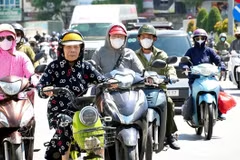
People wear sun-protective clothing when going outside in Quang Ninh province. (Photo: VNA)

Forecast of more intense heat and complex typhoons in summer

The number and activity of tropical cyclones and depressions over the East Sea, internationally known as the South China Sea, and their direct impacts on mainland Vietnam are expected to be comparable to the multi-year average. The long-term average over the East Sea is 5.2 typhoons, with 1.9 making landfall.

An overview of the seminar reviewing the project’s implementation during the 2021–2026 period (Photo: VNA)

Hue project prevents over 933 tonnes of plastic waste leakage

Launched in 2021 with funding from the Norwegian people through WWF-Norway and WWF-Vietnam, the “Hue – Plastic Smart City in Central Vietnam” project aims to help Hue protect rivers, wetlands and coastal ecosystems from plastic pollution while building the city into a model plastic-reduced urban area in central Vietnam.

Deputy Minister of Agriculture and Environment Nguyen Quoc Tri speaks at the event. (Photo: VNA)

Vietnam diversifies financing mechanisms for nature conservation

Initiatives on biodiversity finance, carbon credits, public – private partnerships, nature-based tourism, and private sector investment are creating more opportunities to increase resources for ecosystem conservation and restoration, said an official.

The Dong Thap Muoi Ecological Reserve spans more than 106 hectares and is set to be expanded by an additional 60 hectares in the near future. (Photo: VNA)

Local initiatives drive Vietnam’s push to protect biodiversity for sustainable future

Vietnam has established a network of 180 terrestrial and marine nature reserve covering more than 2.67 million hectares. These sites are being further strengthened to improve ecological connectivity, restore habitats and conserve endangered species. Forest cover remains stable at over 42%, contributing to water protection, climate adaptation and carbon absorption.

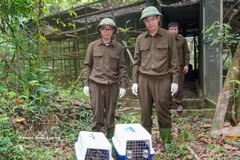
All the animals underwent health checks and assessments of their ability to adapt to the natural environment before being safely released. (Photo: VNA)

Quang Tri releases 13 wild animals back into nature

The animals included two masked palm civets, four stump-tailed macaques, and seven rhesus macaques. All belong to Group IIB under Circular No. 85/2025/TT-BNNMT issued by the Ministry of Agriculture and Environment on the management of endangered, precious and rare species, as well as the implementation of the Convention on International Trade in Endangered Species of Wild Fauna and Flora (CITES).

The clouded monitor (Varanus nebulosus) weighs approximately two kilograms and measures around 70 centimetres in length. (Photo: VNA)

Quang Tri hands over rare clouded monitor to rescue centre

The animal was identified as a clouded monitor (Varanus nebulosus), weighing approximately two kilograms and measuring around 70 centimetres in length. The species belongs to Group IB — a category of endangered and rare forest wildlife species given the highest level of protection in Vietnam, with all forms of commercial exploitation and use strictly prohibited.

The female stump-tailed macaque undergoes a health check by authorities before being released back into the wild. (Photo published VNA)

Rare stump-tailed macaque released into the wild

The stump-tailed macaque, scientifically known as Macaca arctoides, is classified as a rare and endangered species under Group IIB in Vietnam’s regulations on endangered wildlife management.

A graphic image of the Nui Thoong high-tech waste treatment and waste-to-energy plant project. (Photo: hanoimoi.vn)

Hanoi breaks ground on 200-million-USD waste-to-energy plant

Designed to process 2,000 tonnes of waste per day and generate 45MW of electricity for the national grid, the project is the first high-tech waste-to-energy plant in southwestern Hanoi, where large-scale solid waste treatment facilities have long been lacking.

After undergoing health checks, all three sea turtles are released back into their natural habitat in the presence of authorities, local residents and tourists. (Photo: VNA)

Quang Tri authorities release three endangered sea turtles back to the wild

The three turtles, each weighing around 1.5 kilogrammes with shells measuring about 25 centimetres long and 20 centimetres wide, are green sea turtles. They were accidentally caught in fishing nets and found drifting at sea near Con Co waters on May 16 by fisherman Bui Dinh Thuy in Cua Viet commune during a fishing trip.

A rare turtle is transported to Cuc Phuong National Park for care and rehabilitation ahead of its eventual release back into the wild. (Photo published by VNA)

Rare turtles returned to Vietnam under CITES

The shipment includes several endangered Vietnamese species such as the Indochinese box turtle (Cuora galbinifrons), Bourret’s box turtle (Cuora bourreti), keeled box turtle (Cuora mouhotii), and black-breasted leaf turtle (Geoemyda spengleri), all considered highly endangered and increasingly threatened in the wild by habitat destruction, poaching, and illegal trade.

Representatives of the Ngoc Lam Border Guard Station under the Nghe An Border Guard Command and Son Lam commune's police hand over a pangolin voluntarily surrendered by a local resident to the wildlife conservation centre at Pu Mat National Park. (Photo: VNA)

Nghe An residents voluntarily hand over rare pangolins for conservation

On May 11, the Quy Chau Forest Protection Department, along with local police and authorities, took in a critically endangered pangolin, handed over by a resident. The animal was discovered a day earlier by Thai Doan Tuan, from Viet Huong village in Quy Chau commune, after it wandered into his garden. Recognising it as a protected Sunda pangolin, he contacted authorities for assistance.