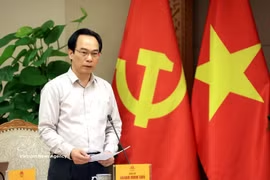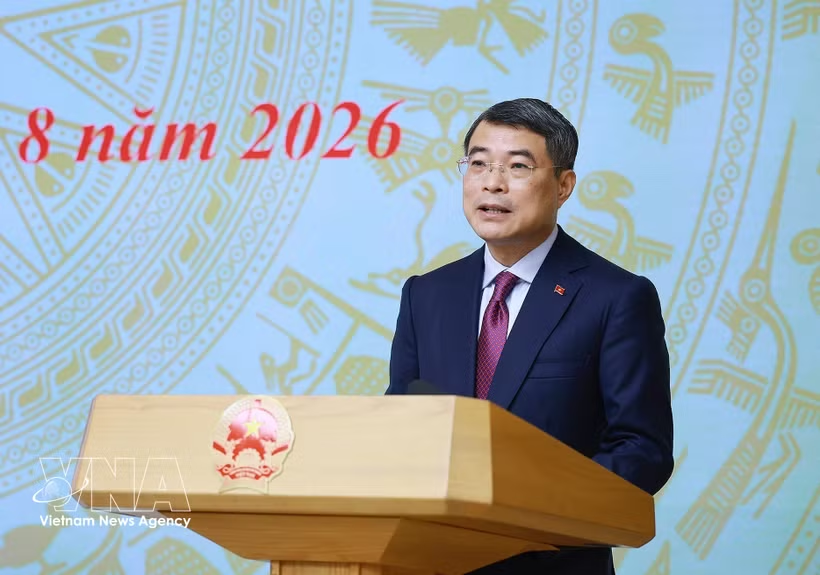
Hanoi (VNA) – Prime Minister Le Minh Hung on August 27 called for substantive breakthroughs in education and training in the 2026-2027 academic year, with reforms measured by tangible outcomes for learners, teachers, schools and the country’s human resources.
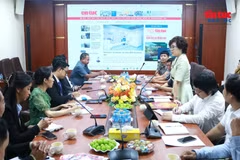
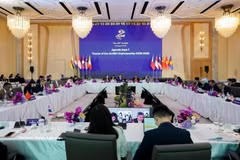
Chairing a national teleconference to review the 2025-2026 academic year and roll out tasks for 2026-2027, PM Hung said the new academic year holds special significance as the first following the 14th National Party Congress and the implementation of major breakthrough policies, particularly the Politburo’s Resolution No. 71-NQ/TW on education and training development.
He acknowledged the education sector’s efforts and important achievements over the past year, while stressing that a number of shortcomings must be addressed. These include delays and weaknesses in policy implementation, shortages of teachers, classrooms and teaching equipment, insufficiently substantive innovation within some schools, and excessive emphasis on grades and examinations. Problems such as achievement chasing, examination cheating, disguised extra teaching and learning, school violence and food safety risks also remain concerns.
According to the PM, the 2026-2027 academic year must mark a fundamental change in both thinking and action. He said the education sector needs to shift from focusing on institutional development to effective implementation, from administrative management to development-oriented governance, and from counting tasks completed to measuring actual results. Innovation should also move beyond external changes to become substantive within every school, classroom, teacher and learner.
Emphasising the motto “Innovative thinking – Strong transformation – Substantive results”, he asked ministries, agencies and localities to focus on removing bottlenecks and unlocking resources so that new education policies will deliver clear outcomes. Progress should be measured through improvements in learners, teachers’ working conditions, school performance and the quality of human resources.
The Government leader particularly stressed the need to ensure “enough schools, enough classes and enough teachers”, while preventing disadvantaged children from being excluded from education. Authorities were asked to urgently address shortages of classrooms and specialised rooms, equipment and school capacity in urban areas and industrial zones, and to ensure proper preparations for boarding schools in border communes.
He also called for substantive internal reform in school governance, teaching and learning methods, and examinations and assessments. He urged the sector to review curricula and textbooks, strengthen education in national history, patriotism, ethics and life skills, and improve foreign-language and digital competencies. The selective application of artificial intelligence (AI) and STEM (Science, Technology, Engineering, and Math) education should also be promoted.
He stressed that schools must be safe, disciplined and healthy environments, with stronger measures to prevent school violence, child abuse, social problems and harmful online content, as well as ensuring food safety.
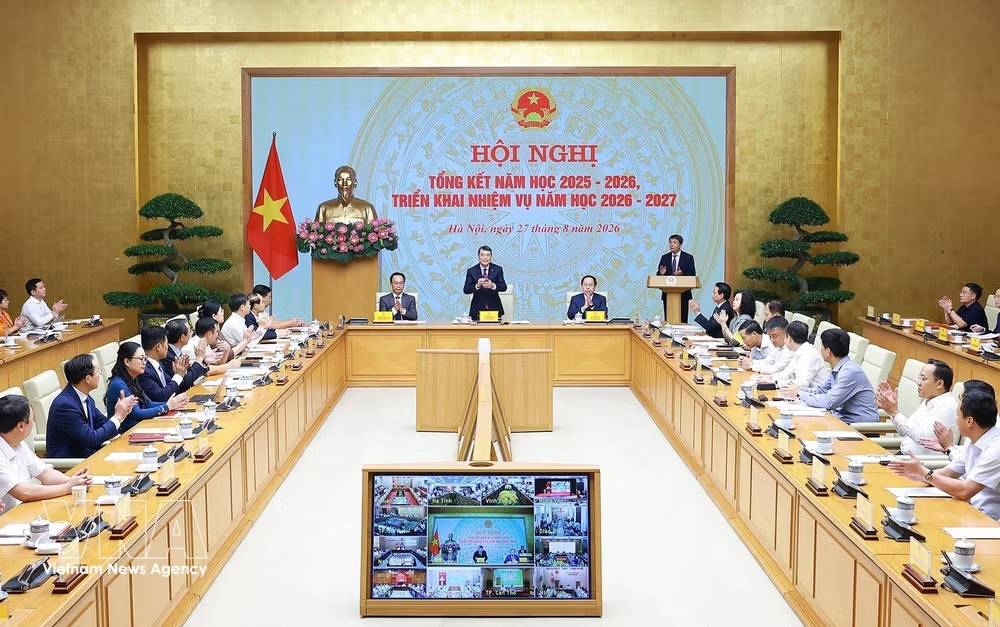
Looking beyond general education, PM Hung said education and training must take the lead in supporting the country’s new development model. Vocational education should be closely linked with businesses and the labour market, while higher education should become a genuine centre for talent development, scientific research, innovation and technology transfer.
He called for stronger implementation of the Politburo’s Resolution No. 57-NQ/TW on science, technology, innovation and national digital transformation, with data serving as a foundation for modernising education governance. Education databases should be accurate, complete, clean, live, unified and shared, and connected with national databases. AI education should also be incorporated appropriately into teaching and learning.
The Prime Minister assigned specific responsibilities to ministries and localities, particularly in teacher recruitment, school infrastructure, land allocation, healthcare, food safety, digital transformation and education management. He asked provincial and municipal leaders to regard education as a key priority, regularly engage with the sector and take responsibility for education quality in their localities.
Special attention should be paid to thoroughly reviewing and fully preparing all necessary conditions to ensure the smooth organisation of the 2026-2027 academic year opening ceremony and the inauguration of inter-level boarding schools in border communes on September 5, he stressed.
Reaffirming that education and training is a top national priority, the Government leader expressed his confidence that the entire sector will act with determination, responsibility and a strong spirit of innovation to make the 2026-2027 academic year one of “Innovative thinking – Strong transformation – Substantive results”. He said the ultimate goal was to have better learners, better teachers, better schools and better human resources for national development./.