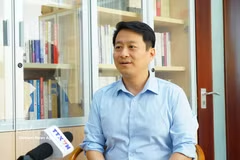
Hanoi (VNA) – To become a “strong maritime nation”, Vietnam must reach out to the sea on the “two pillars of institutions and technology” to create a strategic breakthrough, Associate Professor and Doctor Nguyen Chu Hoi, former Deputy Director of the Vietnam Agency for Seas and Islands, has stressed.
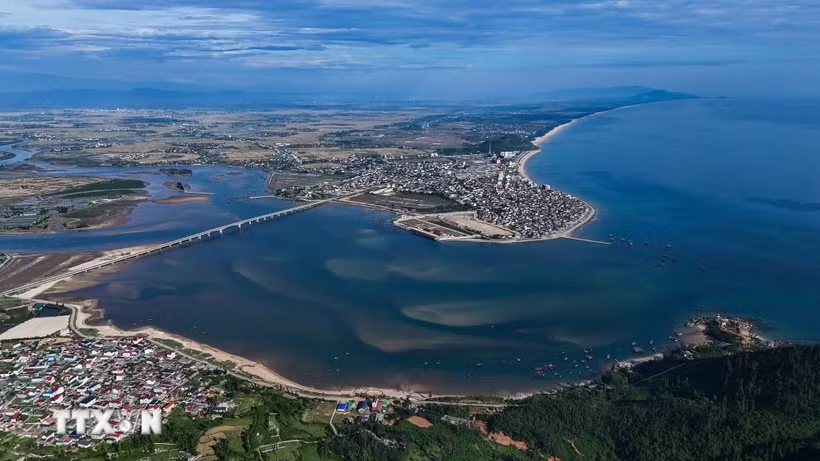
Hoi, who is also Standing Vice Chairman in charge of the Vietnam Fisheries Society, told e-newspaper VietnamPlus that Vietnam has a sea area three times the size of its mainland territory and more than 3,260km of coastline, excluding island coastlines, stretching from north to south and providing the country with a “front door” to the East Sea.
Its indented coastline features numerous capes, bays, river mouths, lagoons and low-lying areas with diverse conservation values and development potential. Vietnam is also among the countries with the largest number of islands in the world, with more than 3,000 islands of various sizes.
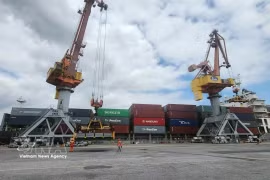
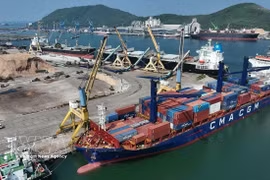
Among the country’s major maritime advantages are fisheries resources, biodiversity and coastal ecosystems, oil and gas, gas hydrates and solid minerals. Other advantages include offshore wind and solar power, biofuels, blue carbon, and the potential of port and maritime development, tourism and urban development.
However, he observed that despite the achievements recorded during eight years of implementing Resolution No. 36-NQ/TW, the exploitation of marine and island resources for economic development remains below its potential.
Apart from the complex impact of the global situation, developments in the East Sea, climate change, natural disasters, and epidemics have also prevented the resolution from being fully translated into reality.
The expert pointed to “bottlenecks” hindering a breakthrough in the marine economy, including significant differences in understanding sustainable marine economic development, and incomplete institutions on the management of seas and islands.
Outdated methods and equipment for exploiting and managing marine resources remain widespread, while the role of businesses and local communities is still limited, he said.
Reaching out to the sea on “two pillars of institutions and technology”
Hoi said the country’s maritime and island potential provides a foundation for expanding offshore activities and developing a “deep-sea economy” in the near future.
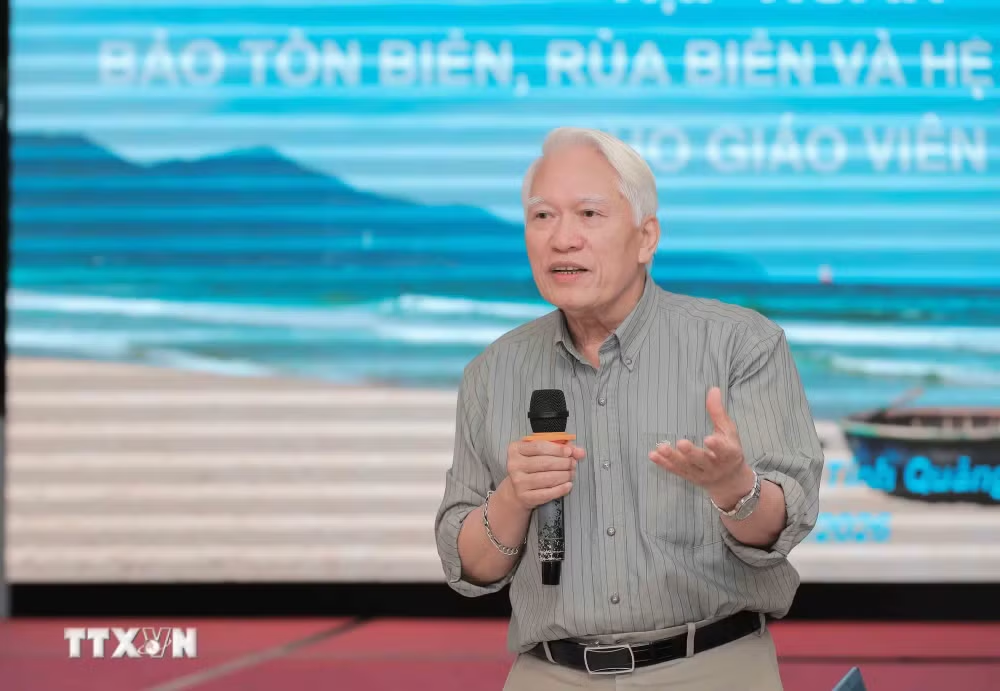
To seize this opportunity, Vietnam needs a strategic approach to transform its potential into a new growth engine while avoiding overexploitation and the sacrifice of the environment for purely economic development.
Offshore and deep-sea activities involve substantial risks from both natural and human-induced hazards, require large investment, and demand highly qualified human resources. Deep-sea and offshore exploitation equipment is also often extremely large, as demonstrated by offshore wind power projects. Vietnam therefore needs to reach out to the sea on the “two pillars of institutions and technology” to create a strategic breakthrough.
It should focus on investment in and application of advanced marine technologies, while accelerating digital transformation and the use of AI to master more remote and deeper maritime areas, covering not only the surface of the sea but also the subsurface space beneath the water column.
Deep-sea exploitation should be industrialised, with equipment increasingly automated, self-lifting and self-propelled.
Marine spatial planning and functional zoning should be introduced from the early stages of development to minimise conflicts between sectors and users competing for the same marine space. Completing institutions, mechanisms and policies is likewise essential to remove barriers to breakthroughs.
As an immediate priority, the Law on Marine and Island Resources and Environment should be revised to facilitate and encourage strategic investors to “move out to the open sea”, while investment should be prioritised in renewable energy and new marine economic sectors.
Vietnam cannot continue to develop its seas and islands according to old thinking. Instead, changes in administrative boundaries must be transformed into a driver of long-term development.
As General Secretary of the Communist Party of Vietnam Central Committee and President To Lam has requested, the marine economy should be developed sustainably within a marine space governed in an integrated, inter-sectoral, interconnected and coordinated manner.
Marine spatial development should also follow the principle of placing economic activities within a multi-purpose space, allowing different sectors to coexist, harmonise their interests, avoid conflicts and develop together while maximising the value of each unit of marine space.
Economic activities in marine areas must therefore be arranged rationally, balancing the interests of different sectors and their respective spatial needs. Development should be phased appropriately in marine exploitation planning and use so that economic activities can grow while maintaining natural and economic linkages.
In other words, the new approach makes it clear that sustainable development of Vietnam’s seas and islands cannot simply be understood as balancing the three traditional pillars of the economy, society and environment. A fourth pillar – security and marine governance – must also be incorporated.
This spatially based approach to development and governance is, in essence, a new development philosophy, Hoi underscored./.