Meeting higher standards helps enhance competitiveness of Vietnam’s handicrafts

Effective implementation of trade agreements is not merely about taking advantage of market-opening opportunities. It should also serve as a catalyst for Vietnamese handicrafts to upgrade production capacity, build stronger brands and capture greater value in international supply chains.

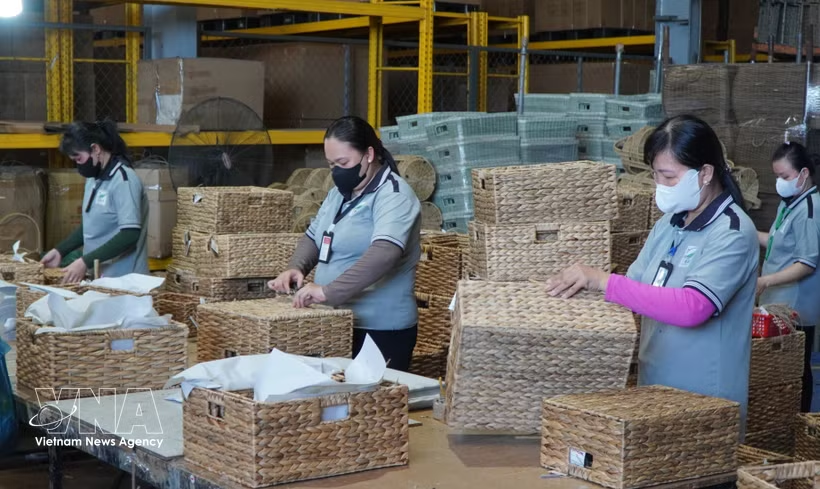
Workers dry handicrafts made from water hyacinth (Photo: VNA)

Hanoi (VNA) - New-generation free trade agreements (FTAs) have opened up greater opportunities for Vietnamese handicrafts to access international markets. However, the challenge is not simply to expand export markets, but also to increase the value of products and strengthen their competitiveness.

Broader opportunities, considerable challenges

Thanks to the EU-Vietnam Free Trade Agreement (EVFTA) and the Comprehensive and Progressive Agreement for Trans-Pacific Partnership (CPTPP), handicrafts have gained greater access to major markets with strong purchasing power.

However, along with rapidly changing consumer tastes, increasingly stringent standards on the environment, social responsibility and transparency require production establishments to change the way they organise their operations.

Nguyen Van Hoi, Director of the Vietnam Institute of Strategy and Policy for Industry and Trade, said new-generation FTAs not only expanded trade opportunities but also imposed higher standards on the environment, labour and transparency. Businesses therefore needed to shift from a production-oriented to a market-oriented mindset, while strengthening links to build competitive supply chains.

More importantly, businesses need to strengthen their own capabilities, from market research and product development to production organisation and distribution.

Innovation to retain markets, increase value

Trinh Quoc Dat, Chairman of the Vietnam Craft Village Association, said design innovation was essential for Vietnamese handicrafts to continue attracting international customers. Traditional designs could initially draw interest, but without regular updates to reflect changing tastes, consumer demand could gradually decline.

To appeal to international markets, designers need to study consumer preferences and incorporate Vietnamese cultural elements into ceramics, rattan and bamboo products and other handicrafts.

Alongside design, the application of science and technology is another way to improve productivity and quality. According to Dat, machinery can be used to support physically demanding and labour-intensive stages of production, while tasks requiring dexterity and finesse should remain in the hands of artisans. This combination can improve production efficiency while preserving the distinctive value of handicrafts.

Green production is another increasingly important requirement. Dat said customers are now particularly interested in environmentally friendly products. However, for small-scale household producers and businesses, investment in low-emission equipment, environmental treatment systems and pollution reduction remains a challenge due to limited capital.

Meritorious Artisan Phan Thi Thuan, Director of My Duc Silk and Sericulture Co., Ltd., stressed that innovation and creativity are essential to preserving traditional crafts. In sericulture, for example, her company has developed silk production using a technique that allows silkworms to spin an entire silk sheet themselves. This has enabled the material to be used in a wider range of everyday products, including blankets, pillows, warm clothing and decorative items, creating new products and expanding their appeal to consumers.

However, Thuan noted that for craft villages to develop over the long term, they must also address difficulties relating to raw material supply areas, production premises, the transfer of traditional skills and human resources.

She also emphasised the importance of telling the story behind each product. Consumers need to understand the materials used, how the product is made and the values it embodies.

Practical experience shows that the competitiveness of handicrafts depends on more than price or craftsmanship. It also rests on the ability to create products that meet market demand, maintain consistent quality, ensure transparent origins and demonstrate distinctive value.

Effective implementation of trade agreements is therefore not merely about taking advantage of market-opening opportunities. It should also serve as a catalyst for Vietnamese handicrafts to upgrade production capacity, build stronger brands and capture greater value in international supply chains./.

VNA
See more

OCOP items are on display at Go!Hanoi supermarket (Photo: VNA)

Vietnam’s AI-led export boom meets FDI dependence, inflation test

Despite global AI-bubble risk, heavy FDI dependence and inflation pressure, Vietnam still has solid macro drivers. If it proactively clears internal bottlenecks, it has enough position and strength to weather short-term volatility and hit its double-digit growth target in the coming time.

Delegates cut the ribbon at the inauguration ceremony of the FPT Poland office. (VNA published)

Tech giant FPT expands operations in Europe

The opening of the FPT Poland office in Gdansk was not only a milestone in the corporation's development but also demonstrated the technological capabilities and international integration of Vietnamese businesses, said Vietnamese Ambassador to Poland Ha Hoang Hai

Illustrative image (Photo: VNA)

Vietnam sharply cuts petrol prices, except mazut

Following the fresh adjustment, E5RON92 gasoline is now sold at 23,203 VND (0.89 USD) per liter, down 1,020 VND per liter from the previous adjustment, and 28 VND per liter below E10RON95-III, which is set at 23,231 VND per liter, down 928 VND per liter.

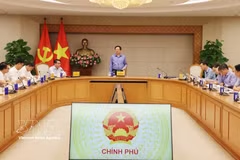
Standing Deputy Prime Minister Pham Gia Tuc speaks at the meeting on November 3. (Photo: VNA)

Deputy PM calls for export-import market diversification, better trade governance

The Deputy PM called for timely handling of trade and tariff issues and effective solutions to address trade deficit. He also asked the drafting agency to continue reviewing the scope, title and content of the draft to ensure a balanced approach to trade governance that takes into account both trade surplus and deficit.

An aerial view of VIFC-Da Nang (Photo: VNA)

More room for Vietnam-Russia financial cooperation: Russian think-tank

For Russia, the Vietnam International Financial Centre is seen as a new financial lane alongside trade, energy and industry. Vietnam–Russia trade hit 4.77 billion USD in 2025, up 4%, generating demand for payments, bank guarantees, letters of credit, transport insurance and trade finance. VIFC financial entities can capture that business if they clear legal and commercial hurdles.

University of Economics & Business (UEB) Vice Rector Nguyen Thi Hong Thuy speaks at the forum. (Photo: Published by VNA)

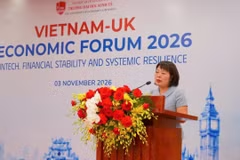
Forum promotes financial innovation alongside systemic safety

UEB Vice Rector Nguyen Thi Hong Thuy said the global financial system is undergoing profound transformation, with fintech, artificial intelligence (AI), big data, cloud computing, digital assets and open finance reshaping the delivery and supervision of financial services.

Deputy Minister of Finance Le Tan Can speaks at the event. (Photo: VNA)

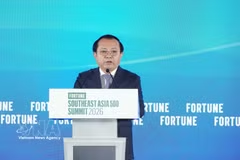
Vietnam eyes opportunities amid supply chain shifts in Southeast Asia

Vietnam aims to become a regional hub for artificial intelligence (AI) and data centres, as well as a destination for multinational corporations, international investment funds and financial institutions. To realise this goal, it is focusing on building a new-generation investment ecosystem that connects foreign-invested enterprises with domestic businesses, while developing logistics, data and clean energy infrastructure and a high-quality workforce.

Work at the construction of the Phu Quoc International Airport. (Photo: Pubished by VNA)

APEC 2027: Special legal framework clears bottlenecks at major construction sites

Beyond successfully hosting APEC 2027, An Giang aims to ensure that these investments deliver long-term benefits. Upgraded aviation, urban transport, water supply and drainage, environmental treatment and digital infrastructure are expected to transform Phu Quoc and create fresh momentum for the special zone’s socio-economic development in the decades ahead.

Tax officers of Phu Tho province provide guidance to help residents grasp tax declaration requirements. (Photo: VNA)

Tax relief expected to support stronger business growth

Economic expert Assoc. Prof. and Dr Ngo Tri Long said the tax cuts will improve cash flow and provide small businesses with additional working capital without incurring borrowing costs, particularly as access to affordable credit remains difficult.

Deputy Prime Minister Ho Quoc Dung speaks at the November 3 meeting to address difficulties in implementing Decree No. 101/2026/ND-CP detailing the Law on Technology Transfer. (Photo: VNA)

Deputy PM calls for ensuring business continuity under technology transfer regulations

Speaking at a meeting at the Government headquarters on November 3 to address difficulties in implementing Decree No. 101/2026/ND-CP detailing the Law on Technology Transfer, Deputy Prime Minister Ho Quoc Dung stressed that the regulations were designed both to promote technology transfer and strengthen state management through the lists of technologies encouraged, restricted or prohibited from transfer.

Quang Tri Airport is a key, catalytic project for the province to achieve strategic goals in socio-economic development, national defence, and security safeguarding. (Photo: VNA)

Central region steps up investment in aviation infrastructure

Through its airports, ACV therefore hopes to strengthen cooperation with local authorities and airlines to explore appropriate support measures, attract carriers, launch new routes, increase flight frequencies, boost passenger numbers and further expand its presence in promising international markets.

Businesses are stepping up export promotion efforts in the year-end push. (Photo: thanhnien.vn)

Export orders pick up pace towards year-end

Many firms have accepted smaller, lower-priced orders and explored niche markets to offset fluctuations in major export destinations such as the US, Japan and the Middle East.